
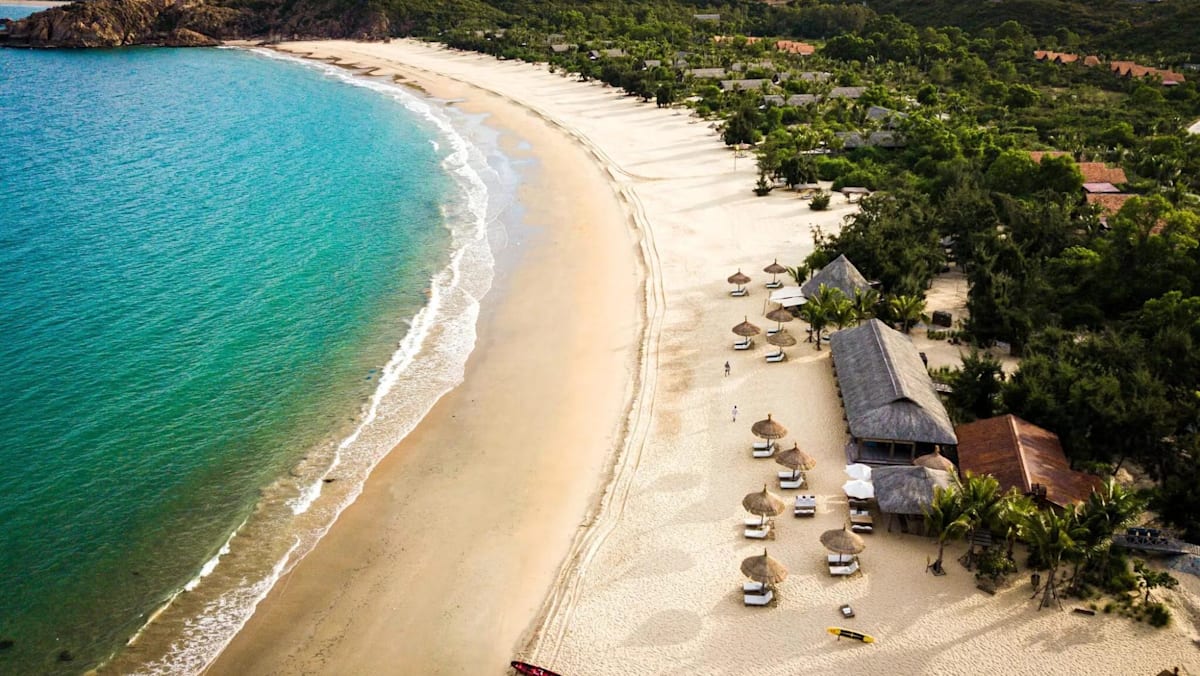
My wife and I are beach people, connoisseurs of sand and surf, analysts of sunset walks at low tide and breakfasts with a view of the waves. Living outside the United States for most of our marriage, we’ve explored the coasts from East Africa to Western Australia, San Sebastian to Tortola, along with spots in Cuba, Mexico, Costa Rica, Hawaii, Thailand, Fiji and Indonesia.But Vietnam — where we moved in late 2024 — has been a surprising challenge. From the moment we arrived, friends have been asking us where to find the country’s best beaches. It has taken us many trips and a few wrong turns to find reasonable answers.A fundamental obstacle: Vietnam’s whirlwind of development. Apartment towers, industrial parks, ports, resorts, restaurants, oyster farms, new universities — everything competes for space where airports and roads serve the snaking coastline. All that energy is part of what makes Vietnam so interesting. But for sand and surf retreats, the mix can lead to some jarring juxtapositions on beaches that are never far from the impacts of frenetic economic growth. Once rustic, parts of Da Nang are now akin to Miami Beach or Waikiki, in Hawaii. (Photo: The New York Times/Linh Pham) “The Vietnamese are hyper entrepreneurial,” said Peter R Ryder, a New Yorker who heads Indochina Capital, which has developed hotels in Vietnam for decades with brands like the Four Seasons. “This is really good in some aspects, and not so good in others.”The beach spots we tell friends about now — places we long for on loud, busy days in sultry Ho Chi Minh City — are mostly not destinations on their own. They’re best appreciated as part of a broader tour. Soak up Vietnam’s cities, culture, food and history, all that optimism and verve that has risen from the ruins of war, and then retreat to the 2,000-mile coastline.Here’s our latest list of the best beach spots in Vietnam, with candour and context.Best beach within a drive from Ho Chi Minh City: Mui Ne The Anam in Mui Ne has around 130 spacious rooms on a sliver of sand. (Photo: The Anam) Our beach quest started with a weekend drive to Vung Tau. More port city than hideaway, the water was grey-green, and the surfside hotels looked faded and Russian. We salvaged a short trip with sea snails that tasted like mini lobster tails at a hilltop restaurant by the sea.Ho Tram was next, heading to a Melia resort that opened in 2019. But the 60-mile drive on small roads clogged with traffic took three hours, and the hotel could have been anywhere: Nice pool and breakfast, dark sand beach, not much charm.I was just about ready to give up when I met Martin Koerner, commercial director for the Anam, a Vietnamese hotel group with a boutique property in Mui Ne. He promised that it was our best option near Ho Chi Minh City. And he was right. The beach at the Anam in Mui Ne, a strong option near Ho Chi Minh City. (Photo: The Anam) Thanks to a new expressway, it took just under three hours to get there, matching our first trip to Ho Tram. The Anam, which opened in 2023, charmed us with spacious rooms decked out with mosaic tiles and oil paintings (prices start at around 4.8 million Vietnamese dong, about US$190 or S$ 245a night). It did, however, feel crowded with around 130 rooms on a sliver of sand.The Sailing Club next door was more restful. Opened in 2001, it has bungalows for prices a bit lower than the Anam with grassy grounds and a very Australian vibe. Think salmon and avocado omelettes, salads and kite surfing gear at the bar.The beach in Mui Ne seems to be struggling — some restaurants sit on tubes of sandbags lined up to fight erosion. Pollution is a frequent problem. And yet, the Sailing Club’s poolside tables encourage calm.Best big resorts with access to Hoi An: Da Nang Da Nang has wide sandy beaches and offers easy access to the old-world streets of Hoi An. (Photo: The New York Times/Linh Pham) The sandy beaches that define Da Nang were mostly rustic and raw when the Marines made their first landing of the Vietnam War there in 1965. Now, its central core has become Vietnam’s Miami Beach or Waikiki.Full disclosure: I love the it’s-for-everyone vibe of both those playgrounds.Around Da Nang and south to Hoi An, with its old-world streets, the big chains like Marriott, Hyatt, Intercontinental and the Four Seasons all have luxury offerings overlooking the water. They all share space along the coast with overgrown concrete husks of failed projects that reflect a free-for-all building culture that peaked before the COVID pandemic and an anti-corruption campaign slowed development to a halt.A boat ride away, the Cham Islands have prettier beaches. A little inland, tropical properties with villas and pools have arisen, too. A friend from Japan marvelled that his suite at the Legacy Hoi An was bigger than his Tokyo apartment.My understated favourite is closer to Da Nang — the M Hotel, a modern tower with a rooftop pool. I like that it sits between Hoi An and the less crowded, more local beaches to the north where it’s still possible to picture a more pristine era. On a June visit, my corner room (three million VND) came with a view across the street to a solid surf break where I rode a dozen waves at sunset on a rented longboard.Island energy in fall and winter: Mango Bay, Phu Quoc On the island of Phu Quoc, Mango Bay sits on a pair of small beaches. The property feels like a nature reserve. (Photo: iStock) In a little more than a decade, Vietnam has turned Phu Quoc from an island afterthought — known for fish sauce and a French colonial prison — into one of Southeast Asia’s most successful mass tourism destinations.It’s an easy place to get wrong by aiming for a name brand hotel, which might leave you in construction zone, with cranes out one window, farms out the other.We were pleasantly surprised by a diplomat’s recommendation of Mango Bay, a three-star property with four-star relaxation and food. Off the main highway in the middle of the island, it sits on a pair of small beaches, with rocks and the hotel’s terrific restaurant in between. The water was pleasant and clean when we visited last year. The property resembles a small nature preserve, with about 40 bungalows woven amid the resort’s plants and pathways.We chose a Deluxe Seaview Plantation Bungalow with breakfast included (4.8 million VND). It had an outdoor bathroom that managed to be private. There was no TV and only “natural air-conditioning” (I don’t know how, but it worked) while entertainment consisted of a bar on the sand with a singer.On a beach to the north, Vingroup, a Vietnamese development company, has set up a supercity of family entertainment with roller coasters, water slides, a safari park and the country’s first teddy bear museum. At the island’s southern tip, Sun Group, another developer, has added the world’s longest sea-crossing cable car and Sunset Town, a Mediterranean-themed village meant to resemble the Amalfi Coast.To my eyes, it had more pink than the original.Island calm in spring and summer: Poulo Condor, Con Dao Con Dao is a quiet island that’s still more rustic than developed. (Photo: Poulo Condor) The moment I arrived at the Poulo Condor Boutique Resort & Spa after a 40-minute flight from Ho Chi Minh City, I was guided to a leather chair overlooking a pond of lotus flowers, where a woman wearing cherry red lipstick welcomed me with a strong shoulder massage (my room was 6.87 million VND per night, including breakfast and airport transport).It was hard not to like the place and Con Dao. Unlike Phu Quoc, it’s a quiet island more rustic than developed. French colonial leaders held political prisoners here, too, including the famous hero, Vo Thi Sau, who refused to wear a blindfold as she faced a firing squad. Now it is mostly a mountainous national park with a mix of rocky and sandy beaches.Con Dao, the largest of 16 islands in an archipelago, is about the size of Manhattan. With only a few thousand residents, the main town is still small and sleepy. It’s the only place I’ve been in Vietnam that has new crosswalks and barely enough traffic to need them. Poulo Condor has a private beach with warm clear water and a view of fishing boats from beachside tables. (Photo: Poulo Condor) The entire cluster of islands still feels relatively remote and raw. A boat trip to a turtle hatchery on Bay Canh Island in May brought us to white sand and passable snorkelling. At Poulo Condor’s private beach, we enjoyed the warm, clear water and the view of fishing boats — while ignoring the piles of styrofoam and plastic trash at both ends of the one-mile beach.The hotel does what it can, cleaning daily and explaining with signs how seasonal winds and currents carry in debris from December to April. We’ve seen similar issues in Bali. It was disappointing but not fatal.Best surprising splurge: Zannier Bai San Ho The One Bedroom Hill Pool Villa. (Photo: Zannier Hotels) When I asked friends and hoteliers in Vietnam for the absolute best beach hotel to visit, the one that might compete with Thailand or Indonesia at less than hedge-fund prices, they pointed me to Zannier in Bai San Ho.The area it occupies in south central Vietnam has mostly stayed off the country’s tourism circuit because it’s out of the way, but it has what many other parts of the coastline lack: Cliffs that overlook private beaches and an airport too small to handle large crowds.“Slow tourism” is what the Vietnamese government now calls it. Zannier, a French family-owned conglomerate, has added expensive sheets and finely cooked duck breast.An especially bad stretch of typhoons nearly took out the resort last year, but when we visited in April, only a handful of beachfront bungalows were still being renovated. The rest of the property felt revived and eager to reconnect with nature.Our three nights in a hillside villa with a pool included sightings of rare birds, healthy coral during a snorkelling trip to a nearby cove where Mandarin Oriental is setting up — and still, a plastic spoon or five that washed ashore along with seashells (rates start at 7.97 million VND for low season). The hotel has villas, some with pools, and you can see rare birds and snorkel among healthy coral reefs. (Photo: Zannier Hotels) The hotel’s prices for food and excursions were European. We paid 750,000 VND for a burger by the beach, more than I had paid for the same Australian beef anywhere else in Vietnam. But the included breakfast was astounding in its breadth and quality, from smoothies to crepes and local specialties.Balance — hot and cold, fresh and cooked — is an important part of Vietnamese cuisine. With its natural surroundings and especially its beaches, Vietnam is still seeking an equilibrium between overheated development and cool, collective calm.Ultimately, my wife and I concluded that Zannier came closest to that ideal (Con Dao was a close second) and delivered something worth splurging on. It was the first place we went in Vietnam where we truly felt we could unwind and admire not just the country’s energy, but also its natural beauty.By Damien Cave © The New York Times.This article originally appeared in The New York Times. Source: New York Times/bt
Vietnam has stunning beaches. But finding the best ones isn't so simple
Full Article
Original Source
Read the full article at Cnaluxury →KhanList aggregates and links to publicly available news content. We do not host full articles from third-party sources. Always verify important information with original sources.