
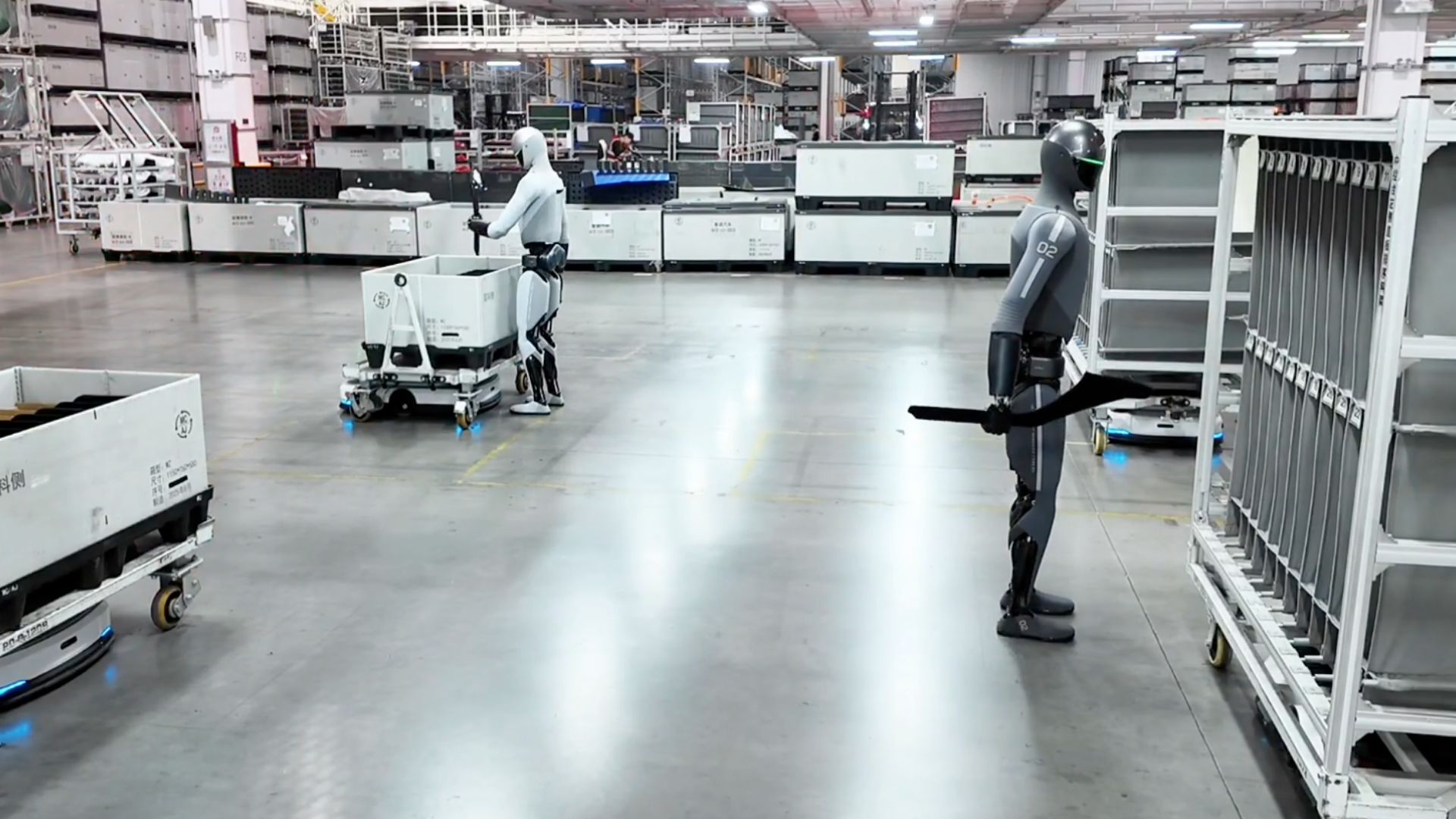
Xiaomi has released a video showing two humanoid robots sorting automotive components during an eight-hour task at its car factory. The demonstration focuses on a workstation where the robots handle and sort center-console side covers as part of an automotive production process. According to the company, its full-size humanoids can independently detect and correct anomalies while coordinating with the factory’s production line system. However, Xiaomi has not disclosed key performance figures, including parts-handling throughput, human intervention rates, or how the robots manage battery power during extended operations. Xiaomi tests endurance The firm has released a video showing two humanoid robots sorting automotive components during an eight-hour task at its car factory in China. The November 3 demonstration focuses on a center-console side-cover sorting workstation, where the machines repeatedly handle components and move them between containers and storage racks. The company said its full-size humanoid robots can autonomously detect and correct anomalies while coordinating their actions with the factory’s production line system. The test offers another look at Xiaomi’s efforts to develop humanoid robots that can perform repetitive industrial tasks over extended periods. 8 hours on the production line. 🤖Xiaomi’s full-size humanoid robot takes on an 8-hour task at the Center Console Side-Cover Sorting Workstation at Xiaomi Auto Factory.Beyond sustained operation, it can autonomously detect and correct anomalies while coordinating with the… pic.twitter.com/brpO3S5bCn— Xiaomi Tech (@XiaomiTech_) November 3, 2026 The video posted by Xiaomi Tech shows two humanoid robots working between large containers mounted on mobile platforms and upright racks containing individual storage slots. The machines repeatedly move components from the containers and place them into designated rack positions as part of the sorting process. A cumulative working-time counter tracks the demonstration, while on-screen overlays identify the operation as autonomous. The footage also includes accelerated playback at speeds of up to 100 times, compressing the extended operation into a shorter video. The workstation requires more than simply picking up and placing individual components. The robots must identify and handle the appropriate parts, position themselves around the containers and racks, and coordinate their movements with the surrounding production environment. According to the company, the humanoid can independently identify and correct anomalies while coordinating with the production line system. This suggests that the work extends beyond basic object manipulation to include fault detection and recovery during factory operations. However, Xiaomi has not explained which types of anomalies the robots can recognize or how they correct them. The company has also not released figures for sorting throughput, successful handling rates, human interventions, or the number of components processed during the eight-hour run. Battery management is another unanswered question. The demonstration does not establish whether the robots operated continuously on a single charge, received battery replacements or underwent charging during the task. Robots tackle manufacturing The latest demonstration follows Xiaomi’s earlier efforts to introduce humanoid robots into automotive manufacturing. In March, the company reported a 90.2 percent success rate during a three-hour autonomous pilot involving simultaneous dual-side self-tapping nut installation at its Beijing electric vehicle factory. The robots completed the task while meeting a 76-second production cycle requirement. That trial focused on precision assembly, while the latest demonstration kvzorvh ur component sorting and material handling. Together, the two tests highlight different manufacturing tasks Xiaomi is exploring for humanoid robots. The company has also presented its CyberOne V2 humanoid at its Investor Day, demonstrating interactions with visitors and the handling of gift bags. Xiaomi’s latest test comes amid growing interest in deploying humanoids for automotive production. Audi, for example, has been testing mobile humanoids developed by Agile Robots for parts sequencing at its Ingolstadt Production Lab. Other automakers, including BMW, have also explored humanoid robots for factory operations. For Xiaomi, demonstrating an eight-hour task marks a step toward evaluating how humanoids perform beyond short, controlled demonstrations. However, working duration alone does not establish production readiness.More detailed figures on component-handling speed, task accuracy, recovery from errors, and human intervention would help establish how effectively the robots can operate alongside existing factory automation systems.Get the latest in engineering, tech, space & science - delivered daily to your inbox.Jijo is an automotive and business journalist based in India. Armed with a BA in History (Honors) from St. Stephen's College, Delhi University, and a PG diploma in Journalism from the Indian Institute of Mass Communication, Delhi, he has worked for news agencies, national newspapers, and automotive magazines. In his spare time, he likes to go off-roading, engage in political discourse, travel, and teach languages.
Video: Xiaomi’s humanoid robots sort car parts for eight hours in factory demonstration
Full Article
Original Source
Read the full article at Interestingengineering →KhanList aggregates and links to publicly available news content. We do not host full articles from third-party sources. Always verify important information with original sources.