
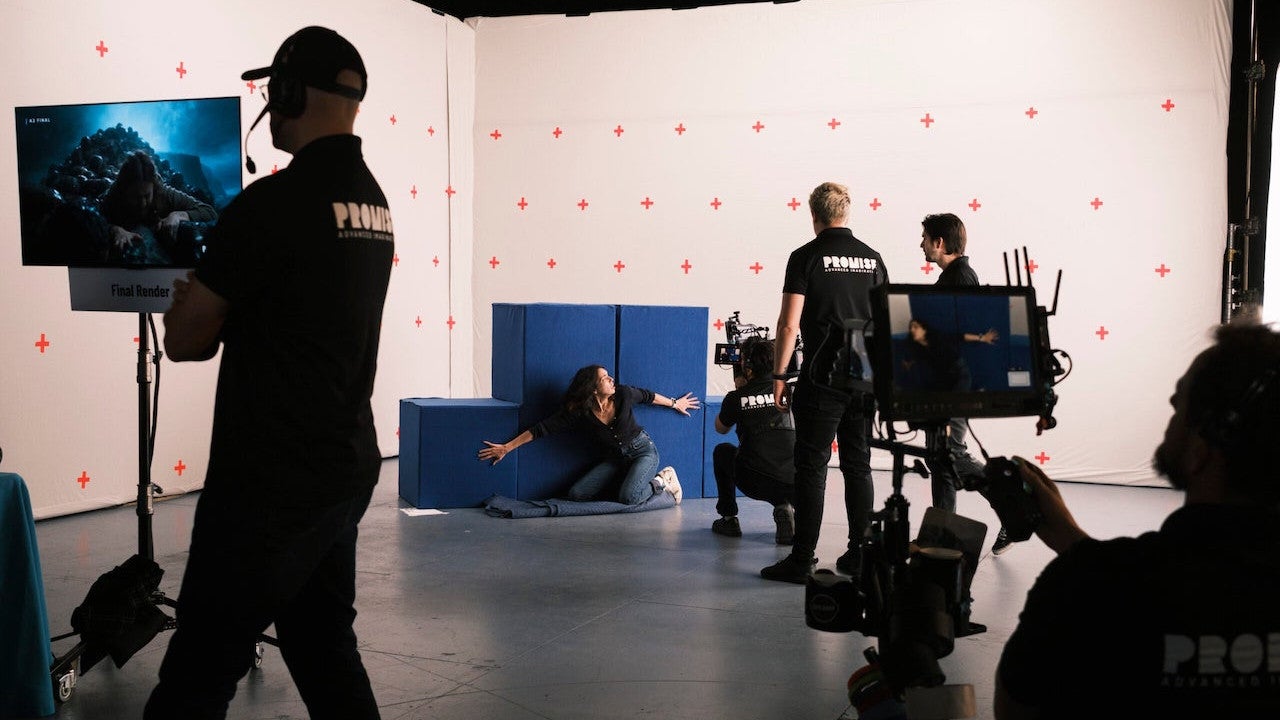
BURBANK, Calif. — Outside the Walt Disney Main Theatre, a Boston Dynamics four-legged robot equipped with a camera and hardware containing AI “brains” from startup FieldAI lurched forward. Around the corner about 15 feet away, another startup, Simile, talked about using AI and tens of thousands of digital twins of real people for virtual focus group testing. And tucked away at a nearby soundstage an actress put on a terrified face in front of a blank “gray box” (actually blue) used for AI hybrid filmmaking akin to Doug Liman’s latest project. Was this an episode of “Black Mirror”? No, it was Demo Day for Disney Accelerator, its program to invest in cutting-edge startups. Can you guess the predominant theme this year? While AI was a touchy subject in Hollywood even a year ago, that’s no longer the case as the major studios offer their full-throated support of the technology. The Disney Accelerator program offers a glimpse into where things are going, and it’s clear there’s a big embrace of AI. What was telling was the variety of different AI applications on display, and how Disney aims to take advantage of them. “We’re working with the technology to see if it can fit into workflows that we have, so we have the artist involved along the way,” David Min, VP of corporate innovation at Disney, told TheWrap. This year, five companies made up the latest cohort of startups in a program that began in 2014. As part of the accelerator, these startups spend 15 weeks with Disney, applying their products and services to different aspects of the company, with much of the focus on theme parks. Unlike other accelerator programs that deal with early stage companies, Disney prefers to invest in startups that are further along in maturity and able to potentially contribute to one of the media giant’s divisions immediately. The 2026 Disney Accelerator cohort with Disney executives Bonnie Rosen and David Min (center) (Credit: Disney) The latest group includes three unicorn startups, with Simile boasting a valuation of $2 billion, FieldAI worth $10 billion and Physical Intelligence worth $20 billion. The embrace of these kinds of companies falls in line with CEO Josh D’Amaro’s ambitions to make Disney a more tech-forward company. “As we look ahead, we’re doing our best and we’ll be very aggressive about this, exploring emerging technologies and seeing how they can support our creators and help us deliver even more engaging and even more personalized experiences all across the globe, and that’s why this matters,” D’Amaro said at the kick-off to Demo Day. Hybrid filmmaking and “vibe directing” Two startups focused on the kind of workflows you’d imagine when thinking about AI are Promise and OpenArt. Promise Advanced Imagination is an AI-native studio whose operating system, MUSE, allows for hybrid filmmaking using a gray box studio, which is essentially a shooting space with neutral lighting, a white or gray background and maybe a few boxes in the middle to stand in for props. AI can then fill the background and boxes with digital scenery and props in near-real time, allowing filmmakers to create expansive worlds and settings with minimal space. This kind of filmmaking, which is extensively like shooting on a green screen but on steroids, is already being done, with Liman’s “Bitcoin: Killing Satoshi,” starring Gal Gadot, Pete Davidson, Casey Affleck and Isla Fisher, the first example of a gray-box AI shoot. “It just gives you a ton of flexibility, and from being a director who’s worked on many sets where budget was always the issue, timing was always the issue, this allows me to just focus on the story, focus on the creative, and not worry about having to get my shots in a day,” said Dave Clark, chief creative officer for Promise. Promise CEO and co-founder George Strompolos said gray box shooting is “still pretty cutting edge” and that this is still in the beginning stages. He noted that Disney is not currently working on a gray box project. OpenArt, meanwhile, offers an easy-to-use interface that allows anyone to write simple prompts to allow for generative AI to create short videos. CEO and co-founder Coco Mao compared AI models to car engines, and likened OpenArt to a self-driving car where you tell it your intention, and it gets you to your destination. She called the conversational instructions you type “vibe directing” a video. Disney talked up how the app, which works with multiple video models, could quickly create new videos for older Disney catalog soundtrack singles or for marketing campaigns. Likewise, the app can be turned over to users to create their own fan creations, a concept Disney has warmed up after striking its ill-fated deal with OpenAI’s Sora. One differentiator is OpenArt’s embrace of a copyright protection tool from CopySight that flags whether content generated by Disney runs the risk of infringing on other IP. Bringing AI to the physical world While most people associate AI with prompts we type into a ChatGPT or Claude, three startups dealt with AI intelligence in the physical world. FieldAI brought several Boston Dynamics robots outfitted with their own hardware and layer of AI intelligence that allows them to walk around and accomplish tasks without a lot of preprogramming. The camera allows the robot to take visual inputs, so the AI system is smart enough to recognize things around it and move accordingly without GPS guidance or other preprogrammed routine. The robots on display were just there as an example, said FieldAI CEO and co-founder Ali Agha, who added that its intelligence software and hardware can be applied to any robot. That includes robots at Disney’s theme parks, and he hinted that the BDX droid from “The Mandalorian and Grogu” film that appears at Galaxy’s Edge already utilizes some of its technology. A demonstration of FieldAI’s intelligence and a Boston Dynamics robot (Credit: Disney) Disney’s video presentation showed a concept of robots shaped to look like “Cars” characters autonomously directing traffic and parking at a test parking lot. Another startup, Physical Intelligence, also worked with robots, but with the more delicate task of manipulating things with robot grippers. It worked at the theme park and focused on the more menial, albeit important task of cleaning and stacking 3D glasses. Because of the different sizes of the glasses and how they’re stored and cleaned, the task can’t be easily automated. But the AI smarts that Physical Intelligence brings to the robots allow them to better manipulate small objects that require varying levels of strength and dexterity. It was also an example of AI being utilized to handle a task that its “cast members” find uncomfortable (the task is done inside a small, hot room) and repetitive. “When we visited this room, people were like, ‘Hey, are you here to automate this? We hate doing this,’” said Victor Hwang, a technical staffer with the company. Returning to Demo Day for a second year was a member of the 2025 cohort, Haddy, which utilizes AI to ensure robot arms are able to quickly and accurately print large-scale 3D objects, in this case to be used by the theme park. Haddy hopes to make theme parks more dynamic by making it easier to print and install facades and other set pieces. “Now you could have a movie primed to come out and pull the cover off of a show set, and that is making the creative come to life faster,” said Haddy co-CEO Jay Rogers. Digital twins The rise of AI has brought the idea of a digital twin of real people, essentially a bot version of you that understands your preferences and needs. Simile has taken that notion and scaled it up by creating synthetic crowds made up of digital twins of real people it has interviewed and surveyed. The startup will talk to between 20,000 and 50,000 people through surveys each week and has a database of a million people. Of that total, it can target a group of likely Disneyland visitors (or any other company it works with) and run virtual focus group tests to get a good approximation of how people feel about a service or product. For Disney, Simile is helping the company run tests of how people would go through its digital booking experience. “So far, we’re looking at the ways that we can simplify and improve the digital booking journey for guests, and to remove elements of friction,” said Lainie Yallen, co-founder and chief operating office of the company.
‘Vibe Directing,’ Hybrid Filmmaking and Robots: Disney’s Startup Program Goes All-In on AI
Full Article
Original Source
Read the full article at Thewrap →KhanList aggregates and links to publicly available news content. We do not host full articles from third-party sources. Always verify important information with original sources.