
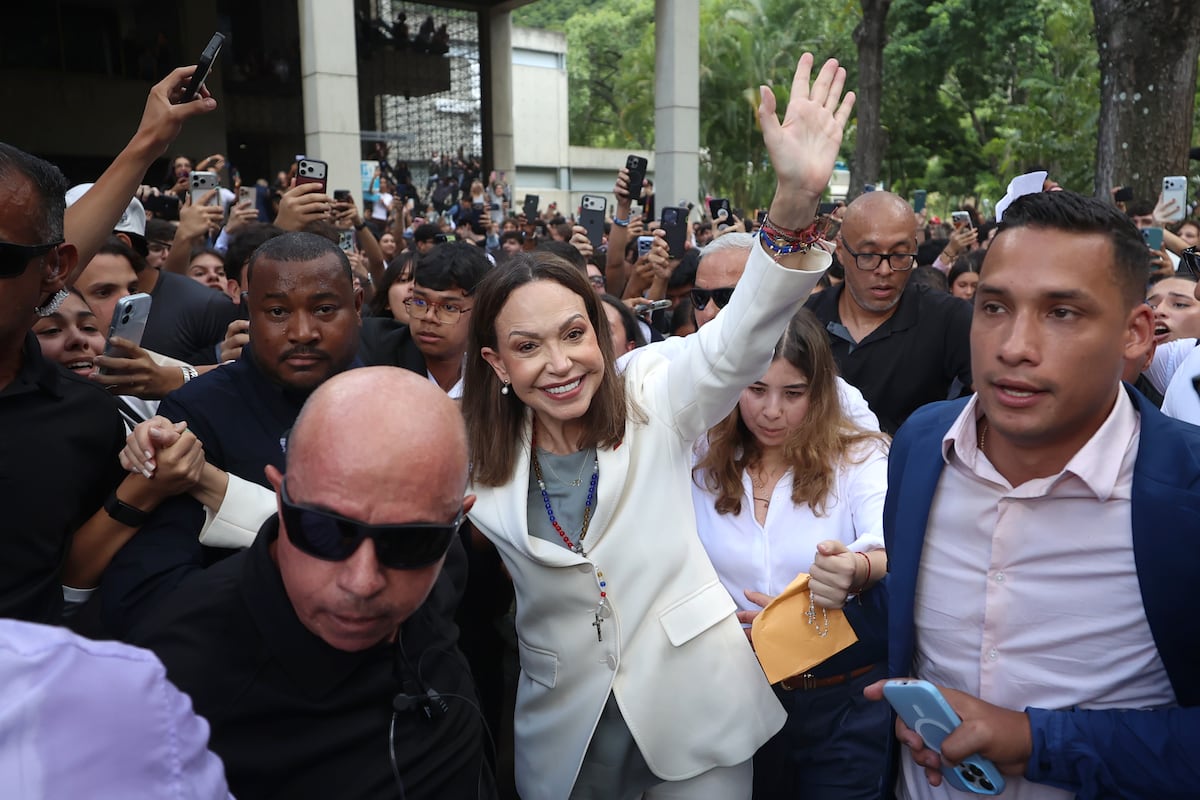
Over the past 10 months, there has been no consensus among academics, political scientists, and observers on whether Venezuela had entered a transition process. One of the most cautious voices was historian Margarita López Maya. However, following María Corina Machado’s return to the country, the scholar has softened her doubts: “We are closer [to a transition] because the political leadership that can bring together the opposition forces and lead them to a possible democratization has arrived,” she says.Predicting the course of the South American country is still as difficult as weather forecasting was 30 years ago. Even so, most analysts agree on two points: first, Machado’s arrival has sounded the starting gun for an early presidential campaign. Second, her return marks the milestone that has led many to conclude that the transition has now truly begun.The public reception for Machado also invites comparisons. One of the cruel jokes that circulated whenever Henry Alviarez, coordinator of Vente Venezuela, announced a new date for her return, only to later acknowledge yet another failed attempt, was that it resembled the Second Coming of Christ. Judging by the images and the staging of recent days, the messianic reference no longer seems so exaggerated.Men in tears, women embracing her, children asking for her blessing. It is an emotional atmosphere that swings between hope and helplessness, and one that confirms what opinion polls have been showing for some time. If elections were held tomorrow, María Corina Machado would win comfortably. Moreover, charisma appears to have become a stronger element of her leadership.But there is still no date for those elections.At her press conference on October 29, Machado insisted that the best timeframe for a presidential election is 2027, specifically July of next year. However, comments attributed to a “senior official” at the U.S. State Department pointed to a more distant timetable. And then there were the recent remarks by acting President Delcy Rodríguez who, in a recorded message broadcast before Machado’s press conference, once again assured Venezuelans that elections will be held in accordance with the Constitution.The assertion is not without irony. After all, if there is one thing that has been systematically undermined in Venezuela in recent years, it is the constitutional order itself. Moreover, both the United States, in its role as facilitator and guarantor of the process, and Rodríguez and the rest of the ruling leadership have avoided formally declaring Nicolás Maduro’s permanent absence from office.This is no minor detail. Under the Constitution, once such an absence is declared, a new presidential election must be called within 30 days if it occurs during the first three years of the term. If it happens later, the vice president is tasked with completing the remainder of the mandate. In 2013, after Hugo Chávez’s death, elections were held within the constitutionally mandated timeframe.Political circles have been abuzz with the theory that the Rodríguez siblings, Delcy and her brother Jorge Rodríguez, are seeking to stretch the timeline for as long as possible to avoid a presidential election in the near term. In the opposition’s worst-case scenario, the process could be delayed to the point where a new vote would no longer be required, allowing Delcy Rodríguez to remain in power until 2030.Machado’s return, however, appears to be disrupting those calculations.Although it remains to be seen how much institutional influence she will wield in this new phase, there is no denying that she commands broad popular support. At the same time, she faces formidable opponents: sectors that have benefited from opaque business dealings and from alliances that thrive in the shadow of corruption, as well as political rivals and a fragmented opposition movement.Since the disputed presidential election of July 28, 2024, I count myself among those who have tried to keep their distance from the waves of euphoria that periodically sweep the country. I did not celebrate on January 3, when Maduro was arrested; I have been cautious about the outcomes of the Negotiating Table established last June; I have questioned whether the much-discussed three-phase plan that some spokespersons repeat like a mantra even exists; and although I am glad Machado has finally managed to return to Venezuela, I am not joining the cheering without some reservations.Not so much because of Machado herself, who deserves the acclaim, but because I continue to believe that the dictatorship’s capacity for adaptation is underestimated, as is the pragmatism it displays, free of any revolutionary nostalgia. Above all, the interests at stake demand a high degree of precision and political finesse.It is a warning that Carlos Valero, a leader of the Un Nuevo Tiempo (A New Era) party, has voiced on several occasions. Valero acknowledges that hopes for change are now largely invested in María Corina Machado and that polls show more than 60% of Venezuelans want political alternation.“But wanting it does not necessarily mean we will achieve it,” he warns.He points to the many missed opportunities and to the opposition’s repeated failure to anticipate its adversary’s strategy, especially its ability to destroy, divide, or reinvent itself.“The Russians have a role to play, too. And no one has yet discovered the formula for building an effective transition. Among other reasons, because every transition is different, and none can simply be copied from another,” he says.Historian Pedro Benítez shares some of that caution. While he acknowledges that Venezuela is going through a period of political change, he still stops short of saying the country is fully in transition.“That will probably become clear within a few years, if an alternation in power does in fact take place,” he argues.One of the risks identified by López Maya is that Machado’s highly personalized leadership could foster sectarian dynamics that ultimately hinder the broad-based participation every democratic transition requires.Valero takes a similar view, insisting that the Venezuelan landscape remains extraordinarily complex. A range of interests coexist and compete within it: the United States, the Venezuelan government, the different factions of the opposition, and actors who, despite sharing the goal of political change, still have deep disagreements with one another.What is clear is that María Corina Machado’s return has altered the country’s political mood. If any event over the past 10 months has brought skeptics closer to concluding that a transition is underway, it is this homecoming. I count myself among those doubters who, for now, are willing to give it the benefit of the doubt.Sign up for our weekly newsletter to get more English-language news coverage from EL PAÍS USA Edition
Venezuela, 10 months later: The transition may finally be underway
Full Article
Original Source
Read the full article at English →KhanList aggregates and links to publicly available news content. We do not host full articles from third-party sources. Always verify important information with original sources.