
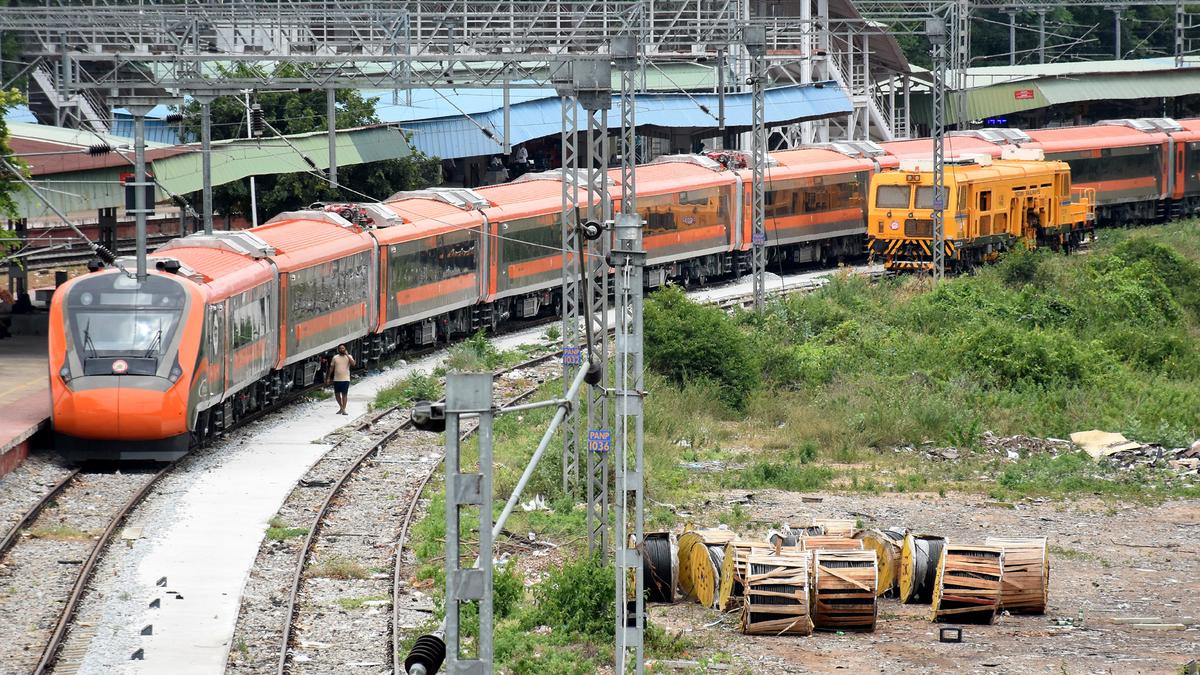
A 20-car Vande Bharat rake fitted with Automatic Emergency Braking (AEB) system manufactured at the Integral Coach Factory (ICF), Chennai, seen stabled at Pandavapura Railway Station ahead of South Western Railway’s Mysuru Division commencing the trial run of VB Express on the Sakleshpur-Subrahmanya Road Ghat section on August 5, 2026. | Photo Credit: M A SRIRAM The stage is set for the introduction of the much-hyped Vande Bharat Express connecting Bengaluru with coastal Karnataka, with South Western Railway’s Mysuru Division gearing up to conduct trial runs from August 11.While Minister of State for Railways V. Somanna had earlier announced that the VB Express would be introduced on the Bengaluru-Mangaluru sector by June, the same did not materialise for want of a VB rake fitted with Automatic Emergency Braking (AEB) system.Now that the Integral Coach Factory (ICF), Chennai, has supplied a 20-car VB rake fitted with AEB to Mysuru Division, the decks are cleared for its trial run and subsequent authorisation for commercial operation. The rake is presently stabled at Pandavapura Railway Station in Mandya district.The trial run starting from August 11, would go on till August 22. A team from the Research, Design and Safety Organisation (RDSO) of the Indian Railways would arrive to conduct the runs shortly, Divisional Railway Manager Mudit Mittal told The Hindu on Wednesday (August 5, 2026). South Western Railway’s Mysuru Division will commence the trial run of Vande Bharat Express on the Sakleshpur-Subrahmanya Road Ghat section from August 11 as a precursor to introducing the VB service on the Bengaluru-Mangaluru sector. | Photo Credit: M A SRIRAM Why AEB for Vande BharatA typical VB rake features an advanced Electro-Pneumatic (EP) assisted disc braking system combined with regenerative braking. While the microprocessor-controlled EP assisted brakes apply pneumatically through electric signals for simultaneous and rapid response across all coaches, the regenerative braking helps feed the power back to the overhead wires during deceleration.As this Ghat section has a steep gradient (1 in 50 – the track rises or drops by one metre for every 50 metres), the Commissioner of Railway Safety had fixed a maximum speed limit of 30 kmph for all trains traversing the section when authorising the opening of the section for train traffic. The Railways has kept a few Banker Locos (additional engines) fitted with AEB with preset maximum speed of 30 kmph. These Banker Locos are attached to normal trains hauled by locos at Sakaleshpur and Subrahmanya Road on the down and up direction. The attachment/ detachment process consumes about 15 minutes.If these Banker Locos are to be attached to a VB too, its nose has to be removed, which would not look nice. The nose has to be taken in the rake either towards Sakleshpur or towards Subrahmanya Road for re-fitting. This process would consume more time compared to normal trains, thereby defeating the very purpose of operating the high-speed train, said a senior officer from the operations department.Therefore, the Railways had been waiting for the supply of a AEB-fitted VB rake. Published - August 05, 2026 03:54 pm IST
Vande Bharat trial run on Sakleshpur-Subrahmanya Road Ghat section from August 11
Full Article
Original Source
Read the full article at Thehindu →KhanList aggregates and links to publicly available news content. We do not host full articles from third-party sources. Always verify important information with original sources.