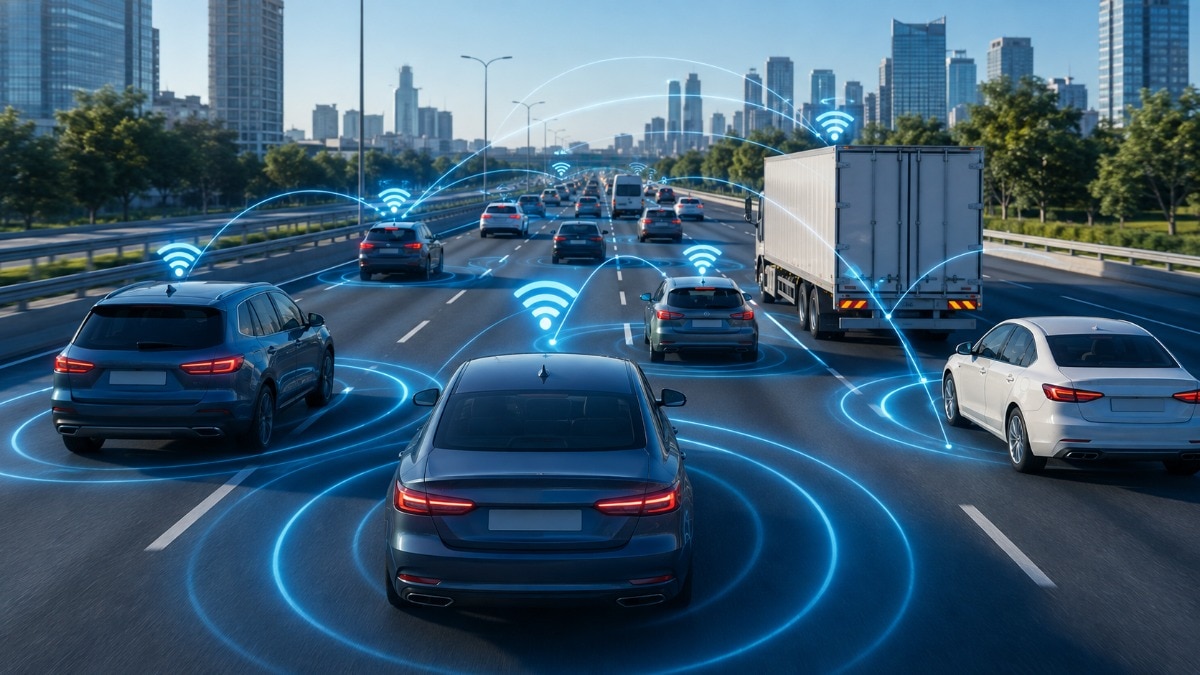
Cars are becoming increasingly intelligent, but the next leap in road safety may not just be about what a vehicle can see. It could be about vehicles communicating with each other.V2V and ADAS may work differently, but together they could make roads safer.Cars are getting smarter. They can already detect pedestrians, keep themselves centred in a lane, brake automatically and warn drivers about vehicles approaching from the side. But the next step in road safety could be cars actually talking to one another.That is where Vehicle-to-Vehicle, or V2V, communication comes in.With the government proposing to make V2V technology mandatory in new vehicles from October 1, 2028, an obvious question arises: Is V2V just another form of ADAS?The short answer is no.V2V and ADAS are different technologies, although they can complement each other and ultimately make vehicles significantly safer when used together. ADAS uses the car's 'eyes'. V2V uses the car's 'voice' The easiest way to understand the difference is to think of a car as a person. ADAS gives the car eyes and ears. V2V gives it a way to talk to other vehicles. Advanced Driver Assistance Systems rely primarily on sensors fitted to the vehicle. Cameras, radars, ultrasonic sensors and sometimes lidar monitor the surroundings and identify potential hazards. For instance, an ADAS-equipped car can detect a vehicle in front, recognise that it is slowing down and issue a forward-collision warning. If the system supports autonomous emergency braking, it can even apply the brakes. But there is one major limitation: the vehicle can only react to what its sensors and camera can detect.This is where V2V changes the equationA V2V-equipped vehicle can wirelessly exchange information with other compatible vehicles, including data such as speed, position, direction and acceleration. It doesn't necessarily have to 'see' another vehicle to know what that vehicle is doing. Consider a busy highway.You are travelling behind a large SUV, which is behind a truck. The truck suddenly brakes because traffic has come to a standstill around a bend. Your camera and radar may not be able to see the truck because the SUV is blocking your view. With conventional ADAS, your car may only realise there is a problem once the SUV in front starts braking or the obstacle becomes visible. With V2V, the truck could transmit information about its sudden braking to nearby vehicles. That warning could travel through the traffic almost instantly, giving your vehicle information about a hazard before it enters the field of view of its sensors.This is the fundamental difference.ADAS detects. V2V communicates.Does V2V replace ADAS?No.In fact, the two technologies could become more useful when combined.ADAS is designed to understand the physical environment around a vehicle. V2V adds information that may not be visible to the vehicle's sensors. A car could therefore use both systems simultaneously. Its radar might detect a vehicle braking immediately ahead, while V2V could warn it that another vehicle several hundred metres ahead has already performed an emergency braking manoeuvre. The car would effectively have two sources of information: what it can see and what other vehicles are telling it.V2V can see beyond the driver's line of sightThis is perhaps the biggest advantage of V2V.A camera cannot see through another vehicle. Radar cannot look around a blind corner. A driver cannot know that an ambulance is approaching from behind a line of traffic.V2V potentially can.The technology could support safety applications such as:Emergency Brake Alert: A vehicle performing hard braking can warn nearby vehicles.Forward Collision Warning: Vehicles can exchange information to warn of an impending collision.Wrong-way Driving Alert: A vehicle travelling in the wrong direction could alert other connected vehicles approaching from the opposite direction.Emergency Vehicle Alert: Nearby vehicles could be warned about an approaching emergency vehicle.These are situations where information from another vehicle can be valuable even before the hazard becomes visible.But V2V has one big catchThere is an important difference between V2V and conventional ADAS: V2V works best when other vehicles are also connected. A radar-equipped car can detect a non-ADAS vehicle. A camera can detect an old car, a pedestrian or a motorcycle. But V2V communication requires compatible equipment and communication between participating vehicles. That means V2V is likely to become progressively more effective as the number of equipped vehicles increases. This is why making the technology mandatory on new vehicles could be important. As the connected vehicle fleet grows, the amount of information being exchanged on the road would also increase.What about two-wheelers?The government's proposed framework is particularly interesting because it isn't limited to cars. The proposed V2V mandate covers Category L vehicles, which include two- and three-wheelers, alongside Category M passenger vehicles and Category N goods vehicles. That could make V2V particularly useful in India's mixed traffic environment, where cars, motorcycles, scooters, buses and trucks share the same roads. For example, a truck approaching a motorcycle could potentially transmit information about its movement even if the rider is in the truck's blind spot. Similarly, a motorcycle approaching a car could become another connected participant in the road-safety network. It is better to think of V2V as another layer of safety technology.ADAS makes a vehicle better at understanding its immediate surroundings. V2V allows that vehicle to receive information from beyond what its own sensors can observe.And eventually, these technologies could work alongside Vehicle-to-Infrastructure (V2I) and Vehicle-to-Everything (V2X) communication, allowing vehicles to communicate not just with one another but potentially with traffic infrastructure and other road users.Subscribe to Auto Today Magazine - EndsPublished On: Aug 7, 2026 12:36 IST
V2V vs ADAS: Are they the same or do they work differently?
Full Article
Original Source
Read the full article at Indiatoday →KhanList aggregates and links to publicly available news content. We do not host full articles from third-party sources. Always verify important information with original sources.