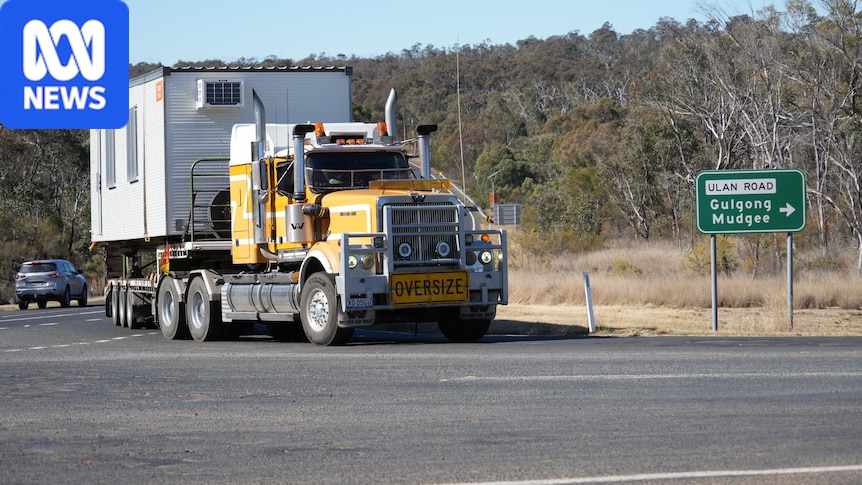
With a population of about 300, Cassilis in the New South Wales Upper Hunter seems an unlikely location for traffic issues.But local woman Jane Hegarty, chair of the district's development group, would beg to differ."There's certainly a lot more oversize and over-mass vehicles where you're having to pull off the road, so it's definitely becoming a much more hazardous journey," she said.Jane Hegarty says her community is frustrated by the increase in traffic. (ABC Upper Hunter: Courtney Yeandle)Ms Hegarty said a major factor in the problem was traffic travelling to and from the Central West Orana Renewable Energy Zone (REZ).Components for the construction of REZ projects are being imported via the Port of Newcastle and transported to the Central West by road."The Golden Highway is the main thoroughfare from Newcastle to Dubbo," Ms Hegarty said."Currently, it is about 30 per cent heavy vehicles and that is increasing with all the developments for the REZ."It is frustrating because … we haven't even got to peak construction period and we're already noticing a difference."Wind turbine components need to be delivered from the Port of Newcastle to projects in the Central West. (Supplied: Port of Newcastle)But help is on the way in the form of new smart highway technology now being trialled by the NSW government.The Rural Intersection Speed Zone (RISZ) system uses vehicle detection and variable speed limit signs to slow down vehicles on the highway, allowing those on the side road to turn into it.The system has been installed on the Golden Highway at Cassilis, which is on the designated REZ route.The RISZ system lowers the speed limit on the Golden Highway when a vehicle is turning from Ulan Road. (ABC Upper Hunter: Courtney Yeandle)First of its kindThe trial is a first for NSW.Transport for NSW (TfNSW) executive director operational technology John-Paul Ahern said it would deploy radar detectors to sense when vehicles were approaching the highway."It will detect vehicles on Ulan Road as they approach the Golden Highway, and it will then trigger some signs on the highway itself, warning those vehicles in advance that there's a vehicle going to come out of Ulan Road," he said.The RISZ system operates from a self-contained, solar powered unit. (ABC Upper Hunter: Courtney Yeandle)Designed specifically for rural intersections, the RISZ aims to help larger, slower-moving vehicles to merge more safely before the speed limit returns to normal.While similar technology is used in Victoria, Mr Ahern said TfNSW had customised it for Cassilis."This particular installation has been designed bespoke for this particular intersection," he said."It's got a lot of heavy vehicles for the renewable energy zone, for freight, for mining."Our crash data did show that there's been three crashes there in the last five years that were serious."It is the first time the system has been trialled in NSW. (ABC Upper Hunter: Courtney Yeandle)'Generational investment'NSW Roads Minister Jenny Aitchison said the RISZ system would help keep local traffic moving by only reducing the speed limit when a vehicle was approaching the intersection.Jenny Aitchison says the government has invested $128 million into upgrading the Golden Highway. (ABC News: Ross McLoughlin)"This is something that we want to see where speed zones are relevant to the traffic needs of the places where they are located and so we're not just putting blanket speed zone restrictions," she said.The minister acknowledged the Golden Highway was playing a significant role in the state's energy transition."We're doing significant upgrades on … the Golden Highway, which has already received over $128.5 million in funding, with more on its way," she said.The state government is upgrading the Golden Highway. (ABC Upper Hunter: Courtney Yeandle)Ms Aitchison said the upgrades would be a "generational investment" in the road network."The long-term benefit will be that once these renewable energy zones are established and the traffic goes back to normal, [the community] will still have the legacy of a vastly improved network on their highway," she said.Cassilis locals say they are noticing increased OSOM traffic for construction of the REZ. (ABC News: Ross McLoughlin)Ms Hegarty said it remained to be seen how effective the RISZ would be."I think it's a measure to try and save the cost of having to put in some turning lanes," she said."It will be interesting to see how effective it is and whether it does prevent accidents."The RISZ system will be trialled at the site for 12 months.
New smart highway technology a fix for renewable energy traffic boom
Full Article
Original Source
Read the full article at Abc →KhanList aggregates and links to publicly available news content. We do not host full articles from third-party sources. Always verify important information with original sources.