
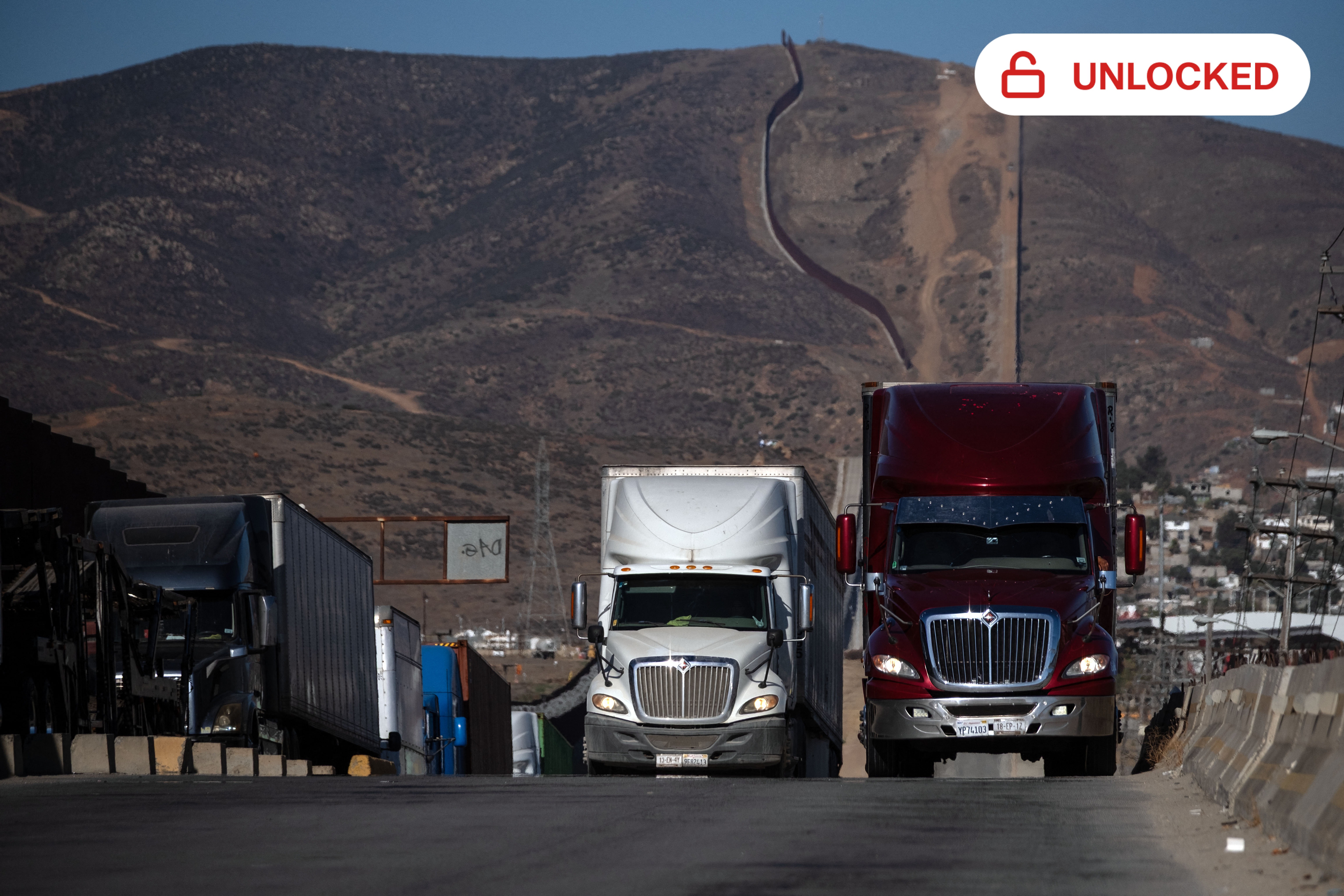
Turn any article into a podcast. Upgrade now to start listening. Members can share articles with friends & family to bypass the paywall. You’re reading Dispatch Markets, a weekly dive into the forces driving economic growth—and those holding it back—featuring Scott Lincicome, Kyla Scanlon, Karl Smith, Marian Tupy, and Adam Ozimek. The three parties to the United States-Mexico-Canada Agreement are back at the table. “Canada and Mexico, and the United States have all confirmed in the last week that they’ve been reengaging much more actively for USMCA negotiations,” report the trade analysts at Flexport. The Trump administration declined to renew the deal when the question came up in July, but that does not mean that USMCA goes away: The agreement, a successor to the North American Free Trade Agreement (NAFTA), remains in force until 2036 unless the U.S. government or one of the other parties takes positive steps to withdraw. My colleagues at the Competitive Enterprise Institute have been arguing for a better USMCA, a deal that is in certain ways worse than NAFTA—worse if you want your free-trade deal to free up trade, that is. For example, the new agreement made the already complex automotive North American-content rules (which cover finished vehicles as well as some individual components as well as restricting the use of imported steel and aluminum) even more onerous. Honest Trade Cargo trucks queue next to the border wall in Tijuana, Mexico on July 31, 2025. (Photo by GUILLERMO ARIAS/AFP via Getty Images) “Most of the NAFTA updates in USMCA were actually bad,” says Ryan Young, a senior economist at CEI. He cites the automotive restrictions as a major example, but there were many other instances of backsliding into more heavy-handed managed trade. “There are little things that are not huge changes in and of themselves but push overwhelmingly in the direction of managed trade, not freer trade. CEI opposed USMCA when it was being negotiated. We support it now, because we asked the oldest question in economics, the one that every economist is taught to ask from birth: How does it compare to the alternative? USMCA is better than no agreement at all and Trumpian tariff chaos.” The main problem involved in getting people who work for Donald Trump to negotiate free-trade deals is that Donald Trump does not like and does not want free trade. And so USMCA, which was supposed to push tariffs in the direction of 0.00 percent, has been relegated to the status of parchment agreement while Trump announces a new set of tariffs with new rates and a new constitutional pretext every 11 minutes. “This was supposed to be a near-zero tariff agreement, and it worked for the better part of 30 years. And now we are imposing ‘national security’ tariffs against ... Canada. And Mexico. Come on,” Young says, noting that the Trump administration also has sanctioned Canada over supposed forced-labor violations. The accusation, to be precise, is not that Canada relies on slave labor but that its government rejects an insufficient share of proposed imports on forced-labor grounds—i.e., it assumes the violation and demands that Canada do something about what might very well be a vapor of Stephen Miller’s imagination. The policy is, as some respectable collaborationists say when Trump launches an illegal war in Iran or murders a boatload of seafarers on the Caribbean, not ideal. “There are formal mechanisms in there,” Young says, “but, ultimately, it is an honor system. And you can’t have an honor system without honor. USMCA will have some value for upcoming administrations of whatever party, but trade agreements are supposed to advance stability. And, for that, we need someone decent and honorable, at least by the standards of politics, if those agreements are going to have force.” I am not the only pointy-headed libertarian who used to insist that a proper free-trade deal could fit on a postcard and would consist of one sentence: “There shall be free trade between x and y.” I was failing to keep my own counsel, Williamson’s First Law, which holds that, “Everything is simple, provided you don’t know a f-----g thing about it.” As I have learned more about trade, I have repented of my simplistic view. To take a silly but useful example: We wouldn’t outsource the manufacture of our nuclear weapons to the Chinese in the interest of free trade, even if doing so were more economically efficient by some accessible measure. But what about the manufacture of military vehicles or rifles? What about military goods other than munitions? A nuclear warhead provides an obvious national-security rationale for requiring domestic production, and a pair of boots perhaps does not—but there is a great deal of shelf space between those two goods, and the question of how those shelves get filled, by whom, and on what terms is not something that can be answered on a postcard. Even closely aligned and similar nations have different environmental, labor, and safety standards. In the case of the United States and Canada, there are issues about how the Canadian government prices timber harvested on public land and whether this amounts to a subsidy that stacks the deck against U.S. producers, who harvest mainly from private land. Answering this stuff is why trade deals—responsible, well-crafted, and liberal trade deals—end up being 2,000 pages. Young argues that at least some of this could be mitigated by limiting trade agreements such as USMCA to trade per se, while creating separate silos for national security, environmental issues, etc. If trade is governed by relatively simple, easily understood, agreed-upon principles, then dealing with the trade effects of legitimate non-trade issues is a good deal easier. So is accommodating technological change: NAFTA was signed before the World Wide Web became publicly available and only months after the National Science Foundation decided to allow commercial use of its network—there was no e-commerce to speak of, and certainly no Amazon and no digital entrepreneurs relying on low-friction international product shipment, no businesses offering essentially frictionless cross-border services enabled by digital connections. It is not unreasonable to think that AI or other technologies will change economic activity in ways that will require updating USMCA and other trade agreements. Perhaps it would be better to think of free trade among the major North American powers or (a man can hope) more liberal trade between the USMCA countries and the European Union not as something enabled by an agreement that is signed and filed and fixed like a bug on a pin but as a process. Rather than trying to do the diplomatic equivalent of open-heart surgery on USMCA every few years, it might be worth it to establish a small, permanent trilateral committee (set them up in Mexico City; the weather is nicer than in Washington or Ottawa) and have them submit a set of revisions to their respective governments on a regular schedule. There is a case for doing this like “BRAC,” the old “Base Realignment and Closure” process that put tranches of military-installation closures up for a yes-or-no vote as a single body, thereby blunting the influence of narrow regional interests. Just as every congressman has an incentive to spare installations in his own district that can be overcome by grouping closures together, packaging small (but big to somebody) changes in trade agreements as a group could help to mitigate congressional homerism. The alternative is to trust Marco Rubio and his insipid insistence that economic protection for Florida sugar barons is a matter of “national security.” But I am with Ryan Young on this one: Yes, we could use better trade agreements, but we desperately need better men and women to look after them. Disclaimer: The opinions expressed above do not necessarily reflect those of the presenting sponsor. Want to see more of The Dispatch in Google search? Add Us as a Preferred Source Kevin D. Williamson is national correspondent at The Dispatch and is based in Virginia. Prior to joining the company in 2022, he spent 15 years as a writer and editor at National Review, worked as the theater critic at the New Criterion, and had a long career in local newspapers. He is also a writer in residence at the Competitive Enterprise Institute. When Kevin is not reporting on the world outside Washington for his Wanderland newsletter, you can find him at the rifle range or reading a book about literally almost anything other than politics.
USMCA, Trade, and the Character Issue
Full Article
Original Source
Read the full article at Thedispatch →KhanList aggregates and links to publicly available news content. We do not host full articles from third-party sources. Always verify important information with original sources.