
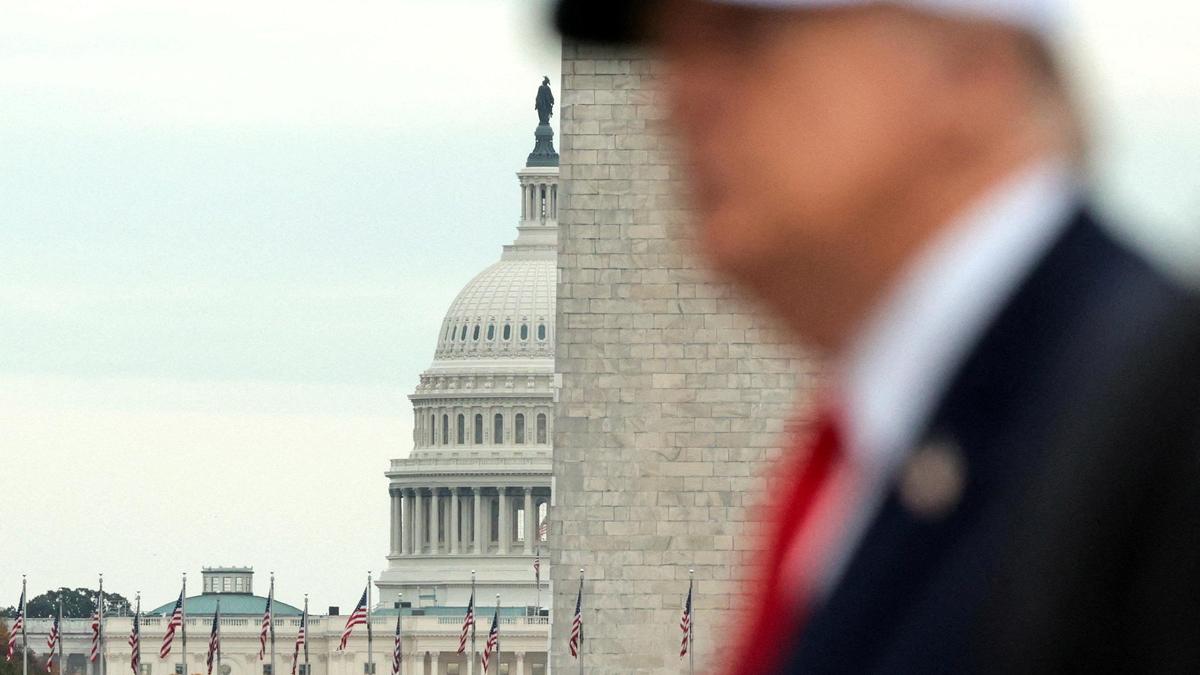
Americans will vote on Tuesday (November 3, 2026) in one of the most consequential elections in recent times, widely seen as a referendum on Donald Trump’s presidency that has been marked by a prolonged war in Iran, rising inflation, trade wars and deep divisions in society.The polling will decide whether President Trump’s Republican Party retains control of the House of Representatives and the Senate, the two chambers of the U.S. Congress, or, as opinion polls are predicting, the Democratic Party wrests control of at least the House if not the Senate, also in the final two years of Mr. Trump’s second term in office.At stake in the elections are all 435 seats of the House and 37 seats in the 100-member Senate.Elections are also being held for the post of Governor in 36 states, including in Ohio, where Indian American Vivek Ramaswamy is locked in a keen contest with his rival and Democratic nominee Amy Acton.Several Indian American candidates are in the electoral fray for posts ranging from Governor to city council member. Democrat Nithya Raman, born in Kerala, is locked in a tight contest with her former boss, Karen Bass, for the mayor's seat in Los Angeles, the second-largest city in the U.S..Indian-American lawmakers Ro Khanna, Ami Bera, Pramila Jayapal and Suhas Subramanyam are seeking re-election to the U.S. House of Representatives, while fellow Democrats Pia Dandiya and Amish Shah are in the fray in competitive races to make their debut as Congresspersons.On Monday (November 2), the Republicans and the Democrats made their final pitch to the voters, with Mr. Trump choosing an unusual venue — the Lincoln Memorial Reflecting Pool — to focus on the renovations undertaken in the national capital instead of talking about tax cuts, tariffs and border security, which have been the high points of his election rallies.According to the White House, Mr. Trump did a whirlwind tour of 20 states, mostly Republican strongholds, to address 30 rallies in the last 32 days. Analysts say his approval ratings are at an all-time low, and he has become a liability to Republican candidates.If the pre-poll forecasts come true and Democrats take control of the U.S. Congress, it will allow for deeper Congressional scrutiny and checks on Mr. Trump’s actions, which will severely limit his ability to push his agenda. He will, however, retain the power to govern through executive orders, which will be valid for two years.Mr. Trump acknowledged the possibility of his wings being clipped but indicated that he would not allow Congress to slow him down."I guess I'll become Mr. Veto," Mr. Trump told the New York Post’s Pod Force One podcast in response to a question on Republicans losing control of both Houses of the U.S. Congress, referring to the presidential power to veto actions by Congress.Former President Barack Obama boosted the Democratic campaign with rallies in Ohio, Michigan and Georgia, which clearly left Mr. Trump rattled.“This election is our last, best chance of at least reining him in, reining in some of the foolishness of this administration,” Mr. Obama said in Georgia.“It’s the circuit-breaker in the system, and we need to flip it,” he said, taking Mr. Trump to task for focusing on White House renovations instead of issues affecting the people.The upbeat Democrats, however, suffered an unexpected setback in the eleventh hour when Congresswoman Haley Stevens of Michigan crossed over to the Republican side on Sunday (November 1), breaking ranks with Senate nominee Abdul El-Sayed, who could be the first Muslim elected to the U.S. Senate.The Democratic Party quickly rallied behind El-Sayed by issuing statements condemning Stevens, who sprung a surprise by endorsing El-Sayed’s Republican rival, Mike Rogers, and appearing alongside him in public.Stevens lost in the Senate primary to El-Sayed. She is a staunch supporter of Israel, while El-Sayed is a fierce critic of the U.S. ally.The Democrats are hoping to flip seven Senate seats — Michigan, Maine, Ohio, Kansas, Texas, Iowa and Alaska — in their bid to gain a majority in the 100-member House. Each of the 50 states in the United States is represented by two Senators who sit in Congress for a six-year term. But the Senators are divided into three lots, and their terms are staggered so that elections are held every two years.The House members are elected for a two-year term.The mid-term elections are also crucial for Vice President J.D. Vance, who is burnishing his credentials to become a successor to Mr. Trump’s mantle.Mr. Vance made campaign stops in New York and Ohio on Monday (November 2), where Republicans were fighting for House and Senate seats.He highlighted Mr. Trump's moves to end taxes on tips and overtime and secure the border while branding Democrats as "lunatics" who have contempt for American voters.About 210 million Americans are registered to vote, according to USAFacts. California has the most registered voters, with 23.2 million, followed by Texas (17.4 million) and Florida (13.6 million). Together, they account for about 26% of all registered voters.Wyoming (278,468), Vermont (459,455) and Alaska (603,310) have the fewest.According to the AP, more than 57 million ballots have been cast in 47 states and D.C. as of Monday (November 2), compared to a little under 44.5 million in 49 states and D.C. in 2022.
U.S. votes for midterm elections, seen as referendum on Trump
Full Article
Original Source
Read the full article at Thehindu →KhanList aggregates and links to publicly available news content. We do not host full articles from third-party sources. Always verify important information with original sources.