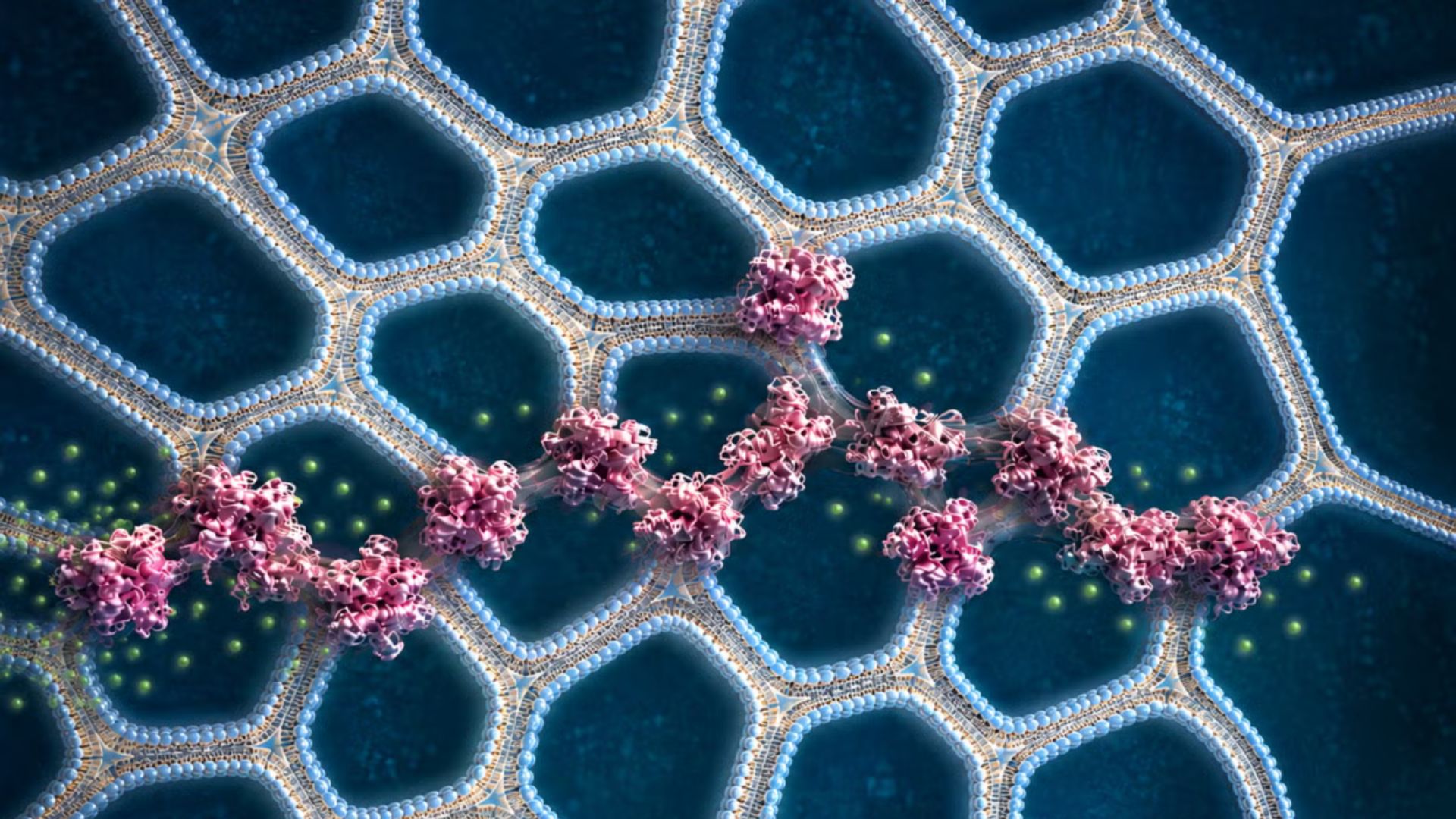
What if a splash of water, a drop of oil, and a standard laboratory centrifuge held the secret to growing human organs, recovering precious battery metals, and building brain-like computers? It sounds like alchemy. But engineers at The University of Texas at Austin have transformed this exact recipe into a 3D-printable material that replicates the selective filtering power of biological tissue. The scientific term for these droplet networks is JIBEs (Jammed Interconnected Bilayer Emulsions). The material acts as a selectively permeable membrane. To overcome the speed and scalability limits of standard manufacturing, researchers developed a fast, scalable method to build large, tissue-like materials in just minutes. Using simple mixing and centrifuge techniques, they jam billions of microscopic water droplets tightly together. These droplets are separated by thin membranes that link up, thereby mimicking the cellular organization of human tissue on a much larger scale. This 3D-printed tissue mimics human tissue’s ability to sort and filter, allowing certain molecules to pass through while keeping others out. Credit: The University of Texas at Austin Centrifuge science The innovation overcomes a hurdle that has frustrated material scientists for over a decade: scale. Earlier, scientists could craft delicate, tissue-like structures on a microscopic level. Scaling those micro-droplets into usable, macroscopic materials proved painfully slow and wildly unstable. Aida Fica, a PhD researcher at UT Austin, broke through the challenge after connecting disparate ideas at an academic conference. Her team created dense, interconnected networks of billions of droplets in mere minutes by mixing two oils with different solubilities to form tiny water droplets, then forcefully packing them together in a centrifuge. Each droplet remains encased in a ultra-thin membrane, perfectly mimicking how living cells group together to form working organs. “Tissues can separate and transport ions and molecules; that’s how our kidneys or intestines work, taking only what they need and leaving the rest behind,” said Manish Kumar, professor in the Cockrell School of Engineering’s Fariborz Maseeh Department of Civil, Architectural and Environmental Engineering and the McKetta Department of Chemical Engineering. Material changing multiple industries As the material prints easily from biocompatible substances, its potential uses span different industries. This bio-material acts as a adaptable platform across medicine, robotics, computing, and environmental science. In healthcare and soft robotics, its flexible, tissue-like structure enables precise tissue growth for human organ grafts and lets delicate surgical or rescue bots navigate environments safely. Moreover, embedding specialized proteins allows the material to conduct ionic currents, laying the groundwork for brain-inspired neural computing. Meanwhile, customized variations act as selective membranes that can extract valuable resources like lithium and filter out pollutants like ammonium from industrial wastewater. “This technology now offers a simple, scalable process with endless applications that could be implemented in any laboratory since it only requires basic equipment,” Fica said. Perhaps most surprisingly, the manufacturing process requires no specialized cleanrooms or hyper-expensive laser equipment. In partnership with the U.S. Department of Energy’s ARPA-E, the team is adapting this technology to recover lithium and other rare-earth elements. Fica and Kumar have already patented the technique, clearing a path for laboratories worldwide to test, adapt, and print the synthetic tissues of tomorrow. The findings were published in the journal Nature Materials. Recommended ArticlesGet the latest in engineering, tech, space & science - delivered daily to your inbox.Mrigakshi is a science journalist who enjoys writing about space exploration, biology, and technological innovations. Her work has been featured in well-known publications including Nature India, Supercluster, The Weather Channel and Astronomy magazine. If you have pitches in mind, please do not hesitate to email her.
US team creates 3D-printed bio-material for robotics, computing, and clean energy
Full Article
Original Source
Read the full article at Interestingengineering →KhanList aggregates and links to publicly available news content. We do not host full articles from third-party sources. Always verify important information with original sources.