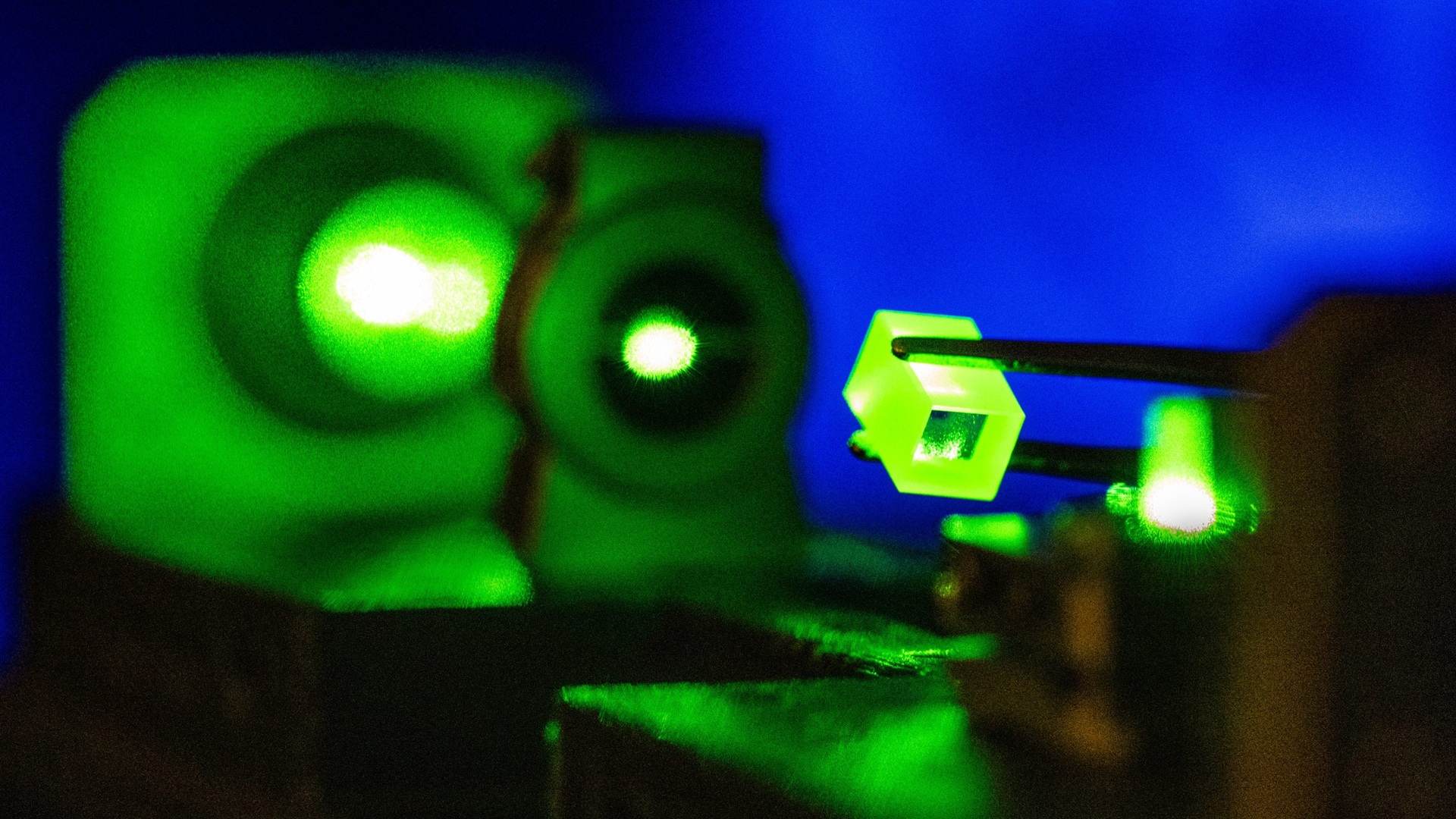
A rare earth garnet used by Sandia National Laboratories researchers to measure intense magnetic fields, such as those needed for fusion research and high-energy physics experiments.Craig Fritz A team of US researchers has developed a tiny laser-based crystal sensor that can track intense magnetic fields in some of the harshest environments, and improve diagnostics for future fusion power plants. For the sensor, the team at Sandia National Laboratories used a rare-earth garnet crystal about the size of a pencil eraser. The device can operate in conditions that often overwhelm conventional magnetic field sensors. These include intense radiation, electromagnetic interference, and fusion plasma. The sensor has been submitted for the 2026 R&D 100 Awards, which is an annual competition recognizing the world’s 100 most innovative technologies. Israel Owens, PhD, a Sandia physicist and co-inventor of the sensor, pointed out that the team is satisfied with the progress. “We think this technology is a pretty major improvement in measuring magnetic fields,” he stressed. “We think it’ll be essential especially for research in fusion, high-energy physics and the power utilities industry.” Inside the sensor The device uses a small laser, a rare-earth garnet crystal, two optical filters, and a light detector. As the laser passes through the crystal, its polarization rotates. In addition, exposure to a magnetic field changes the amount of that rotation, and allows the sensor to precisely measure the field’s strength. According to Sandia, the crystals are made from rare-earth materials like terbium scandium aluminum garnet (TSAG) and terbium gallium garnet (TGG). They are well suited for measuring magnetic fields because their optical properties change in response to electromagnetic forces. Sandia physicist Israel Owens, PhD, adjusting the optics of his laboratory system.Credit: Craig Fritz The researchers started developing the sensor in 2021. Their goal was to improve the measurements inside their Z Machine, the world’s most powerful lab radiation source. It is utilized for basic science research, studies of magnetized liner inertial fusion, and for national security applications The team tested the sensor at Sandia’s High-Energy Radiation Megavolt Electron Source III (HERMES III) and the Short Pulse High Intensity Nanosecond X-Radiator (SPHINX). The device matched the performance of conventional magnetic sensors while providing more consistent measurements in harsh environments. Owens said the sensor is more accurate and operates where conventional sensors fail. “We’ve done quite a bit of testing over at SPHINX, and we saw less statistical spread compared to conventional sensors,” he added. As per the team, the garnet-based sensor would not require frequent calibration and maintenance like conventional sensors. This could reduce operational costs. Since it’s electrically insulating rather than metallic, it also avoids problems that can affect electronic probes in radiation-heavy environments. The technology could be particularly valuable for fusion energy research, where powerful magnetic fields are utilized to confine superheated plasma. Accurately monitoring those magnetic fields is essential for understanding plasma behavior and maintaining stable reactor operation. Owens said that the sensor may eventually function inside plasma environments where conventional metallic sensors short out, and fiber-optic sensors degrade due to radiation exposure. “Our technology has the unique capability of working in areas where conventional sensors would short out,” he noted in a statement. However, the technology remains under development. After successful testing in air and vacuum, the Sandia team has begun evaluating the sensor in low-density plasma. The team ultimately plans to test it in the high-density plasma conditions required for commercial fusion systems. Bryan Oliver, director at Sandia’s Radiation and Electrical Sciences center stressed the importance of the sensor. “The magneto-optical sensor technology is a game-changing diagnostic for measuring varying magnetic fields in difficult radiation and electromagnetic environments,” he concluded. The team secured a patent in December, and one company has licensed the technology. Recommended ArticlesGet the latest in engineering, tech, space & science - delivered daily to your inbox.Based in Skopje, North Macedonia. Her work has appeared in Daily Mail, Mirror, Daily Star, Yahoo, NationalWorld, Newsweek, Press Gazette and others. She covers stories on batteries, wind energy, sustainable shipping and new discoveries. When she's not chasing the next big science story, she's traveling, exploring new cultures, or enjoying good food with even better wine.
US scientists create tiny crystal sensor to measure intense fusion magnetic fields
Full Article
Original Source
Read the full article at Interestingengineering →KhanList aggregates and links to publicly available news content. We do not host full articles from third-party sources. Always verify important information with original sources.