
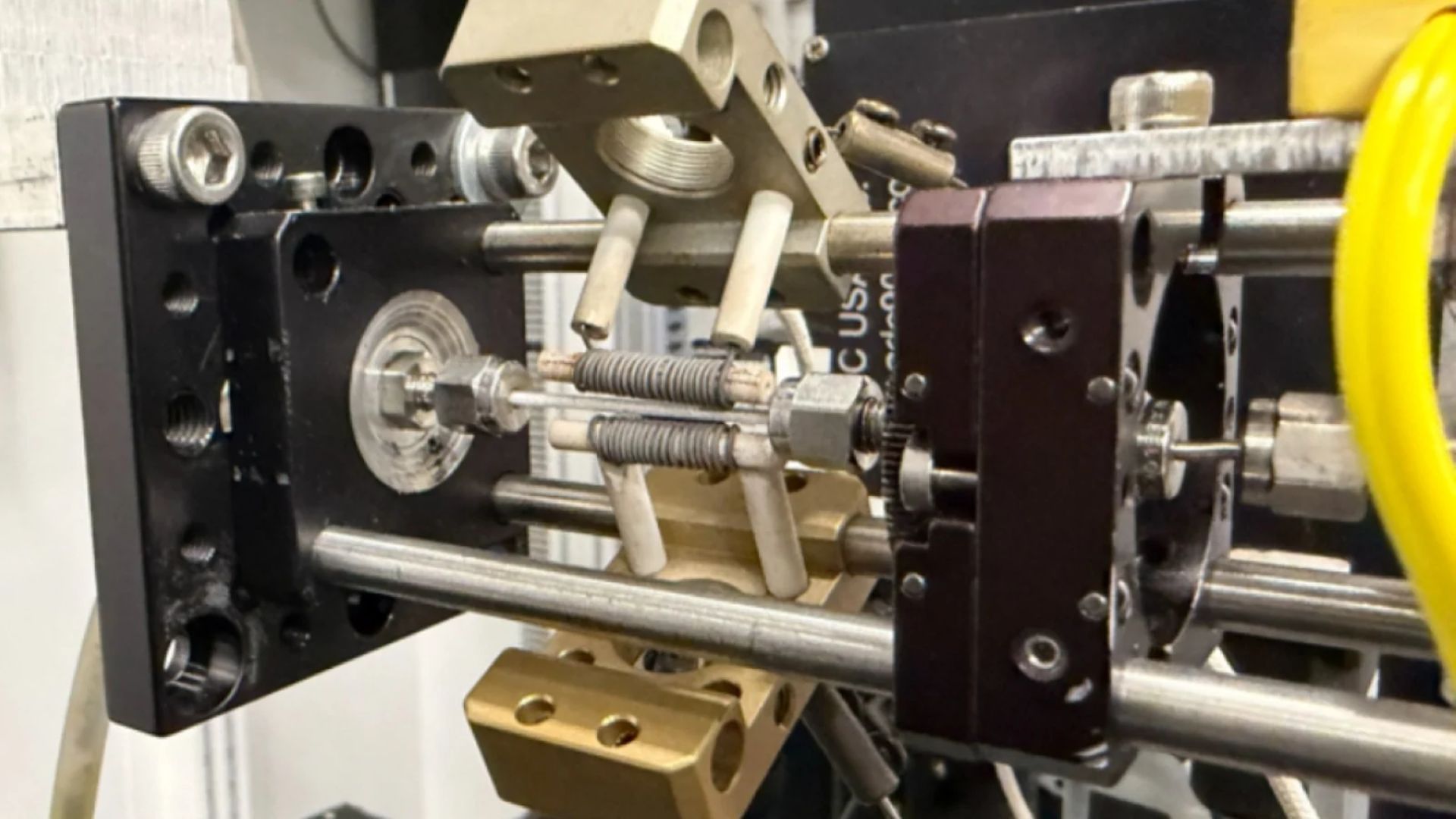
Scientists at the Argonne National Laboratory (ANL) have turned to the world’s brightest light source, the Advanced Photon Source (APS), to probe nuclear materials in real time. This will advance nuclear forensics and improve future nuclear energy production. Nuclear forensics is a critical component of global security, nuclear law enforcement, and non-proliferation efforts. Researchers can determine the origin, manufacturing, and intended use of nuclear materials through scientific examination. Different processing steps leave unique chemical signatures on radioactive material. Studying these signatures could help determine if radioactive material is being diverted from legitimate uses to unauthorized ones. However, these reactions happen so fast that studying them is extremely difficult. This is where the ANL team turned to APS, which is also an Argonne facility. What can APS do? The APS is the world’s brightest X-ray light source. It uses a synchrotron to achieve this, where particles are accelerated in a circular path to generate intense beams. This allows researchers to study the tiniest details in materials. While nuclear forensics has relied on chemical signatures observed after the reactions are complete, the APS allows for these reactions to be studied in real time. Conditions such as temperature, pressure, and the surrounding environment impact the reaction. Using the APS, researchers can observe how the reactions are occurring, the movement of the particles, and the changes occurring in them, all in real time. But to do so, the team had to build customized sample containment boxes where they could carry out the measurements. How did they do it? Since APS is used for a wide range of research activities, working with radioactive materials requires special arrangements. The research team had to work with a limited quantity of nuclear material but also also ensure that it remained in multi-layer, leak-proof containers. To make their measurements, the team designed two containment boxes: one that acts as a heated cell and the other as a flow cell. The heated cell is designed to let researchers expose the nuclear material to different gases and at different temperatures. The flow cell is designed to handle liquid samples and carries out precipitation reactions, i.e., when two liquids react and form a solid product. To establish the standard operating procedures (SOPs) with these new boxes and ensure that they can deliver accurate measurements, the team used nonradioactive materials in their tests. Later, they switched to radioactive materials for the next phase of their research. “We successfully performed plutonium precipitation at the APS using our ‘lab-in-a-box’ containment system,” said Matthew Swindall, a postdoctoral fellow at ANL working on nuclear forensics software development. “We hope that this new capability will open up a whole range of research in nuclear forensics and fuel cycle technologies.” The boxes were made using 3D-printed parts with easily available materials, thereby making them cost-effective. They can further be adapted for applications beyond nuclear forensics. “Our results aligned with already existing data. It makes me feel confident that the apparatus we built is doing what we want it to do,” said Anna Servis, principal radiochemist at ANL, in a press release. Get the latest in engineering, tech, space & science - delivered daily to your inbox.Ameya is a science writer based in Hyderabad, India. A Molecular Biologist at heart, he traded the micropipette to write about science during the pandemic and does not want to go back. He likes to write about genetics, microbes, technology, and public policy.
US scientists capture real-time nuclear reactions using world’s brightest light source
Full Article
Original Source
Read the full article at Interestingengineering →KhanList aggregates and links to publicly available news content. We do not host full articles from third-party sources. Always verify important information with original sources.