
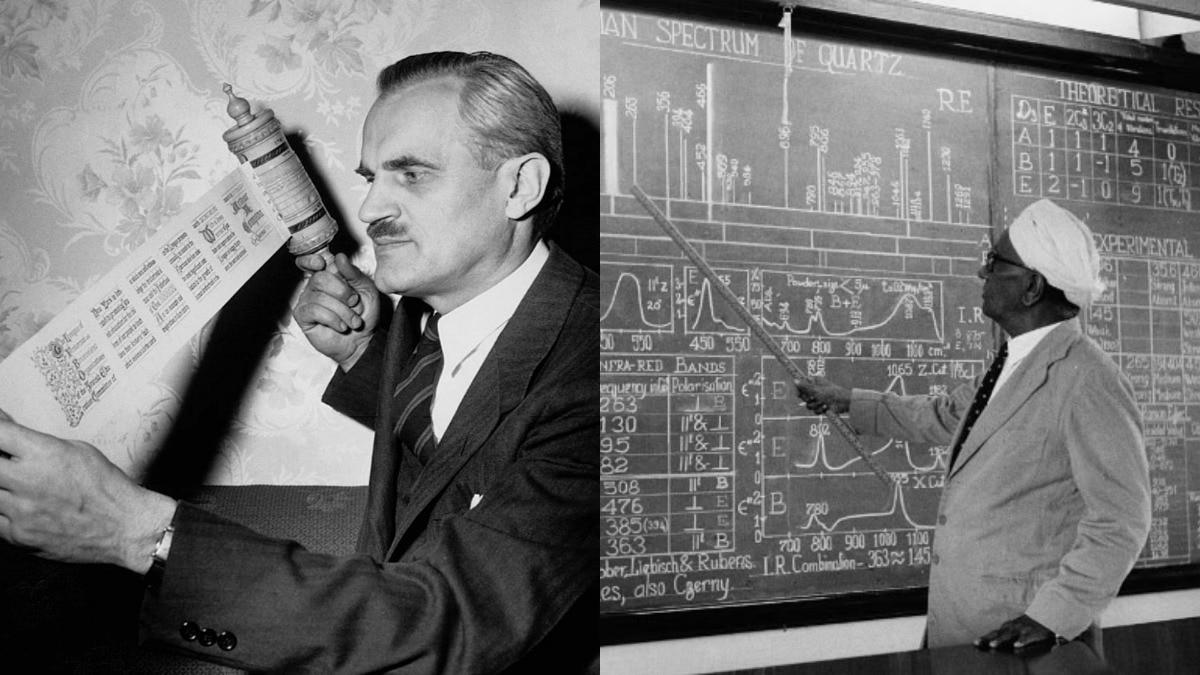
An American physicist made his way to Calcutta 100 years ago in search of an instrument, only to end up building one himself using a hookah bowl. Arthur Compton's encounter with India's pioneering physicist, CV Raman, added another chapter to his research into cosmic rays. A year later, he was awarded the Nobel Prize in Physics for his work on the scattering of X-rays. Read how an instrument improvised with a hookah bowl in Calcutta became part of Arthur Holly Compton's journey to the Nobel Prize.It is a chapter in the history of Indian science in which international research, local ingenuity and the ambitions of Indian scientists came together.New Delhi,Nov 18, 2026 16:31 ISTIn 1926, an American physicist arrived in Calcutta with a scientific problem, but without the instrument needed to solve it. The answer, as it turned out, lay in an object that would hardly have been expected to find a place in a laboratory: the bowl of a hookah. Yes, you read it correctly, it was the bowl that Indian households use in Hookah.With the help of an Indian physicist, most probably the greatest ever, he fashioned it into part of an electroscope, an instrument used to detect electrical charges. What followed was an experiment into one of the great scientific questions of the time: the nature of cosmic rays.The American was Arthur Holly Compton, a Princeton-trained physicist whose work on the scattering of X-rays earned him the Nobel Prize in Physics in 1927, just a year after his visits to Calcutta and Lahore.He would later play a crucial role in the Manhattan Project, the American wartime programme to develop the atomic bomb at the peak of World War II. His Indian collaborator was the Nobel Laureate CV Raman, whose findings into the scattering of light would bring him the Nobel Prize in 1930.Compton's journey after the Calcutta episode would take him to Lahore, where his connection with the University of the Punjab brought him into contact with another Indian scientist, Shanti Swarup Bhatnagar. Thus, an improvised instrument in Calcutta opens the door to a larger story: one that connects Raman's laboratory, Compton's cosmic-ray investigations and Bhatnagar's scientific work in Lahore.The episode, a major one in India's science history, is documented in science historian Edward B Davis's 2009 account in Perspectives on Science and Christian Faith, which draws upon Compton's own recollections.CALCUTTA: WHEN A HOOKAH BOWL BECAME PART OF A SCIENTIFIC INSTRUMENTCompton's visit to India came at a time when the scientific community was seeking to understand cosmic rays, radiation that reaches the Earth from space.The term had been introduced by American physicist Robert Millikan, while Compton was investigating the nature and behaviour of these rays.Upon reaching Calcutta, Compton learnt that he was expected to undertake an expedition to Darjeeling, in the Himalayan foothills, to investigate cosmic radiation.There was, however, a practical difficulty: he needed experimental equipment.He approached CV Raman, who was then working at the Indian Association for the Cultivation of Science (IACS) in Calcutta. The two physicists worked out a way to construct an electroscope using the bowl of a hookah. The account records that the arrangement worked.For Raman, the meeting also forms an interesting part of his association with the international scientific community.His own work on the scattering of light would soon bring him recognition. The discovery now known as the Raman Effect was made in 1928, and he received the Nobel Prize in Physics in 1930.LAHORE: FROM UNIVERSITY OF PUNJAB TO THE HIMALAYASFrom Calcutta, the story moves north to Lahore, where Compton was to spend the academic year of 1926–1927 at the University of the Punjab.He had come to India on a John Simon Guggenheim Fellowship.The appointment brought him into contact with a group of Indian scientists who were engaged in research at a time when scientific institutions in the country were seeking to establish their place in international scholarship.Among them was Shanti Swarup Bhatnagar, a physical chemist who would later become one of the principal architects of India's scientific research institutions and the first Director-General of the Council of Scientific and Industrial Research (CSIR).Bhatnagar had studied at Forman Christian College in Lahore and was then associated with the University of the Punjab.In 1926, Compton wrote to Bhatnagar about conducting further investigations into cosmic rays at a mountain lake in Kashmir. The University of the Punjab supported the expedition, which included Compton, Bhatnagar, Professor JM Benade and Dr Nazir Ahmad.The team travelled towards Gulmarg, near Srinagar and then proceeded to the Tosh Maidan region, where a lake at an altitude of approximately 17,000 feet was selected for the experiment.The researchers carried instruments to measure cosmic radiation at different depths in the water. Their observations continued through the day and night for more than a week.The expedition was recorded in Norah Richards' 1948 account, Life and Work of Sir SS Bhatnagar, and later discussed by A.K. Grover in his 2013–14 C.V. Raman Lecture at Panjab University.THE SCIENTISTS BEHIND THE JOURNEYCompton had already discovered the scattering effect that bears his name in 1922.His work established that X-rays could change their wavelength when scattered by electrons, providing important experimental support for the particle nature of radiation. He received the Nobel Prize in Physics in 1927.Raman, meanwhile, continued his investigations into the scattering of light. In 1928, he discovered the effect that would bring him the Nobel Prize in Physics in 1930.Bhatnagar's contribution followed a different course.He continued his work in physical chemistry at Lahore and later took up responsibilities in the organisation of scientific and industrial research in India.There is a historical distinction worth preserving in this account. The hookah-bowl electroscope belongs to the episode associated with Compton's arrival in Calcutta and the proposed Darjeeling investigation.The later expedition to the Tosh Maidan lake in Kashmir was a separate undertaking organised through the University of the Punjab, with Bhatnagar and other members of the Lahore scientific community.The hookah bowl may appear an unlikely object in the history of physics.Yet its place in this account reminds us that scientific progress has not always depended upon elaborate laboratories or expensive equipment. It has also depended upon the ability of researchers to understand a problem, make use of available resources and work together.A journey that began with an improvised instrument in Calcutta thus leads us to the University of the Punjab in Lahore, where an American Nobel laureate and Indian scientists pursued questions about radiation arriving from space.- Ends
A hookah bowl and an US physicist: Calcutta's century-old link to Nobel discovery
Full Article
Original Source
Read the full article at Indiatoday →KhanList aggregates and links to publicly available news content. We do not host full articles from third-party sources. Always verify important information with original sources.