
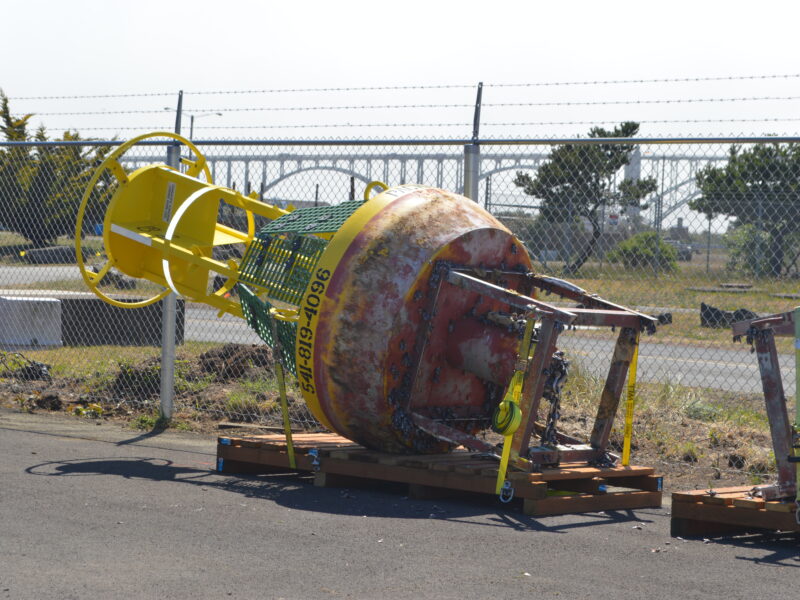
NEWPORT, Ore. (CN) — A research buoy is something like an ant: A single one might not look like much, but put a bunch together and they can make something truly impressive.In the water, a buoy becomes part of a larger system. Together, they provide all kinds of functions, from conducting ocean and weather research to helping satellites stay calibrated.Buoys can handle almost anything the sea throws at them. William Burnett, a meteorologist who has led the National Data Buoy Center since 2022, described them continuing to collect data even after being “hit dead center by hurricanes.” That’s on top of the usual sources of wear-and-tear: rain, ice, barnacles, saltwater.One of the biggest threats to buoys comes from surprisingly cute sources: seals and sea lions.“We were noticing that the buoy cables were being chewed through,” Burnett noted in a phone interview.To get around the problem, the National Data Buoy Center installed cages around the research devices. That’s mostly worked, though smarter animals do find a way to mess with them, even using them like makeshift surfboards.“If they can find the platform," Burnett said of these rambunctious animals, “they’ll get on it.”California sea lions catch some rays on a large rock in the San Juan Islands. (Lily Roby/Courthouse News)Another vulnerability for America’s national research buoy network comes in the form of public policy. Following an 80% budget cut last year by the Trump administration, the National Science Foundation began pulling research buoys from the water.The policy prompted harsh backlash: Buoys provide a vast amount of data for little cost. Congress soon restored the funds, but a NSF spokesperson said the agency was nonetheless pursuing “a nimbler approach.”Then, in June, the NSF reversed course, announcing it would start redeploying buoys. Even so, it could take months or years before the buoy network is fully back online.An anthill, after all, is more than just a collection of ants. It takes time and coordination to build one.U.S. research buoys come in two main flavors.The National Data Buoy Center operates around 100, providing information on barometric pressure, wind, humidity, sea-surface temperature and wave conditions as part of a roughly 60-year-old ocean observation network.Some of them, placed deep in the ocean, can also provide advanced warning about tsunamis. That network was untouched by the Trump administration’s cuts.Then there are the National Science Foundation’s buoys. Before the policy reversal this summer, these buoys were slated for removal. In the Pacific Northwest, many were removed from the water.These buoys are more tailored, providing information to universities and other institutions for specific areas of research. They might, for example, track algae blooms or oxygen levels — information that helps researchers understand ecosystems and lets fishers assess the health of fisheries.The Hatfield Marine Science Center's Guin Library, operated by Oregon State University, contains a wealth of weather and ocean data from the past several decades, including this 1970s buoy data log. (Lily Roby/Courthouse News)At the University of Washington, oceanographer Jan Newton is one of many scientists who opposed the NSF’s removal decision. She runs the Northwest Association of Networked Ocean Observing Systems or NANOOS, a regional ocean-observing organization that aggregates buoy data.Newton thinks the NSF reversed course “because they didn’t realize how much people were actually using their data — and it wasn’t just being used to fuel scientific papers.” Even so, she says it will take time to rebuild the network. Some technicians left the program following the budget cuts, leaving important roles empty.In an effort to raise public awareness, Newton started collecting impact statements from others who said they were impacted by the loss.At the Washington Department of Ecology, scientists Alex Fisher and Micah Horwith said they lost data on ocean acidification, making it harder to track waters that could harm shellfish and crabs. At the University of Washington, Parker MacCready said a lack of data would make it harder to know about algae blooms, affecting the university’s LiveOcean forecasting model used by regulators and fishers.Then there’s the Quinault Indian Nation in coastal Washington, where NSF buoys sat in the tribe’s treaty fishing grounds.Without this data, the tribe was “back to witnessing mortality events after they occur,” tribal fisheries biologist Joe Schumacker said. For example, they might only learn about mortality events after dead crabs started washing up on the beach. “Taking these away,” he wrote, “is a money loser, not a money-saver.”This weather research tool operated by the National Data Buoy Center is named Station NWPO3 and stands in Oregon's South Beach State Park. It tracks data such as air temperature and wind speed. (Lily Roby/Courthouse News)It isn’t just researchers and officials. In the coastal town of Newport, Oregon, commercial fishers have long worked with research groups like the local Hatfield Marine Science Center, run by Oregon State University. The center provides important data, helping keep fishers informed about fish stock and water conditions.Part of a four-generation fishing family in the area, Taunette Dixon doesn’t care much who funds or runs which particular buoy. What she cares about, she said in an interview, is making sure her friends and family get home safely after a day at sea and that they continue to have sustainable fisheries.“I want my grandkids to be able to fish,” Dixon said, “and have a hardy stock in our oceans.”Dixon and her husband fish for groundfish, crab, shrimp and occasionally salmon and tuna.Although catching Dungeness crab is lifeblood in the region, it’s also one of the most dangerous industries, not least because the season occurs during the winter when coastal waters here are cold, foggy and choppy.Dixon has heard stories about what it was like to fish in her father and grandfather’s time, before the advent of sophisticated weather-mapping data.“It was a lot riskier,” she said. “Now, we have the advantage of having a pretty accurate forecast.”Some of the most important data for fishers comes from the National Data Buoy Center, the network that the Trump administration hasn’t dismantled.Still, stories like Dixon’s show how widely U.S. buoy data gets used. It helps explain why the NSF faced such backlash, and why it’s now racing to redeploy its buoys — though only after going through the trouble of removing them. In the meantime, in a paved lot at a marine research campus in Newport, two squat buoys lay on their sides in the gravel, out of commission, part of a data-gathering anthill that just months ago was thriving.Although this buoy is purely for navigational purposes, thousands of buoys fill the rivers, inlets and seas of the Pacific Northwest. (Lily Roby/Courthouse News)Harbor seals look warily at the camera as they rest from feeding, swimming and possibly terrorizing nearby buoys. (Lily Roby/Courthouse News)Subscribe to our free newslettersOur weekly newsletter Closing Arguments offers the latest about ongoing trials, major litigation and rulings in courthouses around the U.S. and the world, while the monthly Under the Lights dishes the legal dirt from Hollywood, sports, Big Tech and the arts.Additional Reads
US research buoys are caught in currents of change
Full Article
Original Source
Read the full article at Courthousenews →KhanList aggregates and links to publicly available news content. We do not host full articles from third-party sources. Always verify important information with original sources.