
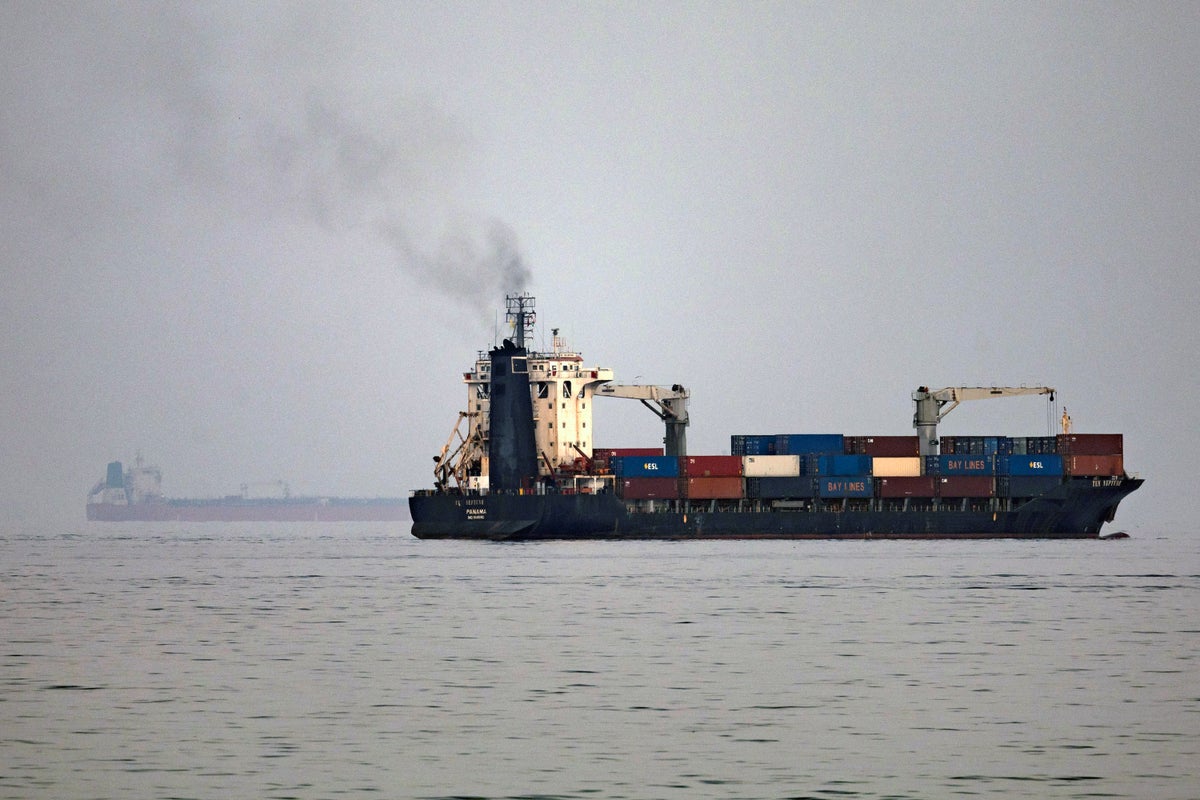
American forces disabled a commercial vessel attempting to bypass a blockade of Iranian ports in the Gulf of Oman, according to an announcement Friday from U.S. Central Command.An aerial military strike launched "precision munitions" targeting the stern of the Palau-flagged M/V Pacific Archer on Thursday, resulting in the "ship’s propulsion was ultimately disabled and the civilian crew was unharmed," the statement detailed.Central Command reported that the Pacific Archer departed the Iranian port of Bandar Abbas prior to its blockade-running attempt. Ship tracking data lists the vessel’s intended destination as Singapore.The military action occurs as the Trump administration considers its strategic choices in the ongoing conflict with Iran, which broke out in late February and has settled into a quiet stalemate in recent months.Earlier in November, regional officials informed The Associated Press that Israeli Prime Minister Benjamin Netanyahu was pressing Washington to reignite the war or grant permission for Israel to carry out airstrikes targeting Iran’s nuclear facilities and missile capabilities.The Trump administration is considering its strategic choices (Getty)Meanwhile, government and security representatives from Persian Gulf nations, along with Pakistan and Turkey, engaged in a coordinated diplomatic push—including telephone conversations with senior U.S. officials—to prevent a renewed escalation of warfare across the region.President Donald Trump has wavered between threatening fresh, large-scale bombardments against Iran and asserting that the conflict "militarily is effectively over."The U.S. military continues to deploy a substantial naval presence throughout the region, featuring two aircraft carriers on constant assignment alongside numerous auxiliary warships.Washington has enforced a blockade on Iranian sea ports since April, though operations were suspended during summer discussions with Tehran before resuming in July. U.S. military authorities say they have since diverted 158 commercial vessels, disabling any ships that refuse to obey instructions.The Pacific Archer represents at least the 15th vessel immobilized by the U.S. armed forces since blockade operations began last spring, and the sixth since enforcement resumed this summer. The previous vessel was disabled on Nov. 7.Back in June, the tactic drew international criticism after a military strike on a Guinea-Bissau-flagged tanker attempting to evade the blockade caused three fatalities.Three Indian sailors lost their lives when U.S. forces hit the Palau-flagged M/T Settebello, Indian officials confirmed at the time. The head of the International Maritime Organization, a United Nations agency, issued a condemnation.U.S. Central Command has repeatedly asserted that American forces issue numerous warnings prior to targeting merchant ships.Iran’s Revolutionary Guard stated on Friday that two oil tankers attempted to pass through the Strait of Hormuz via an "unauthorized" route, claiming one struck a naval mine while the second was compelled to turn around.Iran claimed Friday that two oil tankers tried to pass through the Strait of Hormuz via an ‘unauthorized’ route (Reuters)The reports could not be independently verified.In a statement broadcast on Iranian state television, the Revolutionary Guard added that the volume of crude tankers attempting transit through unauthorized channels in the vital waterway has declined significantly over recent days.Tehran continues warning commercial vessels against traversing the strategic maritime corridor without official authorization.Crude flows during the first two weeks of November fell roughly 20 percent to about 13 million barrels per day compared to October, when export figures roughly matched prewar levels of 15 to 16 million barrels daily, according to Rystad Energy.Factors contributing to the November drop include Iranian attacks discouraging tankers from braving the strait, alongside diminished volume through a vital Saudi pipeline to the Red Sea port of Yanbu, which has likewise endured several attacks.A report published by U.N. Trade and Development notes that ongoing disruptions across the Strait of Hormuz, the Red Sea, Black Sea, and Panama Canal are lengthening shipping routes, pushing up fuel expenses, causing port bottlenecks, and heightening market instability. Alternative ports, inland transport, and revised logistics have maintained trade, albeit at elevated costs.
US military disables another ship in Gulf of Oman after attempt to breach Iranian ports blockade
Full Article
Original Source
Read the full article at Independent →KhanList aggregates and links to publicly available news content. We do not host full articles from third-party sources. Always verify important information with original sources.