
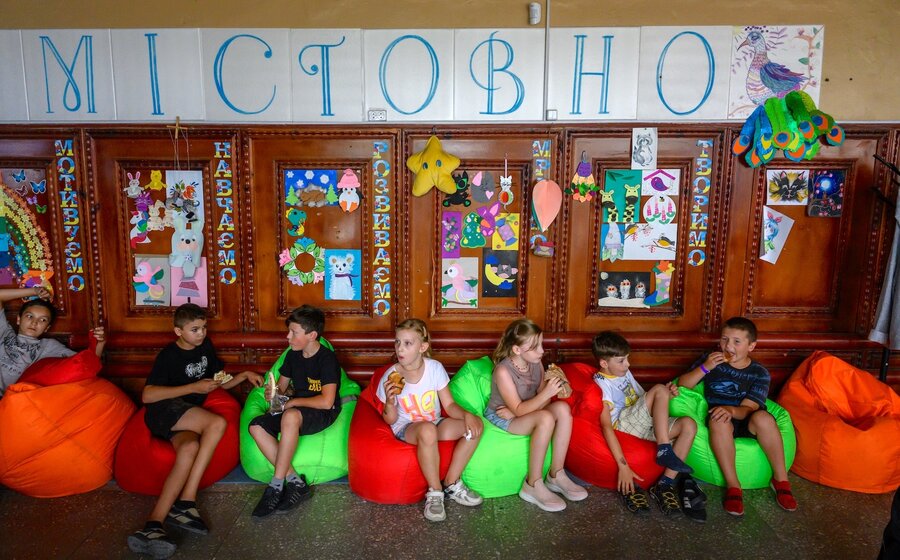
Each November marks another year (37 so far) of global agreement on a universally accepted moral principle: the safeguarding of life and learning opportunities for the world’s children. It is enshrined in the 1989 Convention on the Rights of the Child, the most widely agreed-upon human rights treaty in history. Still, conflicts in years since have targeted and forcibly involved young people in violence, often invoking localized loyalties or a bellicose nationalism.This year, the Russian government, nearly five years into its war against Ukraine, is extending its emphasis on fighting and dying for one’s country all the way down to students of preschool age. But even as the Kremlin ups its militaristic rhetoric, some parents and students are pushing back on what they see as insidious efforts to pollute or pervert youthful innocence and intellects. Their efforts are rooted in a recognition of young people’s inherent rights and ability to exercise reason, truth-seeking, and empathy.In the Siberian city of Novosibirsk, teenagers recently spoke with German media outlet Deutsche Welle about their skepticism of the official line of President Vladimir Putin’s administration. A textbook that was introduced this year “urge[s] children to prepare themselves to die for their country” and asserts that “love always involves [such] sacrifice.” In the view of one student, that would mean dying for “the president’s interests and ambitions.” The student and his peers are skirting around social media blocks and blackouts to find other points of view and facts about domestic issues as well as the war against Ukraine.There is also an increased turn to homeschooling as a way to avoid pervasive propaganda. One study found a nearly tenfold increase – to 175,000 – in the number of students in alternative forms of education between 2016 and 2023. A regional politician in Russia has since called on Moscow to make the homeschooling option “more difficult” because of the steep rise in that preference.For other families, consistent conversation and gentle correction are key to countering state influence on their young children. “It’s one thing to know history so as to avoid repeating mistakes, but it’s quite another to ... tell [children] that everyone around us is an enemy and that we alone are right,” the mother of a 4-year-old told Novaya Gazeta, an independent outlet that was forced to shut down in October. Negating the official push “to raise pseudo-patriots,” she said this past summer, requires “talk[ing] to your child” and explaining “what war is and why it is bad.”The child rights convention states much the same: “It is important in the context of education systems affected by conflict ... [that] programmes be conducted in ways that promote mutual understanding, peace and tolerance.” On the other side of the border, Ukraine’s school system – with children often studying and playing in underground bunkers – is attempting to follow that guidance. Over the past two years, the beleaguered country has altered its curriculum to include skills in survival and self-defense, primarily for older students. This, as The Kyiv Independent observed in September, “raises the question of where preparing children to survive a war ends and preparing them to fight one begins.”“A balance is needed,” Kateryna Rashevska of the Regional Center for Human Rights told the media outlet, “so that children also study human rights, the means of resolving international disputes, and international humanitarian law.” Deepen your worldviewwith Monitor Highlights.Politics with respectGet political stories with respectful analysis.There‘s a world of new ideas in everyBooks newsletter.There‘s more to life, enrich yours withCulture & Learning weekly.Follow humanity‘s discoveries withScience & Nature stories in your inbox.Gain a spiritual perspectivefrom the stories in your inbox.Want to understand the deeper impact of critical events? Learn the Monitor‘s insight.Already a subscriber? Log in to hide ads. The revamped course now includes a civics- and values-based component, designed by history teacher Tymur Demchuk. “Children should understand that defending the country is not simply about the country itself, but about the values it represents,” he told the Independent. “We value human rights, human life, and dignity. Russia represents the opposite model.”But among ordinary Russians, there might be more alignment with such universal values than is widely realized. Bring news welcomed in any home into your home45% off$110/year → $60/yearJournalism that gets above the fray and brings perspectives you won't get anywhere else.Already a subscriber? Sign in
Safeguarding children – and their innocence – in both Russia and Ukraine
Full Article
Original Source
Read the full article at Csmonitor →KhanList aggregates and links to publicly available news content. We do not host full articles from third-party sources. Always verify important information with original sources.