
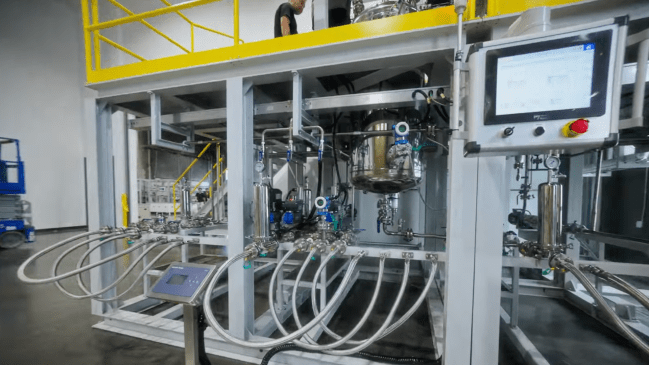
A new US battery materials facility is set to begin construction in Louisville, Kentucky, with its core technology designed to replace conventional liquid electrolytes with polymer-based materials that could make lithium-ion batteries safer, more energy-dense and more flexible. Battery tech company Anthro Energy broke ground on the facility in mid-August, describing it as the first US-owned and operated advanced electrolyte manufacturing plant of its kind. Once operational in late 2027, the facility is expected to produce about 12,000 metric tons of advanced polymer electrolyte each year, enough material for as much as 25 GWh of lithium-ion battery production. The new technology is aimed at applications ranging from electric mobility and consumer electronics to robotics, energy storage and defense systems. Polymer electrolyte replaces conventional liquid systems At the center of the project is Anthro Energy’s proprietary Anthro Proteus platform, which replaces the conventional liquid electrolyte found in lithium-ion batteries with an advanced phase-change polymer electrolyte. Electrolytes are essential to lithium-ion batteries because they allow ions to move between the cathode and anode during charging and discharging. Conventional liquid electrolytes, however, can create safety and design challenges, including the risk of leakage and thermal runaway under certain conditions. Anthro’s polymer-based approach is designed to address some of those limitations while remaining compatible with existing lithium-ion battery manufacturing infrastructure. The company says the material can improve battery safety and energy density while providing manufacturers with greater flexibility in battery design. Because it is intended to work with existing production processes, the technology could potentially be adopted without requiring an entirely new battery manufacturing ecosystem. That compatibility is particularly important as manufacturers look to improve battery performance while keeping efficient production costs and infrastructure changes. Facility aims to scale advanced battery materials According to Anthro Energy, the Louisville facility is expected to begin commercial production in late 2027. Its planned annual output of 12,000 metric tons would support up to 25 GWh of lithium-ion battery production across various industries. The company also says the plant will use inputs that are free from Foreign Entity of Concern restrictions from the beginning of operations, positioning it as a domestic source for a critical battery material. The project is backed by close to $25 million from the US Department of Energy under the Infrastructure Investment and Jobs Act, along with $18.4 million in investment tax credits through the Inflation Reduction Act’s 48C Advanced Energy Project Tax Credit Program. Its location in Louisville also places the facility close to the growing US Battery Belt, allowing Anthro to supply automakers, battery manufacturers and other industrial customers across the South and Midwest. The company notes that the facility will help establish a domestic source of advanced electrolyte materials at a time when battery manufacturers are seeking greater control over their supply chains. If the technology scales as planned, the plant could provide more than a new source of electrolyte materials. It could also demonstrate how polymer electrolytes can move from laboratory and pilot-scale development into large-scale battery manufacturing, potentially contributing to safer and higher-performing lithium-ion batteries across multiple domains. Get the latest in engineering, tech, space & science - delivered daily to your inbox.Bojan Stojkovski is a freelance journalist based in Skopje, North Macedonia, covering foreign policy and technology for more than a decade. His work has appeared in Foreign Policy, ZDNet, and Nature.
US: Lithium battery materials plant supporting 25 GWh of cell production breaks ground
Full Article
Original Source
Read the full article at Interestingengineering →KhanList aggregates and links to publicly available news content. We do not host full articles from third-party sources. Always verify important information with original sources.