
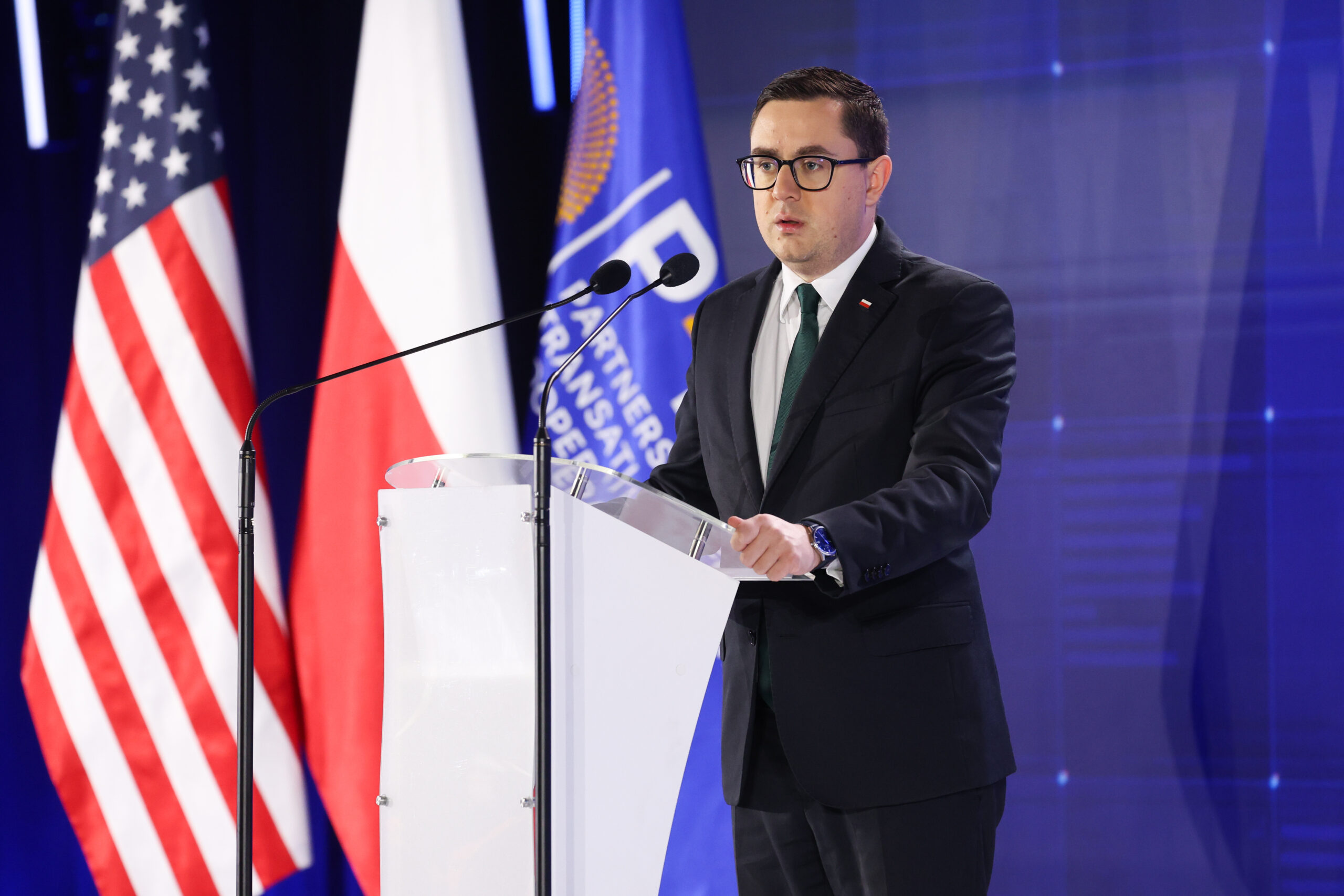
Watch the event Event transcript Uncorrected transcript: Check against delivery MINISTER MIŁOSZ MOTYKA: I would like to welcome you once again cordially to Warsaw, to Poland, during the second day of the most important conference on transatlantic cooperation—the most important conference that is going to define the future of energy and our security for the coming months, years, but I believe that also for the coming decades. Welcome to Poland, fastest-growing economy in the European Union. And I’d like to thank our friends from the United States. Poland has the privilege to participate in the work of the Group of Twenty to express a strong voice of the entire region. Transatlantic cooperation is a foundation of security of our region and is a guarantee of the security of Europe. It’s not a truism. It’s not a slogan. For years, it’s been about facts and decisions. I’m not going to talk about slogans; I’m going to talk about where we are thanks to this cooperation—thanks to the fact that this cooperation, built on trust, shared values, building an axis of good has led us to affluence. For years, our region needed new growth engines. It was a region that tried to regain independence. We were often asked whether we are the East or the West and who should decide about our future. Our region today, Central and Eastern European region, is a key region for all of Europe. It is us who will and who are defining the future of Europe, in the East and in the West. For that, we need transatlantic cooperation. For years, this cooperation was a guarantee of our security—military security, after years of wars and conflicts. Permanent presence of the United States and transatlantic cooperation was a foundation of our security. We’re not going to veer off this road; we are going to reinforce the access of good. It’s our fundamental task. In the moment where we find ourselves as Central and Eastern Europe, the dominating voice of the European Union, we need new growth engines. We are at a special moment. Global crises in different spots around the world affect not just companies, administrations. Yesterday, we had a day dedicated to business and administration. Today, we’re going to focus on the citizen, because we are countries and economies that are based on democratic values. It’s the voice and decisions of the citizens that are paramount to us. And this is what citizens expect from us: easy, good regulations to create jobs; cheap energy; building new capacity; and being at the forefront of the race for new technology. Europe today has to go back to its roots. Europe has to go back to entrepreneurship, has to focus on labor. We have to be strong with what we are manufacturing. We need to yet again redefine our objectives. Energy is everything. It’s one of the slogans that our friend the secretary of energy of the United States, Chris Wright, is emphasizing often: Without energy, there is no security of Europe. Energy today is the engine of growth that can guarantee growth to our companies and cannot be in any way a factor that would lead to the restriction of development of Europe. For centuries, for ages, Europe was where ideas came from, people came from, technology came from. It powered the growth of the world. Europe was where the world was looking to. Other continents, other economies were looking to Europe. I would like us—this conference emphasizes the value of transatlantic cooperation, and I’d like you to leave this conference with a strong voice of the region that Europe again can build its industry, its technologies, and to be a leader in this race for new technologies. We cannot do that, however, without easily available energy, without new investments, without investments in our industry which will drive us for years to come. Today, the key objective that we should specify at the level of the European community that we’re part of and we’re proud of, which is an area of security and development. For years, Europe was affected by wars/conflicts, and thanks to the European Union we can say that we are secure and we are able to build a safe future for our children. But the main goal for the European Union today is going back to high economic growth, focusing on entrepreneurship, on businesses. When we have economic growth, all the other goals—climate goals, environmental goals—will also become feasible. But Europe cannot lose its competitive edge. We cannot lose the strength of our industry. Europe cannot allow for other economies to grow faster, trying to encroach on our market and make our economies dependent on themselves because they have cheaper energy, they have simpler regulations, and because European companies find it easier to grow elsewhere. We need to go back to a zone of growth and entrepreneurship in Europe. Today there is policy, European policy, that requires certain adjustments that we are co-shaping in a democratic way. We, as part of the Partnership for Transatlantic Energy Cooperation, focus on nuclear energy. Years of crises prove to us the lessons we should learn from them. There’s no reason for us to keep making the same mistakes over and over again. Today, Europe wants to talk about clean energy, available energy. It has no alternative; it has to focus on nuclear, both large-scale and SMRs. Europe should not be afraid of ready sources. We need them. Europe should listen to the voice of its industry and businesspeople. Our administration, our government, can proudly say today that Poland is the twentieth-largest economy in the world. But we will not get there if, instead of deregulation, we will be creating more red tape; if we were imposing further restrictions on businesses, rather than listening to them. It’s thanks to entrepreneurs, the industry, the Polish economy is climbing up the ladder of the most-developed economies in the world. I’m saying this not only to show you the strength of Polish businesses such as Orlen, which is ahead of Gazprom, Lukoil, and other Eastern companies, but I’m saying this for you to be certain that we have a tested strategy that is leading Poland’s economic growth and to make Poland the best place to live. Proof of our cooperation, the agreements and memoranda that we signed, and the decisions that we’re making in Brussels, in your capitals, in your countries, should be perceived as an expression of partnership. Because this partnership, this cooperation, is not just a word; it’s a guarantee that every citizen in Slovakia, and Croatia, and Czechia, Hungary, all the countries of our region, with whom we have excellent relations, these citizens need to feel that it all makes sense, that we’re meeting here in Warsaw today for every single citizen to have cheaper energy, for businesses to grow, and for jobs to be secure. Today, during discussions, during many ministerial panels, we should yet again prove and demonstrate that this cooperation is a response to risk—that we’re no longer egoistic, we’re not turning away from one another, we’re not trying to dig holes under one another, but where we’re focusing on is shaking hands and lending a helping hand, not just in moments of crises but also when new businesses are coming to our region. Why will we be competitive? What was building the places where we are living for years? The fact that businesses are able to grow in a solid regulatory framework. We were not impeding one another’s growth. American companies can build their presence here. They can add jobs. Other companies from other countries are also most welcome, not because they are colonizing us; we would like to benefit from your experience. Our government, the Polish administration, is an open place for investment, and we’re ready to welcome you to Poland with your investments and your experience. And also, something that defined Europe for years was pragmatism, well-defined goals. I spoke about goals, entrepreneurship, the key goal. But on our way to this goal, at every step we should remember the word—idea of cheap available energy and entrepreneurship. Not ideology of any imposed goal; it’s about pragmatism, pragmatism that built the strength of Europe in previous decades. Today, we are here in Warsaw, and this is a groundbreaking moment. Geopolitical crises show the strength of economies, and they need to be addressed. I am convinced that Central and Eastern Europe—which, like no other region globally over the last thirty years, thanks to solidarity, thanks to boldness and determination, transformed so quickly and is growing so fast, and offers new jobs—will be the region that will set the tone of discussions in Europe and will be a strong partner for the United States of America in creating a new security architecture globally. Let’s be pragmatic, let’s be open to entrepreneurship, and let’s be honest with one another. Let’s build our partnership on trust, just as we’ve been doing it so far. Thank you very much. SECRETARY CHRIS WRIGHT: Good morning, everyone. Energy is life. It is critical that we not get energy policy wrong. The downsides are huge. The upsides are gigantic for getting energy correct. So, as we talk about energy policy in the future, I think it’s always—any discussion of the future should always be informed by a view of the past. Last night, I spoke about a thousand years ago, starting here in Europe. Today, we’re only going to go back twenty years, and I’m going to talk mostly about the United States. The experiences in the United States, I think, can help inform the decisions Europe makes looking forward. Twenty years ago, the United States was by far the world’s largest importer of oil in the world. China holds that title today. Twenty years ago, the United States was by a fair margin the largest importer of natural gas in the world. China’s also taken that title from us. We had natural gas prices in the United States in inflation-adjusted terms three times what they are today. We had oil prices over twice as expensive in inflation-adjusted terms as they are today. The United States was looking to build LNG import terminals because our demand for natural gas was growing but we were not able to grow our production of natural gas. That’s in spite of the fact that we were running 1,200 rigs drilling for natural gas, four hundred or five hundred rigs drilling for oil—about the same number as we have drilling for oil today. But with those 1,200 rigs drilling for natural gas, we were growing our imports. Today, the United States runs 125 rigs for natural gas, roughly a 90 percent decline. We’ve more than doubled our natural gas production, and we have become by far and away the world’s largest exporter, with easy to grow our production dramatically from where it is today. It’s limited only by the ability to move that gas, to have a place to put it, whether it’s more industrial consumption in the United States, it’s more exports to our friends and allies abroad, most critically here in this room to our friends and allies in Europe. Today, we have 160 million tons per annum of capacity for natural gas exports. And roughly the same amount approved, and a good bit of it under construction, additional will again double US natural gas exports in the next five to—five to eight years. That resource is just immense. In oil, we went from, as I said, the largest importer of oil in the world—we’ve more than tripled our oil production—and today are a significant net exporter of oil and refined products. In fact, the second-largest export from the United States of America is oil and refined oil products, and the third-largest export from the United States of America is LNG, and that’s our fastest-growing export. That’s the shale revolution. The shale revolution just transformed the American energy situation, to the enormous benefit of our country but I think it’s important to say to the enormous benefit of the world—of the world. We have dramatically lowered global oil prices and natural gas prices from where they otherwise would be, and there’s room to run there—to continue to grow production, to continue to put downward prices on—not just in the United States, but to our friends and allies abroad. The key with natural gas is to build infrastructure. If you can move natural gas on pipelines and you have receiving terminals and you buy it long term and you buy it in volume, it’s just an amazingly cheap energy source. And you can do almost anything with natural gas. It’s the biggest source of electricity in Europe. It’s by far the biggest source of electricity in the United States. But less than 40 percent of the natural gas we consume in the United States is used for electricity generation. That’s just one use of natural gas. We use it for home heating, commercial heating. It’s the biggest fuel of our industrial activities. We make fertilizer out of it. We make petrochemicals out of it. It’s a rapidly growing transportation fuel. In fact, you will see not just in the United States but around the globe a significant reduction in diesel demand because people are going to switch to trucks running on natural gas—much cheaper, much more abundant, burns cleaner. If climate policy in Europe was really about greenhouse gas reductions, you would be running down the road of changing long-haul trucks from burning diesel to burning natural gas. If it’s about politics, well, natural gas is still evil because it’s a hydrocarbon. But if it’s about emissions reduction, it’s a very different trajectory of where to go. So the macro story for the United States with energy, because of entrepreneurship, because of freedom, is an incredibly positive story. Yes, we had administrations at the federal level that tried to stop this. Yes, we’ve had states that have crushed this. But at a federal level, private property rights, private property, and state property have allowed development of the shale revolution. The federal lands in the United States have often been impeded and have not seen the development and the benefits of the shale revolution. But in spite of some politicians’ efforts, we’ve overall achieved tremendous success. We want to make sure that success benefits not just America, but our friends and allies abroad. As I’ve said multiple times, Poland has been an ally of the United States since the United States’ Declaration of Independence. Central Europe, as I’ve also said, all the nations represented here at P-TEC, you are the growth engines. You are the driver of Europe’s future. It is not the drivers of Europe’s past that will define Europe’s future; it’s you. It’s everyone in this room. Let me give examples of some choices you have, and I know which choice I believe you will embrace. But choose energy addition. Choose freedom. Choose prosperity. Choose optimism for your kids and your futures… So, as you look at the states in the United States, if I look back that same twenty-year time period, I look at the price of electricity in New York state and the price of electricity in Florida, they were about the same. In fact, you would think they would be much lower in New York. New York has awesome hundred-year-old hydropower assets. It’s got nuclear power plants. It had coal plants. It’s got natural gas plants. Look at Florida. Florida is this huge peninsula. It’s the world center of hurricane damage. Imagine the cost to maintain power lines in Hurricane Alley. Florida’s got a rapidly growing population. And Florida doesn’t have any meaningful energy resources in Florida, where New York on the other hand has the Marcellus and Utica Shale underneath it, the greatest developed shale gas resource on planet Earth. Its neighbor to the south, Pennsylvania, has been all-in developing the Marcellus Shale; New York outlawed it. Hence, they’ve denied the economic opportunity for the rural residents of New York state. But New York followed what are called climate policies, but I think if you’re honest and if you do the math, these aren’t really climate policies. New York has made energy expensive in its state, and what does that mean? … New York’s climate policies, have not really driven anything for climate change; they’ve just made it hard to do business in New York, manufacturing, or any energy-intensive business. So those businesses just moved to other states. They didn’t reduce those emissions; they just moved them. When Europe has exported—Western Europe has exported its industry, those emissions don’t disappear; they go to Asia. There’s one atmosphere. If you want to have total emissions reductions, you have to have better energy sources. You have to have energy addition. Moving emissions doesn’t count. Making people poor and struggling to afford their heating bills so they have to turn their thermostats down, that may be a minute reduction of emissions but it’s a much larger increase in poverty and risk of death, particularly for older and people in poor health in the winters, where mortality spikes. Five to ten times more people die of the cold than die of the heat. When you make energy expensive, you make life a little bit deadlier. Now, what did Florida do? Florida didn’t follow the same policies as New York. It said that electricity and energy in general, it’s for humans. We want to make people’s lives better. We want to give them more opportunities. We want to deliver affordable, reliable, cheap electricity. They just followed different choices. Today, electricity prices in Florida are one-half of what they are in New York state. That was a choice. New York had the energy resources and said no. Florida doesn’t have any domestic energy resources in its state, but it said we care about our people, we care about our future; they made different choices. The outcome of that? You look over the last ten years, GDP growth rate in Florida, just under 4 percent average compound annual growth rate. It’s Poland-like economic growth rate in Florida. What has New York done over the last decade? Less than 2 percent compound annual growth rate. This is in the financial capital of the world. New York has so much going for it, a very wealthy state that made bad choices and made itself relatively much less wealthy. These are choices. Nebraska, rural Nebraska, big in ethanol production, but like almost all states in the United States and countries in Europe, its two biggest energy sources by far is natural gas and oil. It doesn’t produce them in Nebraska; it just buys them via pipelines. Nebraska, as well, thought about its citizens first. It has the third-cheapest electricity prices in the United States. It has enormous amounts of investment pouring into the state—new manufacturing, new mining, artificial intelligence manufacturing. Just choices. California, on the other hand, was the third-largest oil producer in the United States. It has unbelievable energy resources. But it decided, politics—and again, politics guised in the name of climate policies. California, like Western Europe, did a lot of climate policies that did nothing to reduce global greenhouse gas emissions. In fact, I would say they’re counterproductive because they slow innovation. They slow where investment goes. California, a state with everything going for it, delivered the highest electricity prices in the United States except for Hawaii, because Hawaii’s an island that burns diesel for its electricity. But it’s going to switch to burn natural gas for its electricity and bring its own prices down. California’s biggest source of electricity by far natural gas. Second-biggest source? Imported from other states. They have the highest adjusted poverty rate of any state in the nation. If you’re rich, you’re in artificial intelligence, you’re in advertising, or you’re in finance, California’s awesome. I lived there for nineteen years. If you weren’t lucky, you didn’t win the genetic or birthplace lottery and you’re working-class in California, it’s a very rough place to live. Shouldn’t be that way. That’s choices the government of California made to make it harder, particularly for middle- and lower-income people, to realize their dreams. So New York and California have another thing in common: net population outflow. Americans—far more Americans leave California than move into California. In fact, it’s a problem with U-Haul. There’s way more trucks leaving California for people moving out. They have to drive those trucks back empty to come back into California for the next people to move out. People move into California, but far more move out. Same thing for New York state. Florida’s the opposite, right? People are running into Florida. Florida, much smaller economy, much smaller number of people, produces more electricity than all of California. In fact, Pennsylvania, not a—not a world-famous state, produces more electricity than California. Choices are what drive energy conditions in your countries and they’re what design economic opportunities for your citizens. So it is a time for choosing. All of you in your states, it is a time for choosing. We welcome you. Please join the United States in energy addition, in freedom, in prosperity and opportunity for yourselves, for your children, and your grandchildren. Please don’t either have imposed on you or succumb to the choice of energy subtraction. Energy subtraction leads to the cessation of economic growth. It leads to the moving of emissions to other jurisdictions where energy-intensive industries will go. It leads to reduced life opportunities, reduced optimism, not just for you but for your kids and your grandchildren. America loves this region of this world. We want to be your partners in bringing natural gas—low-cost, at-scale natural gas. We want to take our American nuclear renaissance and spread it together with you across your nations to bring better opportunities and better lives for all of our citizens. God bless you all. Join us. Choose freedom. Choose opportunity. Choose energy addition. Thank you so much. Watch the event Image: Miłosz Motyka speaks at the seventh Partnership for Transatlantic Energy Cooperation on November 19, 2026.
US Energy Secretary Chris Wright and Polish Energy Minister Miłosz Motyka on why Europe’s security depends on its energy supply
Full Article
Original Source
Read the full article at Atlanticcouncil →KhanList aggregates and links to publicly available news content. We do not host full articles from third-party sources. Always verify important information with original sources.