
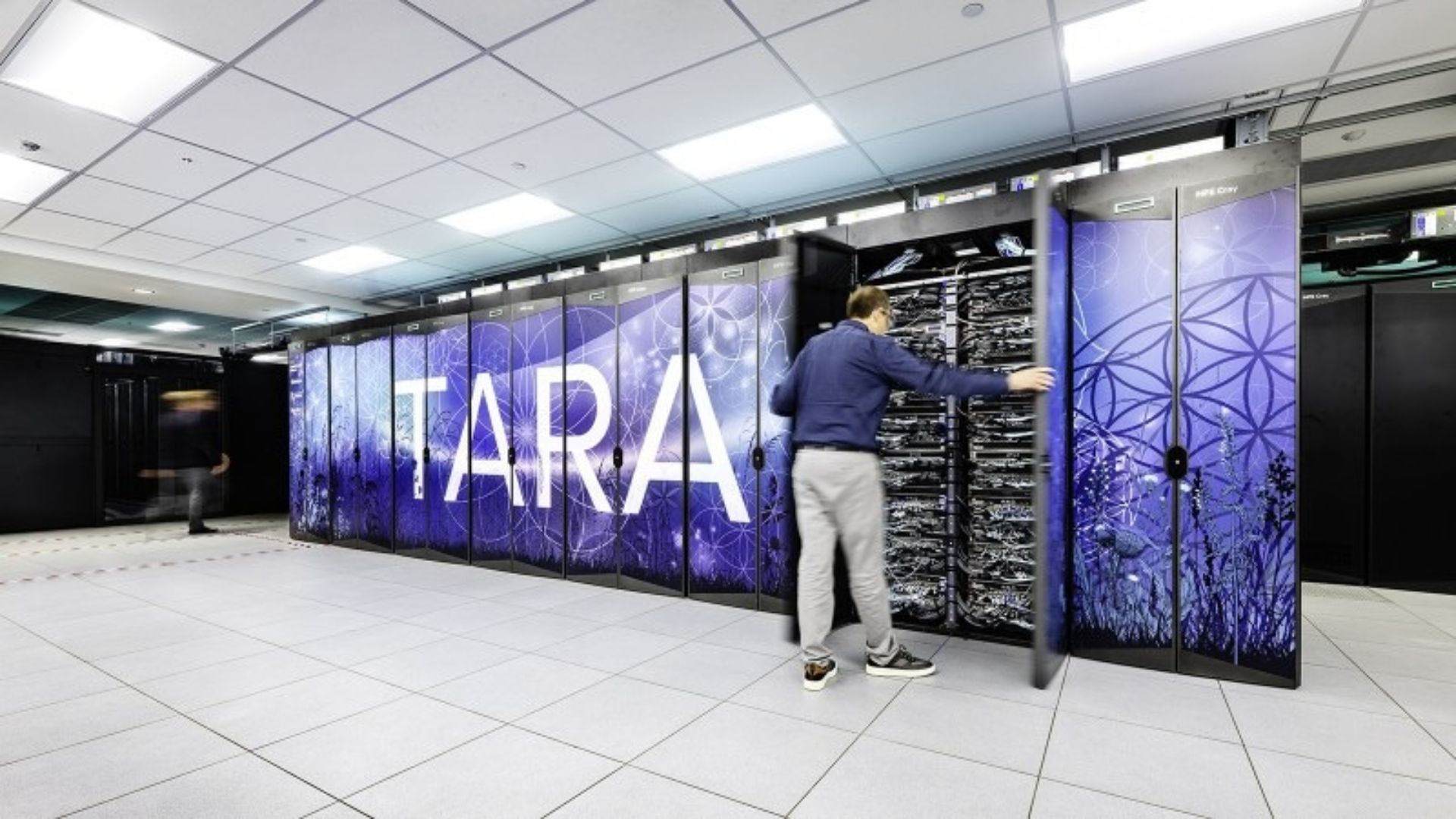
Argonne National Laboratory’s Argonne Leadership Computing Facility (ALCF) is expanding its inference service, led by the deployment of a new large-scale system called Tara, built on supercomputing architecture. The expansion brings a wider array of AI/super intelligence (SI) models and agentic workflows directly into scientific research. The upgrade arrives at a pivotal moment for American science. Going beyond simple prompts, researchers can now use autonomous AI agents to plan experiments, write code, and run lab instruments at scale. “The ALCF has long provided the computing resources researchers need to pursue science at scale,” said Venkat Vishwanath, SI team lead at the ALCF. “As inference and agentic workflows take on a growing role in science, we are evolving to provide new services and tools that complement our computing systems and help scientists be more productive in their research.” Advancement in memory and speed Tara is a powerhouse built alongside Hewlett Packard Enterprise (HPE) on its exascale-class HPE Cray Supercomputing EX4000 architecture. The supercomputer packs 672 computing nodes and 2,688 NVIDIA GH200 Grace Hopper Superchips. Tara delivers roughly 100 times the GPU memory previously available on the platform. Tara does not stand alone. Argonne also unveiled Minerva, an eight-node system built with World Wide Technology and powered by 64 NVIDIA B200 GPUs. At the same time, the lab tripled its Metis platform to six SambaRacks equipped with 96 SambaNova SN40L chips. Paired with the existing Sophia platform, this hardware expansion supports more than 50 advanced models, including open-weight large language models, scientific foundation models, and computer vision tools. All of these capabilities operate inside a secure, on-premises environment built to safeguard sensitive research data. Real-world science in motion Offering inference as a shared national resource gives individual research teams affordable access to massive AI models via APIs or a chat-like interface. These scientific agents connect directly to supercomputing power and specialized tools to prepare simulations, optimize code, and analyze experimental data in real time. “We’re moving to a point where agentic workflows are playing a much bigger role in the scientific process,” said ALCF Director of Science Katherine Riley. “We’re seeing researchers put agents to work to connect scientific tools, automate multistep calculations and data analysis, and use experimental results to help determine what to investigate next.” Early applications already show how this infrastructure accelerates the Department of Energy’s (DOE’s) Genesis Mission for discovery science, national security, and energy innovation. Argonne’s ChemGraph framework turns plain descriptions of chemistry and materials problems into automated simulations and analyses. Meanwhile, the SYNAPS-I project demonstrated autonomous experiments at a DOE light source, where an AI agent scanned a microelectronics sample, analyzed the visuals with computer vision models, and steered the instrument directly to a target boundary. For scientists across the ALCF user community and DOE national laboratories, the limiting factor is shifting from access to raw computing power to imagination. Vishwanath highlighted the payoff of embedding inference directly into simulations and experiments. Researchers can now tackle far larger problems and move from an initial spark of an idea to a breakthrough faster than ever before.Get the latest in engineering, tech, space & science - delivered daily to your inbox.Mrigakshi is a science journalist who enjoys writing about space exploration, biology, and technological innovations. Her work has been featured in well-known publications including Nature India, Supercluster, The Weather Channel and Astronomy magazine. If you have pitches in mind, please do not hesitate to email her.
US deploys supercomputer with 2,688 NVIDIA chips to accelerate scientific discovery
Full Article
Original Source
Read the full article at Interestingengineering →KhanList aggregates and links to publicly available news content. We do not host full articles from third-party sources. Always verify important information with original sources.