
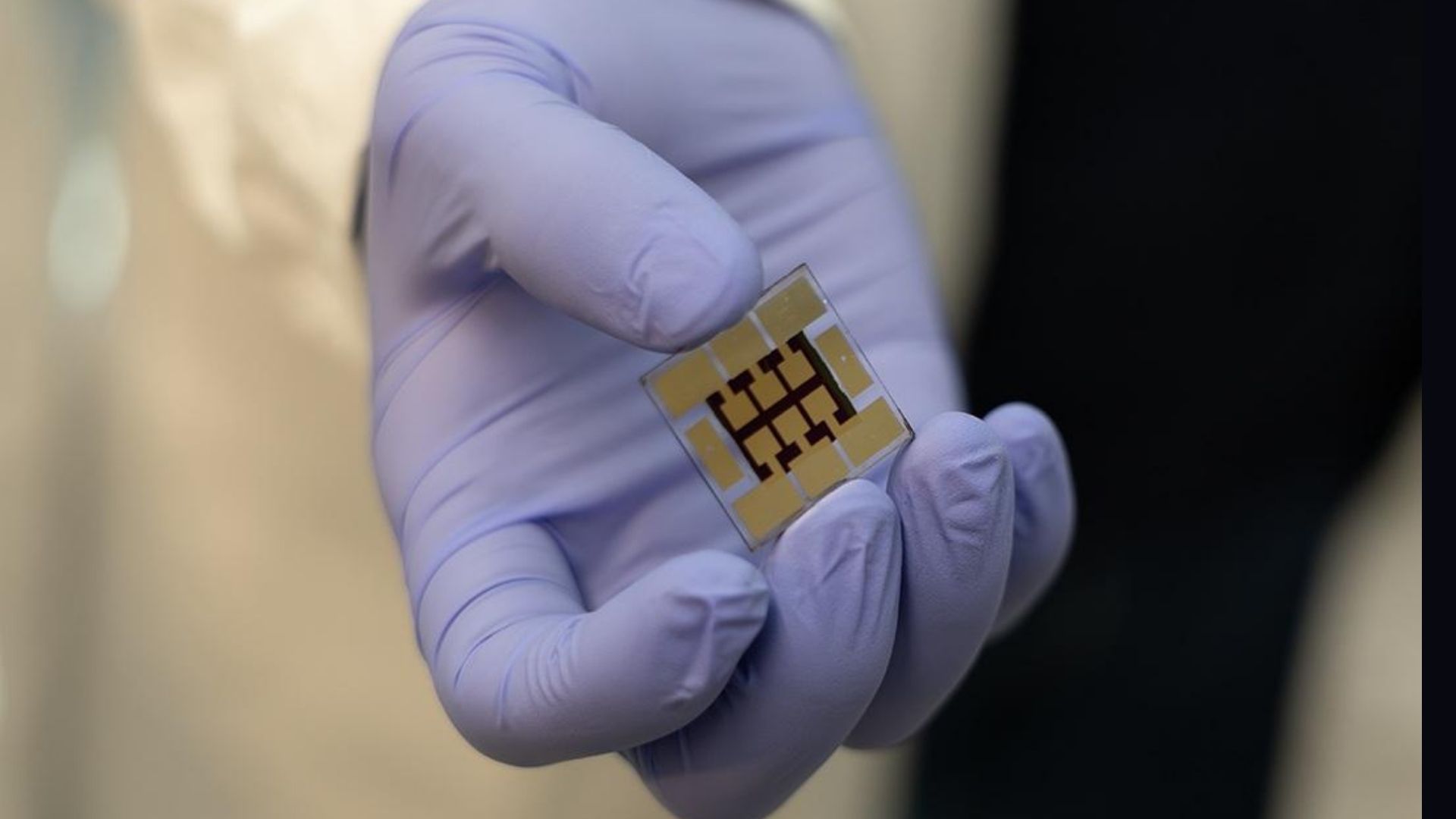
Remember those solar-powered calculators that seemed to work forever without a battery? A new generation of indoor photovoltaic technology is taking the same basic idea much further, using advanced semiconductor materials to harvest the relatively weak light found inside buildings. Researchers at Penn State have developed a perovskite-based thin film designed specifically for indoor lighting. The team improved both how efficiently the material absorbs indoor light and how well it maintains its performance when exposed to brighter light for extended periods. The team published the findings in APL Energy. Tuning a solar material for indoor light Conventional solar cells are designed to capture a broad range of sunlight. Indoor photovoltaic devices face a different problem: artificial lighting is much weaker and has a narrower spectrum. That means a material optimized for sunlight is not necessarily the best choice for harvesting light from LEDs or other indoor sources. The Penn State team addressed this by changing the bromine-to-iodide ratio in the crystal structure of its metal-halide perovskite. The researchers produced six different compositions and gradually shifted their optical properties toward wavelengths commonly available from indoor lighting. The composition containing 35% bromine performed best in their experiments, according to the researchers. The work also highlights why indoor photovoltaics can require different material designs from conventional solar panels. Rather than maximizing absorption across the entire solar spectrum, researchers can tune the semiconductor’s bandgap toward the narrower spectrum of artificial light. A thin film designed to last longer The researchers also worked on the way the perovskite film itself forms. During fabrication, the materials are dissolved in a solvent and then crystallize as the solvent evaporates. The team replaced commonly used chlorobenzene with dichlorobenzene as an antisolvent, a change based on earlier work by members of the research group. The goal was to produce a more uniform film with compact crystal grains and fewer voids and defects. Such defects can interfere with the movement of electrical charges and reduce photovoltaic performance. The final step was adding phenethylammonium bromide (PEABr) to the surface of the perovskite. The salt forms a passivation layer that helps protect the material from defects and degradation under prolonged illumination. During testing, the resulting device showed no decline in performance over 240 hours at high light intensities. The researchers estimate that the device could remain stable for thousands of hours based on the observed trend. That estimate, however, is a projection rather than a demonstrated operating lifetime. The tests were also conducted at light intensities roughly 10 to 50 times higher than those required by a recently proposed consensus framework for evaluating indoor photovoltaics, corresponding to about 8% to 50% of sunlight’s intensity. Small electronics could be the target The potential applications are less about replacing rooftop solar panels and more about eliminating batteries and wired power from low-energy electronics. Devices such as smart thermostats, sensors, remote controls and some wearable electronics could potentially operate by continuously harvesting ambient light rather than relying entirely on disposable or rechargeable batteries. But commercialization still faces a major obstacle: durability. A 2026 Penn State review of perovskite indoor photovoltaics noted that reported efficiencies have exceeded 44% in some devices, while relatively few studies have systematically reported long-term stability using standardized protocols. The researchers argued that better stability testing will be essential for determining how laboratory results translate into real-world lifetimes.The new Penn State device therefore represents less a finished replacement for batteries than another step toward making indoor light harvesting practical. If researchers can continue improving both stability and measurement standards, the humble solar calculator’s basic concept could eventually become useful across a much wider range of connected devices.Get the latest in engineering, tech, space & science - delivered daily to your inbox.Kaif Shaikh is a journalist and writer passionate about turning complex information into clear, impactful stories. His writing covers technology, sustainability, geopolitics, and occasionally fiction. A graduate in Journalism and Mass Communication, his work has appeared in the Times of India and beyond. After a near-fatal experience, Kaif began seeing both stories and silences differently. Outside work, he juggles far too many projects and passions, but always makes time to read, reflect, and hold onto the thread of wonder.
US boosts perovskite films’ performance for indoor solar power with 35% bromine recipe
Full Article
Original Source
Read the full article at Interestingengineering →KhanList aggregates and links to publicly available news content. We do not host full articles from third-party sources. Always verify important information with original sources.