
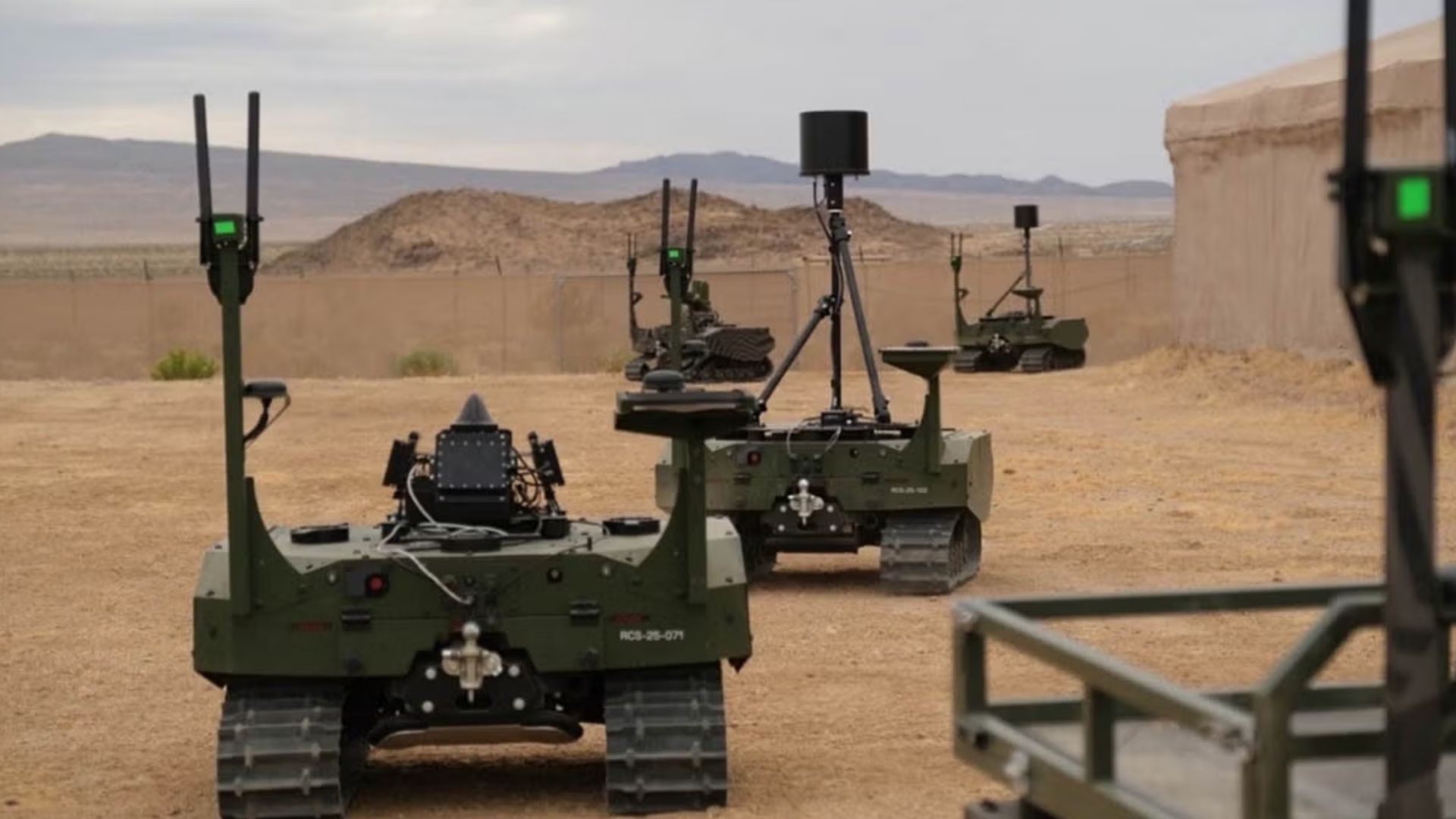
L3Harris Technologies and ARX Robotics have demonstrated a robotic ground vehicle carrying a counter-drone sensing system during the US Army’s Project Convergence-Capstone 6 experimentation campaign. The concept is relatively straightforward. Instead of placing soldiers and electronic warfare equipment near a likely drone threat, put the sensor on a remotely controlled robot and send it forward. For the demonstration, L3Harris mounted its CORVUS-RAVEN counter-drone capability on ARX Robotics UK’s GEREON uncrewed ground vehicle. The system was used to explore how mobile robotics could extend the reach of passive drone detection into forward or hazardous areas while operators remained elsewhere in the battlespace. Moving the sensor instead of the soldier Small drones have become an increasingly difficult problem for modern militaries. They can fly at low altitude, approach from multiple directions, and potentially appear across a wide area. That means counter-drone sensors need to be positioned where they can detect potential threats, but those locations may also expose the personnel operating them. The L3Harris-ARX demonstration explored a different approach. CORVUS-RAVEN passively detects signals associated with potential drone threats and provides bearing information to improve situational awareness. By mounting it on the remotely controlled GEREON, the companies showed how the sensing system itself could be moved closer to likely threat approaches. “By mounting CORVUS-RAVEN on a remotely controlled uncrewed ground vehicle, we explored how operators could extend passive sensing into forward or hazardous areas, enhance situational awareness and reduce personnel exposure,” said Nicky Tabram, Managing Director of Global Spectrum Superiority UK at L3Harris. The robotic vehicle could also potentially reposition as the tactical situation changes, giving commanders a more mobile alternative to fixed sensing locations. Passive detection meets modular robotics The demonstration brought together two different technologies designed around adaptability. GEREON is ARX Robotics’ modular ground platform, built to carry different mission payloads. In this case, that payload was L3Harris’ counter-drone system. CORVUS-RAVEN is designed around an open architecture and can generate TAK-compatible messages for integration with command-and-control and battle-management applications. That means threat-bearing information can potentially be added to a shared geospatial operating picture used by personnel elsewhere. According to L3Harris, the system can also provide an integrated electronic defeat capability without requiring separate external equipment. The larger engineering idea is modularity. Rather than designing an entirely new robotic counter-drone vehicle, the companies combined an existing robotic platform with an existing sensing and electronic warfare capability. “Integrating the CORVUS-RAVEN with the GEREON, we show how passive and active electronic warfare can be moved closer to the threat while keeping operators at a safer distance,” said David Roberts, CEO of ARX Robotics UK. A battlefield test bed for emerging technology The demonstration took place during Project Convergence-Capstone 6, part of the US Army’s continuing effort to evaluate emerging technologies and experiment with future operational concepts. For L3Harris and ARX, the exercise provided an opportunity to test how modular ground robotics and counter-drone technology could operate together in a military experimentation environment.The companies said that using modular hardware and open architectures helped reduce integration barriers and allowed the two systems to be combined more quickly. As drones continue to reshape the battlefield, that separation between the person operating a system and the system sitting closest to the threat could become increasingly important.Get the latest in engineering, tech, space & science - delivered daily to your inbox.Kaif Shaikh is a journalist and writer passionate about turning complex information into clear, impactful stories. His writing covers technology, sustainability, geopolitics, and occasionally fiction. A graduate in Journalism and Mass Communication, his work has appeared in the Times of India and beyond. After a near-fatal experience, Kaif began seeing both stories and silences differently. Outside work, he juggles far too many projects and passions, but always makes time to read, reflect, and hold onto the thread of wonder.
US Army tests robot that takes counter-drone sensing closer to the battlefield
Full Article
Original Source
Read the full article at Interestingengineering →KhanList aggregates and links to publicly available news content. We do not host full articles from third-party sources. Always verify important information with original sources.