
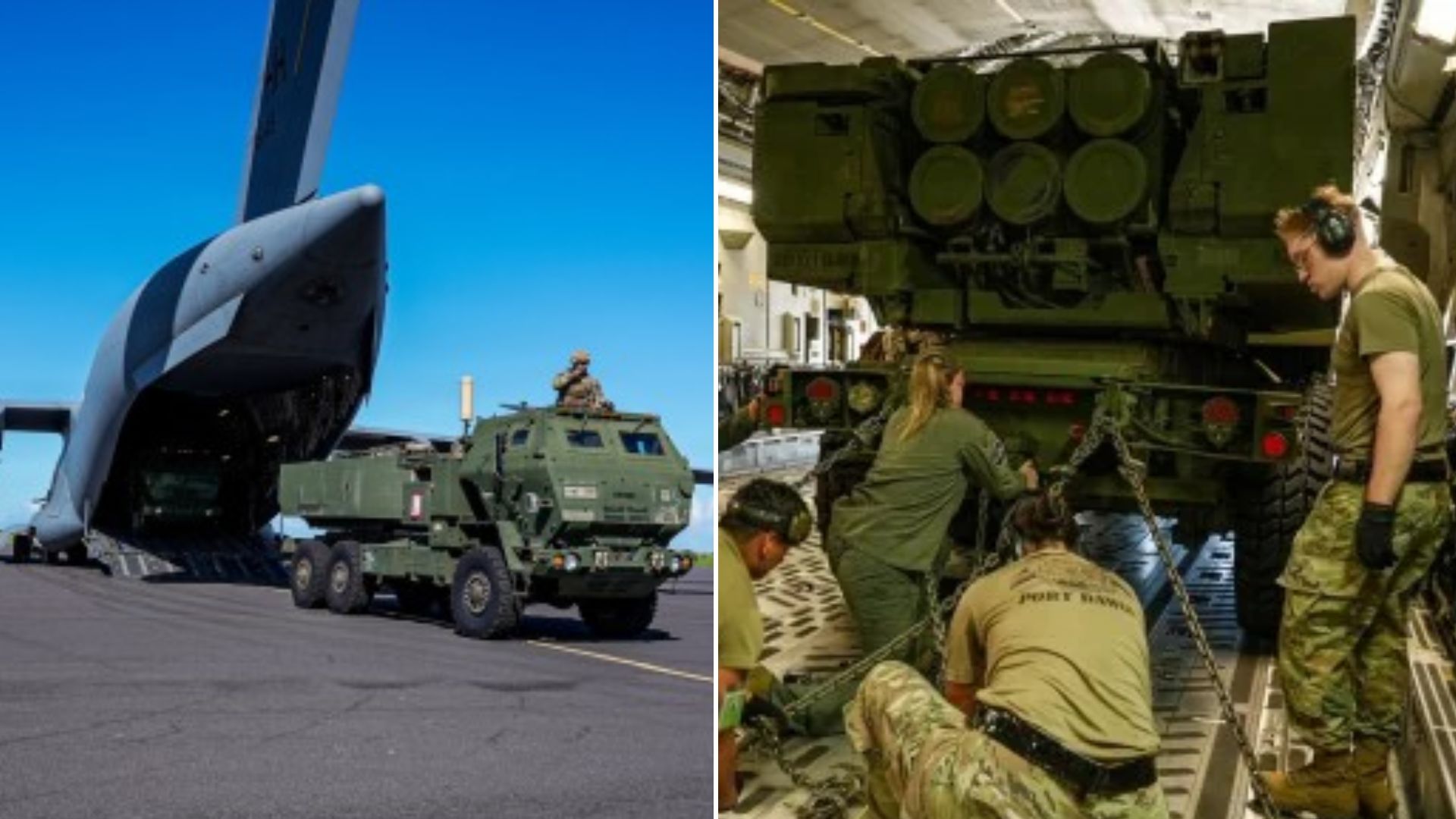
The US Army has rehearsed rapid deployment of its High Mobility Artillery Rocket Systems (HIMARS) across the Pacific. During the exercise, military cargo planes airlifted the launchers to a remote site, where crews simulated a precision strike before preparing for immediate extraction. The exercise took place on Kauai, Hawaii, during Joint Pacific Multinational Readiness Center (JPMRC) Rotation 27-01. Soldiers from the 2nd Battalion, 11th Field Artillery Regiment, 25th Infantry Division, conducted a HIMARS rapid infiltration (HIRAIN) dry-fire mission with support from the US Air Force’s 15th Wing. The operation tested how quickly artillery crews could move launchers from aircraft to a firing position and coordinate a simulated strike. Rather than remaining at a fixed location, the crews practiced preparing the systems for another move immediately after completing the exercise. The approach is intended to make long-range artillery harder for an adversary to locate and target, particularly in the vast and geographically dispersed Indo-Pacific region. Moving HIMARS by air HIRAIN is designed to rapidly insert HIMARS launchers into locations where conventional ground transportation may be impractical or too slow. In the Kauai exercise, US Air Force transport aircraft delivered the launchers to an airfield, where Army crews unloaded them and transitioned into a firing posture. The Army did not identify the specific aircraft model in its account, but the 15th Wing operates C-17 Globemaster III transport aircraft. The aircraft can carry heavy military equipment over long distances and operate from a range of airfields. The sequence requires close coordination between Army artillery crews and Air Force personnel. Loadmasters need to ensure the launchers are properly secured in flight, while ground crews unload and prepare the systems quickly after landing. Once in position, HIMARS crews can receive targeting information and execute a fire mission. In this exercise, the mission was conducted as a dry-fire rehearsal, meaning no rockets were launched. Afterward, the launchers were secured and prepared for follow-on movement. This quick repositioning is central to the HIRAIN concept: a launcher that can move into a firing position, complete its mission, and leave quickly is less exposed to potential counterfire. Why rapid deployment matters in the Pacific HIMARS is a truck-mounted rocket artillery system that can fire guided rockets and longer-range missiles from interchangeable launch pods. Its mobility allows Army units to relocate between firing positions rather than operate from permanent artillery sites. The system has become an important part of the US Army’s long-range precision fires capability. Its mobility and relatively small logistical footprint compared with heavier artillery systems make it particularly useful for expeditionary operations. In the Indo-Pacific, however, moving these systems presents additional challenges. The region spans enormous distances and includes island chains, limited infrastructure, and widely separated operating locations. Units may need to move equipment by air or sea before they can establish firing positions. The 25th Infantry Division’s exercise also emphasized coordination across military services. While HIMARS crews operated on Kauai, joint forces coordinated capabilities and simulated effects across Hawaii during the wider JPMRC rotation. Army commanders said the exercise tested the ability to connect communications, targeting information, logistics, and precision fires under demanding conditions. The goal is to ensure artillery units can respond to short-notice deployments while remaining connected to the wider force.The division is also preparing for future deployments to the Philippines as part of Operation Pathways, the US Army’s series of regional exercises and engagements with Indo-Pacific partners. In a region where distance and limited infrastructure can complicate military operations, the ability to rapidly deploy, fire, and relocate long-range artillery could become an important part of maintaining a distributed force.Get the latest in engineering, tech, space & science - delivered daily to your inbox.Kaif Shaikh is a journalist and writer passionate about turning complex information into clear, impactful stories. His writing covers technology, sustainability, geopolitics, and occasionally fiction. A graduate in Journalism and Mass Communication, his work has appeared in the Times of India and beyond. After a near-fatal experience, Kaif began seeing both stories and silences differently. Outside work, he juggles far too many projects and passions, but always makes time to read, reflect, and hold onto the thread of wonder.
US Army tests rapid air deployment of truck-mounted rocket launchers in Hawaii
Full Article
Original Source
Read the full article at Interestingengineering →KhanList aggregates and links to publicly available news content. We do not host full articles from third-party sources. Always verify important information with original sources.