
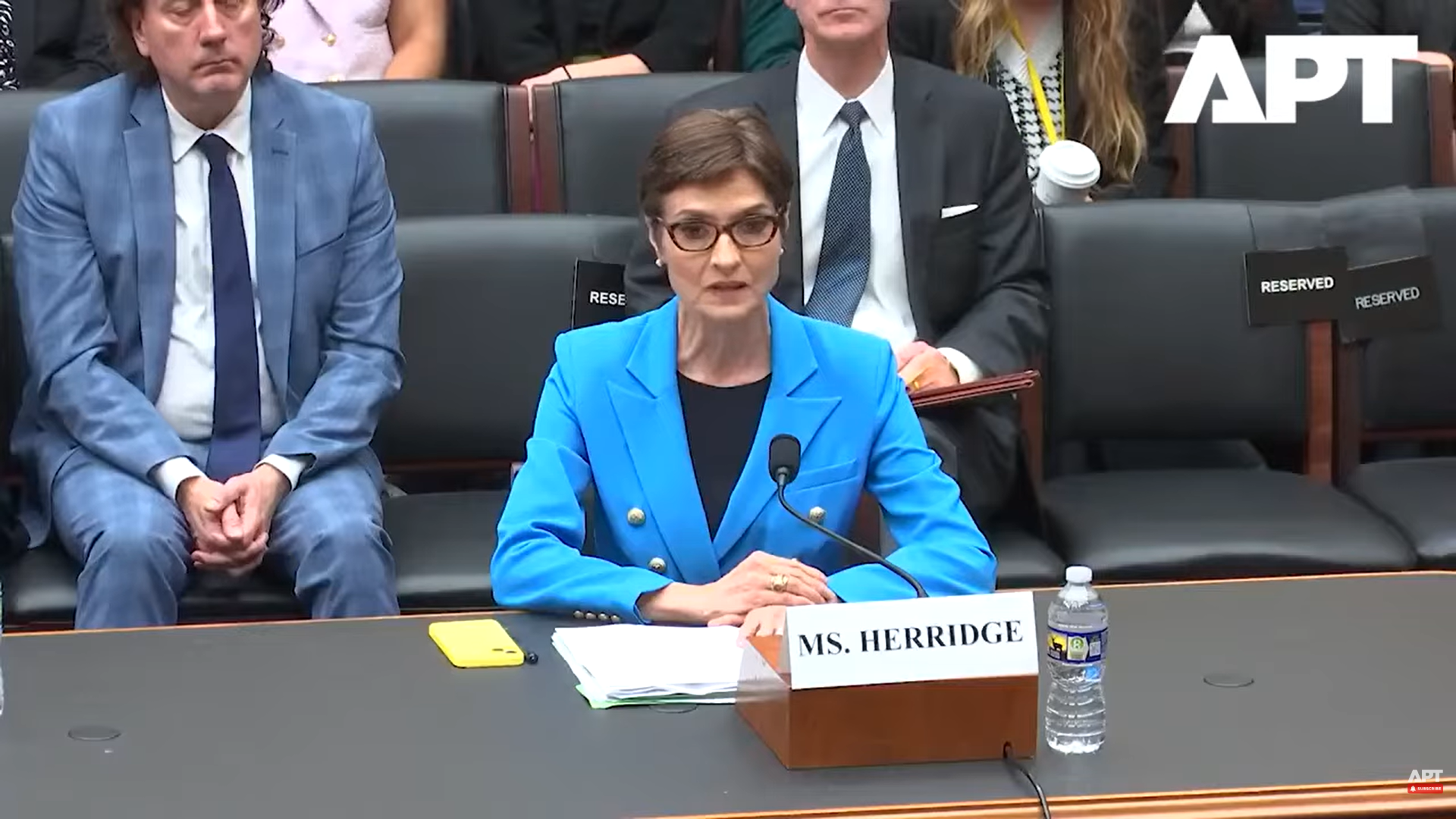
“Nvidia Chief Seen as Target of Chinese Spy Plot,” headlined the New York Times article from two weeks ago that broke news of a relationship between the chip maker’s founder and a Chinese businesswoman, who, according to the article, “was found to be passing intelligence to Beijing.” Since then, Jensen Huang, the founder and CEO of Nvidia, has admitted to an extramarital affair and apologized for his conduct. Nvidia’s Board of Directors has also announced an independent investigation. The Times’ reporting further prompted the House Foreign Affairs Committee and the House Permanent Select Committee on Intelligence to request Huang “appear before their committees for a joint, closed-door briefing on Huang’s interactions with Megaspeed executive Alice Huang, a publicly reported People’s Republic of China (PRC) intelligence asset, and NVIDIA’s security protocols against foreign adversary espionage.” It will be some time before the public learns of the depth and seriousness of this scandal, but this recent reporting should serve as a wake-up call to another stealth threat to our national security — the weaponization of the Privacy Act. For some four years, Yanping Chen has aimed the tip of the Privacy Act spear at Catherine Herridge, the renowned national security journalist. Herridge, then Fox News’ Chief Intelligence Correspondent, reported on an FBI counterintelligence investigation into Chen, who at the time ran the University of Management and Technology (“UMT”) in Northern Virginia, where, among others, many members of the U.S. military completed coursework. In her Privacy Act lawsuit, Chen alleged federal government employees leaked FBI records pertaining to an investigation of Chen to “one or more employees or agents of Fox News.” Chen alleged that as a result of the allegedly “illegal leak or leaks of Dr. Chen’s private information to Fox News, three Fox News reports were published and broadcast, leading to the destruction of Dr. Chen’s livelihood and the termination of the University of Management and Technology’s participation in DOD’s Tuition Assistance program.” Herridge served as the senior journalist for the three Fox News reports that formed the basis of Chen’s lawsuit. Among other things, one Fox News segment reported “Chen had lied on her immigration forms about whether she had previously worked for the Chinese military.” According to the complaint, one Fox News report “also displayed images of personal photographs seized from Dr. Chen’s home during the FBI search” — left unsaid by Chen was that the picture showed her wearing a Chinese People’s Liberation Army (“PLA”) military uniform. Chen also complained that the reports included “data taken from, and images of, Dr. Chen’s immigration and naturalization forms . . .” However, much of the information included in Herridge’s reports came from an informant who spoke with the national security journalist or from details contained in a search warrant affidavit filed on the public docket. According to Herridge’s pending Supreme Court petition — more on that shortly — that search warrant affidavit included nearly all the details included in the Fox News reports, with the exception of the images displayed by the network of Chen’s immigration forms, wherein she denied ever belonging to the Communist Party, and the photographs depicting Chen in her PLA uniform. The Fox News exposé of Chen also included Herridge’s on-camera interview of Stephen Rhoads, a former UMT employee turned FBI informant. Rhoads told Herridge that Chen said she had been a PLA colonel and had told him to lie about it to a grand jury. Rhoads also told Herridge that UMT collected information about U.S. servicemembers’ military histories that could be accessed remotely, while the Department of Defense paid the school Chen founded between $250,000 and $300,000 a month through its tuition assistance program. Herridge also interviewed Peter Mattis, an expert on the Chinese military, who explained why the PLA might value those personnel records UMT collected. Following Herridge’s reporting, in 2018, the Department of Defense suspended tuition payments to UMT on “national security” grounds. Chen responded by filing a Privacy Act claim against the FBI, DOJ, DoD and DHS on December 21, 2018. Unlike a case alleging defamation, to prevail on her Privacy Act claims, Chen need not prove that the information Herridge published was false. Instead, Chen must only establish that a federal agency “intentionally or willfully” disclosed a “protected record,” and that the disclosure caused a financial harm. Among other things, Chen argued that Herridge’s reporting prompted the Department of Defense to drop the university Chen founded from its tuition-assistance program, financially paralyzing the school. While Chen did not sue Herridge, Chen subpoenaed Herridge as part of her Privacy Act case against the government, arguing she needed Herridge’s testimony to prove that a member of one of the federal agencies sued had intentionally (or willfully) disclosed her immigration paperwork and the photograph of Chen in her PLA uniform. In August of 2023, the district court ordered Herridge to sit for a deposition, which she did, but Herridge nonetheless refused to reveal her source (or sources) to Chen. The presiding judge, Christopher Cooper, later held Herridge in civil contempt of court, ordering her to pay $800 per day for refusing to disclose to Chen how she had obtained the immigration papers and photographs, although Judge Cooper stayed the fine pending an appeal. On appeal, the D.C. Circuit, in September 2025, upheld the lower court’s decision that Herridge must identify her source (or sources) to Chen. The Supreme Court would later refuse to stay the fine and Herridge paid over $14,000 in sanctions before the district court put the fines on hold pending the completion of any Supreme Court proceedings. Herridge then turned to the U.S. Supreme Court, filing a petition for review in the high court on August 20, 2026. The petition details the many important reasons why the Supreme Court should grant the petition, including the fact that it has been over fifty years since the justices weighed in on a reporter’s privilege — and even then, only in the context of a criminal case. Since then, Herridge’s petition stressed that the lower courts have crafted a variety of standards for assessing whether a journalist may be forced to reveal a confidential source. On Friday, a handful of amicus curiae, or friend-of-the-court, briefs hit the docket supporting Herridge’s petition for review. While several media organizations filed briefs stressing the importance of confidentiality to their professions, it was the brief submitted by Sens. Ted Cruz, Mike Lee, and Cynthia Lummis that proves particularly significant in light of the New York Times coverage of the affair between Huang and Alice Huang, the latter of whom the Times claimed passed “intelligence to Beijing.” In their amicus brief, the trio of senators argued that the Supreme Court should take Herridge’s appeal because the lower court’s decision failed to give any weight to the fact that it was ordering the release of the identity of government sources to Chen — an individual who had self-identified as a PLA colonel and whose school the Department of Defense axed from its tuition-benefit program on national security grounds. Led by Cruz, the legislators further argued in their amicus brief that allowing Chen to use the Privacy Act to obtain this information represents a further threat to national security because it will leave whistleblowers hesitant to speak with the press for fear of being outed. “Congress’s oversight of the Executive Branch,” the brief stressed, “depends in part on the press.” “Members, including amici, learn of waste, abuse, and security lapses from reporters like Herridge,” the senators continued, adding: “A rule that lets any investigation’s subject unmask those sources through civil discovery will dry up that reporting, and with it impede Congress’s critical oversight of executive agencies.” And this brings us back full circle to the Nvidia scandal. According to the New York Times’ reporting, “American spy agencies” had surveilled Alice Huang, with U.S. officials reportedly concluding “she was a Chinese intelligence asset, funneling information to Beijing.” This reporting prompted both Nvidia and two House committees to launch investigations into the situation. Admittedly, after the Times’ role in the Russia-collusion hoax, it is difficult to trust the legacy outlet’s reporting. That is particularly true here given the story had a get-Trump taste to it, with the authors writing “[r]oughly a year ago, Mr. Trump was briefed about the intelligence findings, which have not been previously reported, and chose not to do anything with the information.” But assume for the moment that the New York Times’ reporting is accurate: Under the currently standing Herridge precedent, a plethora of federal agencies could still face a lawsuit for violating the Privacy Act, and a judge could force the New York Times to reveal its sources. Now, that is unlikely, because unlike Chen, Alice Huang is not a U.S. citizen and the Privacy Act — with limited exceptions — only protects citizens and lawful permanent residents. And given the scandal, it is unlikely the embattled Nvidia CEO would want to file suit. Nonetheless, the entire Nvidia scandal illustrates the importance of confidential sources, not merely to journalism, but also to our national security, for without an assurance of confidentiality, it is unlikely sources will speak to the press. Cruz, Lee, and Lummis understand that reality and so does Catherine Herridge. Hopefully, the Supreme Court will too. Margot Cleveland is an investigative journalist and legal analyst and serves as The Federalist’s senior legal correspondent. Margot’s work has been published at The Wall Street Journal, The American Spectator, the New Criterion, National Review Online, Townhall.com, the Daily Signal, USA Today, and the Detroit Free Press. She is also a regular guest on nationally syndicated radio programs and on Fox News, Fox Business, and Newsmax. Cleveland is a lawyer and a graduate of the Notre Dame Law School, where she earned the Hoynes Prize—the law school’s highest honor. She later served for nearly 25 years as a permanent law clerk for a federal appellate judge on the Seventh Circuit Court of Appeals. Cleveland is a former full-time university faculty member and now teaches as an adjunct from time to time. Cleveland is also of counsel for the New Civil Liberties Alliance. Cleveland is on Twitter at @ProfMJCleveland where you can read more about her greatest accomplishments—her dear husband and dear son. The views expressed here are those of Cleveland in her private capacity. Catherine HerridgeChinaDepartment of DefenseJensen HuangNew York TimesNvidiaSCOTUS
Nvidia Scandal Shows Why SCOTUS Must Allow Catherine Herridge To Protect Her Sources
Full Article
Original Source
Read the full article at Thefederalist →KhanList aggregates and links to publicly available news content. We do not host full articles from third-party sources. Always verify important information with original sources.