
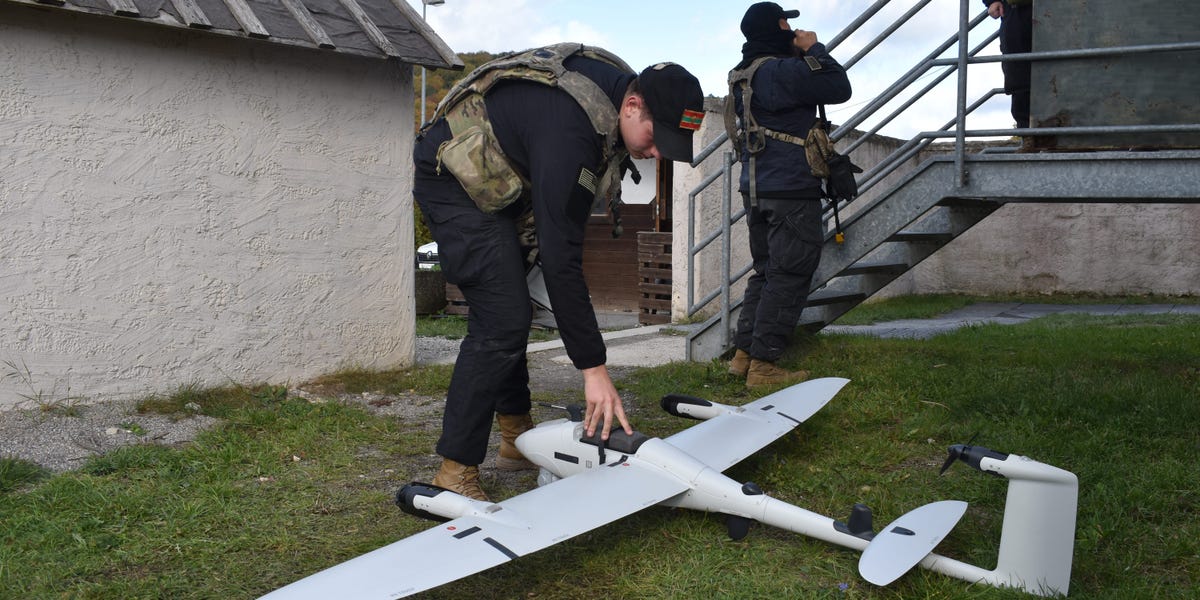
An American soldier simulating an enemy picks up a drone during a recent exercise. Jake Epstein/Business Insider HOHENFELS, Germany — A drone can fly only as far as its pilot can keep the connection. At the US Army's main overseas combat training center, that critical link can disappear on the far side of the rolling hills and thick forests that make the terrain particularly useful for war games.The Army is looking to the sky for answers to the problem. The service wants to use drones as airborne communications relays that can help pilots maintain control of uncrewed aircraft operating beyond the reach of a direct line-of-sight signal.Locked in a drone war with Russia, Ukraine has already turned to this approach on the battlefield, using relay drones to extend the connection between a pilot and a mission drone. Similar to how WiFi extenders work, these airborne signal repeaters are typically small quadcopters that can fly higher than ground-based antennas, allowing the mission drone to fly farther.Roughly 50 Ukrainian soldiers participated in Combined Resolve, a recurring large-scale US Army exercise held last month at the Joint Multinational Readiness Center in Bavaria, north of Munich.Business Insider spent two days observing the training exercise, a kind of stress test for the Army as the service integrates drones, electronic warfare, and other emerging technologies into its armor operations to make tanks and infantry fighting vehicles more survivable on modern battlefields.Army officers said that the US is learning many lessons from Ukraine and from its visiting soldiers, who participated in the exercise alongside the 1st Armored Division's 1st Armored Brigade Combat Team (1/1 ABCT) as it fought an opposition force simulating an enemy.One of these lessons is how to use relay drones for extended range, said Capt. Kevin Rincon, the troop commander of the multifunctional reconnaissance company, 1/1 ABCT's action arm. Ukraine uses relay drones to extend the range of other drones on strike and surveillance missions. Jake Epstein/Business Insider Speaking in the dense forest surrounded by armored vehicles, Rincon said fine-tuning the ability to operate relay drones and extend the range of mission drones will greatly improve survivability.Chief Warrant Officer 2 Carlos Porres, who oversees drone operations, said the airborne relays let pilots fly mission drones several miles beyond line of sight, an ideal advantage given the unfavorable terrain. Maintaining a signal isn't the only requirement for longer ranges, though. Army officers said colder temperatures in Europe, especially this time of year, also impact drone battery life and potentially longer-range operations. Soldiers at training sites spanning a range of climates and conditions have found that drones can be negatively affected by heat, humidity, wind, rain, cold, and other environmental factors.During the exercise, the Army's 1st Battalion, 4th Infantry Regiment, a unit stationed at Hohenfels that serves as the opposition force during training exercises, also used relay drones to extend its operational range.In one case, the opposition force used relay drones to extend the range of a ground robot deployed to attack 1/1 ABCT, an officer involved in the mission shared, speaking in a makeshift command post in the basement of a rundown building.Ukraine's participation in various iterations of Combined Resolve has helped the Army learn better drone tactics, said Brig. Gen. Terry Tillis, the commander of the 7th Army Training Command, which operates under US Army Europe and Africa.He said that moving forward, the Army intends to continue inviting Ukraine to participate in similar exercises. The US Army is taking many lessons from Ukraine to inform its own training. Jake Epstein/Business Insider The concept of using aircraft as signal repeaters is not exactly new for the US military. For decades, and in conflicts around the world, it has used drones and aircraft to extend the range of communications beyond the line of sight.However, at a tactical level, relay drones, specifically using drones to allow other drones to fly farther from their operators, are proving increasingly important. Nowhere is this more prevalent than in Ukraine, where the battlefield is heavily saturated with drones and electronic jamming technology meant to counter them.Drone pilots are being pushed back farther from the front lines as the kill zone — a miles-wide area under heavy surveillance where any movement can trigger a deadly strike — continues to expand.Ukrainian pilots and defense companies told Business Insider that relay drones are essential for extending the range of first-person-view (FPV) quadcopters, which are used to deliver precision strikes on enemy troops, vehicles, and positions.Omnitech Defense, a Ukrainian firm, said that its relay drones can double the range of standard FPV drones and allow troops to operate beyond line of sight and over hills that might otherwise disrupt radio signals — the same restrictive terrain features that rotating Army brigades face at Hohenfels.Glib Dreger, the company's international development lead, said at a demonstration in southern England that the relay drones also work under electronic warfare conditions, which many defense firms believe is now a requirement for modern weapons.Relay drones are "extremely critical, to the point where traditional drone pilot training has now incorporated this system as part of the official doctrine on the use of UAVs," Dreger said. Read next Business Insider tells the innovative stories you want to know Business Insider tells the innovative stories you want to know Business Insider tells the innovative stories you want to know Business Insider tells the innovative stories you want to know Jake Epstein is a defense correspondent in London for Business Insider, covering the US military, NATO, and European security, as well as emerging tech in warfare.Jake has filed stories from conflict zones in Ukraine and the Middle East, where he embedded with a US aircraft carrier on a combat mission in the Red Sea. Jake has reported extensively on NATO operations and activities across Europe, including from aboard one of its AWACS surveillance aircraft along the Russian border, a British Voyager tanker refueling fighter jets over the Baltic Sea, and a Dutch helicopter flying to a warship in the Arctic. Ukraine Russia Drones More
US Army soldiers are taking a page from Ukraine's playbook to fly drones farther
Full Article
Original Source
Read the full article at Businessinsider →KhanList aggregates and links to publicly available news content. We do not host full articles from third-party sources. Always verify important information with original sources.