
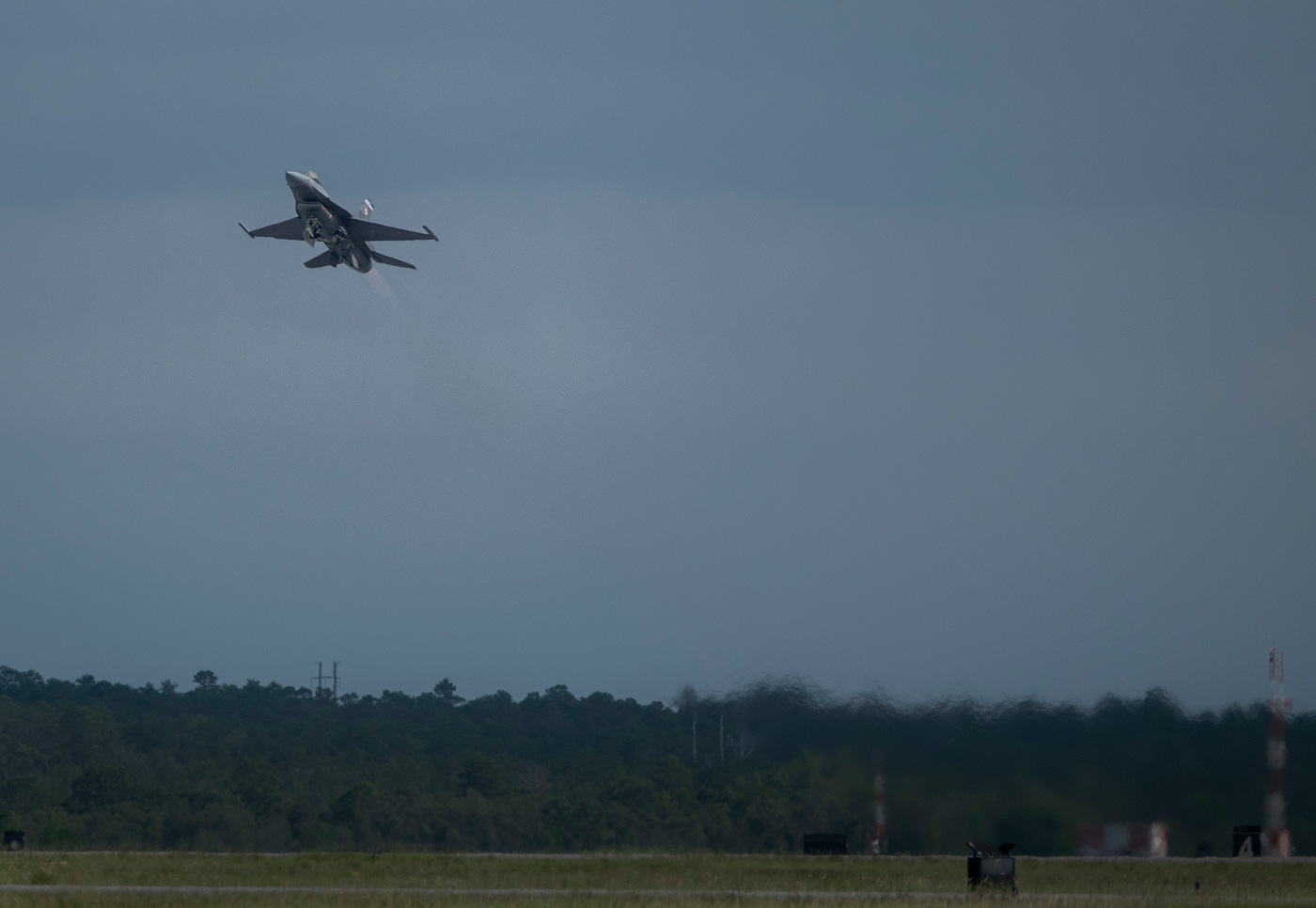
The Defense Advanced Research Projects Agency (DARPA) and the United States Air Force (USAF) report that they have successfully flown a modified F-16 remotely using artificial intelligence (AI). This capability is nothing new for DARPA and the USAF; they have previously demonstrated similar capabilities using the X-62A VISTA, but this is the first time a retrofitted older aircraft has been used. The test marks a major milestone for the Viper Experimentation and Next-generation Operations Model (VENOM) Autonomy Kit, which essentially puts an AI pilot in the cockpit. Interestingly, the kit was installed on the F-16 without needing to rewrite the aircraft’s core flight software. VENOM, DARPA explains, is capable of not only controlling the aircraft but also monitoring sensors and other mission systems. “These groundbreaking flight tests of VENOM-modified F-16s advance the infrastructure needed to develop trusted, autonomous air combat capabilities,” said Brigadier General James “Fangs” Valpiani, Ph.D., DARPA program manager. VENOM: giving old planes AI pilots During the test, a human pilot conducted the takeoff, with the AI then taking control once airborne. The same human pilot remained in the cockpit, monitoring the AI’s performance and ready to take over should any issues arise. A human pilot is also essential for the program’s “human-on-the-loop” requirements. Essentially, the human acts as an overseer but may or may not intervene in AI decision-making. This differs from the more commonly known “human-in-the-loop” setup, where the human needs to authorize decisions. “The Air Force and DARPA team have automated flight controls and sensors on a standard F-16 without changing the jet’s core software. This enables an efficient pipeline for developing dominant AI for aerial combat, allowing us to rapidly innovate for the warfighter,” he added. The use of modified F-16s for the test is significant, as it not only proves the technology in older aircraft but also makes scaling it more viable. With multiple modified F-16s, DARPA and the USAF could, potentially, test different agents running different tactics at the same time. It can also enable them to test cooperation between AI agents and their individual and collective responses to aerial and electronic warfare (EW) threats. It also provides a means for testing coordination between crewed and uncrewed aircraft. “The emerging threat environment, especially as it relates to aerial combat, is growing increasingly complex,” added Valpiani. “AI has tremendous potential to help humans manage this complexity in beyond-visual-range combat, but many hard questions remain concerning the performance and trustworthiness of combat AI in the extreme fog and friction of modern warfare,” he added. Keeping pilots safe in the future Looking ahead, this test (and the VENOM program in general) will help support DARPA’s Artificial Intelligence Reinforcements (AIR) program. The eventual aim is to provide a fleet of self-flying aircraft, such as the F-16. In combat, this would see human pilots commanding groups of autonomous aircraft, especially for beyond-visual-range operations. Such a capability will not only keep human crews safe but also drastically increase offensive range and reaction times in battle. “The AIR program aims to apply cutting-edge combat agents to operationally relevant scenarios to address these questions and field war-deterring, war-winning capabilities to our warfighters,” he concluded. “I’m incredibly proud of the AIR program’s role in advancing our nation’s combat autonomy, demonstrated by this VENOM milestone,” said Lieutenant Colonel Patrick “Dice” Highland, Ph.D.“We now have the opportunity to create dominant autonomy for beyond-visual-range, multi-ship combat. These flights give us an early glimpse of how AI agents may begin actively transforming air warfare,” he added. “I share Gen. Valpiani’s deep appreciation for the incredible dedication of our DARPA and industry teammates, joint engineers, the System Program Office, Eglin’s test and maintenance crews, and the entire AIR and VENOM ecosystem which has made this milestone possible,” said Terry Wilson, Ph.D., director of AI Development and Transition for the Air Force Research Laborecosystem,atory’s Autonomy Capability Team (ACT3). “I look forward to unleashing the VENOM platform and moving these capabilities out of simulation and into the sky,” he added. Recommended ArticlesGet the latest in engineering, tech, space & science - delivered daily to your inbox.Christopher graduated from Cardiff University in 2004 with a Masters Degree in Geology. Since then, he has worked exclusively within the Built Environment, Occupational Health and Safety and Environmental Consultancy industries. He is a qualified and accredited Energy Consultant, Green Deal Assessor and Practitioner member of IEMA. Chris’s main interests range from Science and Engineering, Military and Ancient History to Politics and Philosophy.
US Air Force, DARPA retrofit legacy F-16 with VENOM kit for successful autonomous flight
Full Article
Original Source
Read the full article at Interestingengineering →KhanList aggregates and links to publicly available news content. We do not host full articles from third-party sources. Always verify important information with original sources.