
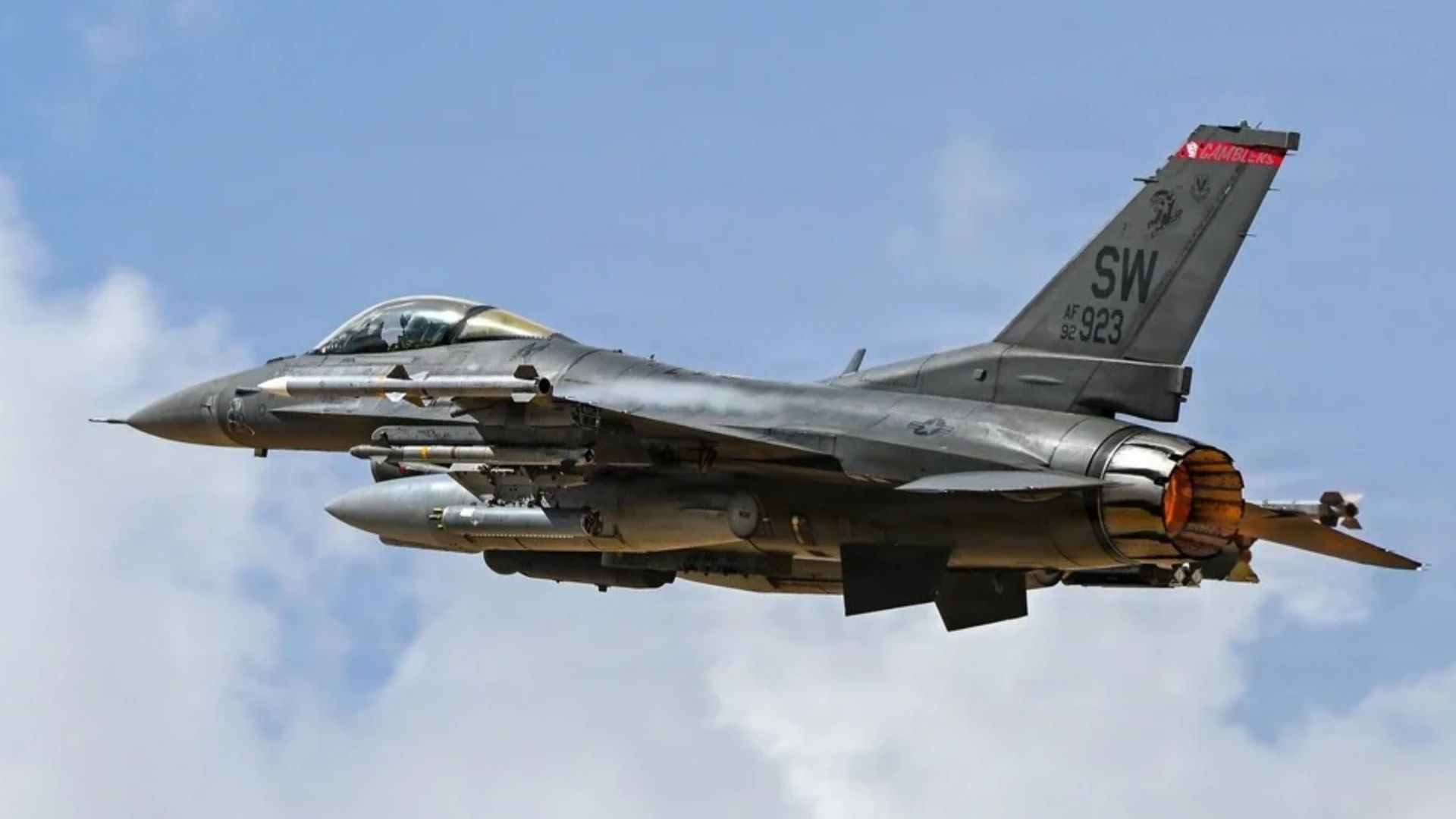
The US Air Force is taking steps to integrate a hypersonic strike weapon with one of its most widely used fighter jets. Defense technology company Castelion has received a contract modification from the Air Force Research Laboratory (AFRL) to begin integration activities for its Blackbeard missile with the F-16 Fighting Falcon. Castelion announced the development on October 26, saying the award expands its existing work with AFRL. The company has not disclosed the value of the modification, a timeline for integration, or when the missile could first be launched from an F-16. Blackbeard is designed to fly faster than Mach 5 Blackbeard is a long-range strike weapon designed to travel at more than five times the speed of sound while maneuvering within the atmosphere. Castelion is developing it with an emphasis on affordability and mass production, aiming to make hypersonic strike capabilities available in larger numbers than traditionally expensive systems. Hypersonic weapons can complicate air defense because their speed and maneuverability can make their flight paths harder to predict. However, actual performance depends on a weapon’s flight profile, guidance systems, and the defenses it encounters. Castelion has not publicly released a complete set of Blackbeard’s technical specifications, including detailed range and guidance information. Castelion has been awarded a contract modification to its existing work with the Air Force Research Laboratory to begin Blackbeard integration activities with the F-16. We are grateful to the Air Force for their trust.Aim High. pic.twitter.com/UerIcDG6Jx— Castelion (@Castelion) October 26, 2026 The company is pursuing both air-launched and ground-launched configurations. The ground-launched version is intended to be compatible with the US Army’s M142 High Mobility Artillery Rocket System (HIMARS). F-16 integration could expand the missile’s reach The F-16 Fighting Falcon is a multirole fighter operated by the US Air Force and air forces around the world. Adding Blackbeard to its potential weapons loadout could give the missile another aircraft launch platform beyond the US Navy’s F/A-18E/F Super Hornet. Air-launched weapons can be carried to a launch point and released later, potentially extending their reach without requiring the aircraft to fly directly over a target. Integrating a new missile, however, involves more than mounting it to an aircraft. Engineers must address weapon controls, aircraft software, communications, flight safety, and testing to verify that the systems work together. Castelion has not revealed whether the F-16 effort will include live-fire launches, or whether the work could eventually support aircraft operated by US allies. Navy and Army programs are already advancing The F-16 effort adds to Blackbeard’s development across other US military services. In October 2025, Castelion announced integration contracts with the Army and Navy to adapt the weapon to military platforms and demonstrate its capabilities in live-fire tests. The Navy has since moved further ahead. In April 2026, it awarded Castelion a $105 million contract for Blackbeard integration with the F/A-18E/F Super Hornet, including flight-testing activities. The service later ordered early operational capability weapons and, in September, announced a production delivery order valued at up to $200 million. The Army is pursuing a ground-launched version compatible with HIMARS. These efforts give Castelion multiple routes to introduce Blackbeard into the US military, although each platform requires its own integration and qualification work.Separately, AFRL increased an existing Castelion contract by $16.4 million in September, bringing its total value from $20.9 million to $37.2 million for continued development of a low-cost, mass-producible long-range strike weapon. Castelion has not confirmed whether the new F-16 activities fall under that same agreement.Get the latest in engineering, tech, space & science - delivered daily to your inbox.Kaif Shaikh is a journalist and writer passionate about turning complex information into clear, impactful stories. His writing covers technology, sustainability, geopolitics, and occasionally fiction. A graduate in Journalism and Mass Communication, his work has appeared in the Times of India and beyond. After a near-fatal experience, Kaif began seeing both stories and silences differently. Outside work, he juggles far too many projects and passions, but always makes time to read, reflect, and hold onto the thread of wonder.
US Air Force advances to fit Mach 5 hypersonic missile on F-16 fighter jets
Full Article
Original Source
Read the full article at Interestingengineering →KhanList aggregates and links to publicly available news content. We do not host full articles from third-party sources. Always verify important information with original sources.