
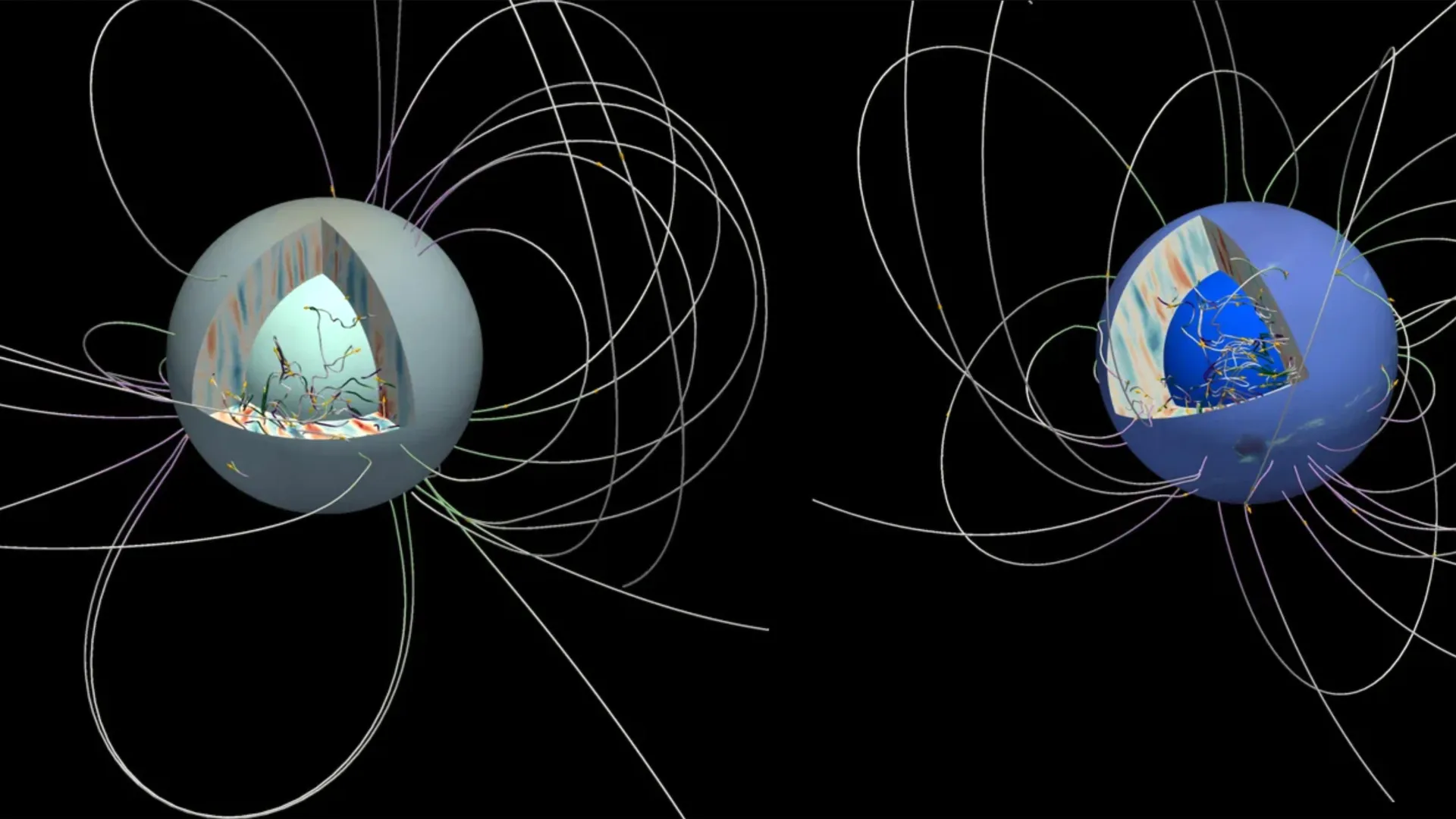
When NASA's Voyager 2 spacecraft visited Uranus and Neptune in the 1980s, it discovered something extraordinary. Unlike Earth, which has a relatively orderly magnetic field with clearly defined north and south poles, both distant planets possess strangely distorted and dramatically tilted magnetic fields. For decades, scientists have struggled to explain why. Now, researchers believe they may have found an answer hidden deep inside these enormous worlds. A new study suggests that changes in how well materials conduct electricity under extreme conditions could explain the planets' unusual magnetism. The findings also raise an intriguing possibility: the magnetic fields of Uranus and Neptune may change dramatically over just a few decades. The research, published in Communications Physics, was led by scientists at The University of Texas at Austin in collaboration with researchers from the University of California, Los Angeles, Imperial College London, and Northumbria University. Why Uranus and Neptune Have Such Strange Magnetic Fields Planetary magnetic fields originate deep beneath the surface, where moving fluids capable of conducting electricity generate magnetic forces. Scientists call this process a dynamo. On Earth, the dynamo operates within the outer core, a layer of molten metal surrounded by mostly solid rock. As liquid iron circulates and the planet rotates, it generates a magnetic field resembling that of a giant bar magnet. This produces the familiar north and south magnetic poles that allow compasses to point in a consistent direction. Earth's magnetic field is also closely aligned with its rotation axis. Its main magnetic axis, known as a dipole, is tilted by only 11 degrees. Uranus and Neptune are strikingly different. Uranus has a magnetic dipole tilted by 59 degrees, while Neptune's is tilted by 47 degrees. Explaining these extreme tilts requires a better understanding of what lies inside the two planets. Uranus and Neptune are classified as ice giants, a name that reflects their presumed composition rather than suggesting they are simply frozen worlds. Each is approximately four times wider than Earth, and scientists believe their interiors contain substantial amounts of hydrogen, helium, water, ammonia, methane, and rocky material. However, their precise internal compositions remain uncertain. Extreme Conditions Deep Inside the Ice Giants Chi Yan, the study's lead author and a research associate at the UT Jackson School of Geosciences, believes the combination of the planets' enormous size and unusual chemical makeup may help explain their distorted magnetic fields. "Deep inside Uranus and Neptune, pressures and temperatures become extremely high," said Yan. "Under these conditions, which can cause water molecules to break apart into ions, the material may become increasingly electrically conductive with depth." Ions are electrically charged particles that can carry electric current. If the materials inside Uranus and Neptune become more conductive at greater depths, that could significantly influence how their magnetic fields are generated. To investigate this possibility, the researchers developed computer simulations designed to reproduce the strange magnetic fields recorded by Voyager 2. Their models assumed that electrical conductivity increases deeper inside the planets. The researchers also tested a variety of possible internal structures, examining how circulating fluids, temperature changes, and magnetic forces interact over time. The results suggest that these changing electrical properties could play a crucial role in producing the unusual magnetic fields observed around both ice giants. Magnetic Poles Could Shift Dramatically Within Decades Perhaps the most surprising finding is that the magnetic fields of Uranus and Neptune may be far less stable than Earth's. According to the simulations, their magnetic axes could undergo substantial changes in relatively short periods. In some scenarios, the magnetic tilt shifted by tens of degrees within only a few decades. That raises the possibility that the magnetic fields surrounding Uranus and Neptune today are significantly different from those measured when Voyager 2 flew past them in the 1980s. "Earth's magnetic tilt drifts by only a degree or so over 50 years," said Yan. "Our models show the ice giants can behave very differently. In some stretches the tilt swings by tens of degrees within decades. In others it shifts only slightly over the same span." These dramatic changes remain predictions from computer models rather than confirmed observations. However, scientists may already have a way to look for evidence of them. James Webb Telescope Could Reveal Magnetic Changes Researchers are now examining detailed infrared images of Uranus and Neptune captured by the James Webb Space Telescope (JWST). They are particularly interested in the planets' auroras, which form when charged particles from the Sun interact with gases in their atmospheres. Auroras are closely connected to planetary magnetic fields, making them valuable clues to what is happening far above the planets' hidden interiors. Changes in the appearance and arrangement of these glowing atmospheric features could help researchers determine whether the magnetic poles have shifted since Voyager 2's encounters. "We are busy working on what's contained within these observations, but the shape and structure of the aurora, as well as other weird patterns in the ionosphere, promises to provide us with a way of understanding how the magnetic fields have changed, an important stepping stone," said Tom Stallard, a professor at Northumbria University who led the JWST observation campaign and reviewed the paper for the journal. The ionosphere is a region of the upper atmosphere containing electrically charged particles. Its behavior is influenced by magnetic activity, offering another potential source of information about the planets' changing magnetic environments. The research team hopes to combine Webb's auroral observations with Voyager 2's original magnetic field measurements and the new dynamo simulations. Together, these sources of evidence could provide the clearest picture yet of how the magnetic fields of Uranus and Neptune are arranged today. Even so, scientists emphasize that fully understanding the planets' deep interiors will require new spacecraft missions to these distant worlds. Until then, improved simulations and powerful telescopes may help unravel one of the solar system's most unusual magnetic mysteries. The research was funded by The University of Texas Institute for Geophysics (UTIG) in the Jackson School of Geosciences, the National Aeronautics and Space Administration (NASA), and the Science and Technology Facilities Council.
Uranus and Neptune’s bizarre magnetic fields may finally be explained
Full Article
Original Source
Read the full article at Sciencedaily →KhanList aggregates and links to publicly available news content. We do not host full articles from third-party sources. Always verify important information with original sources.