
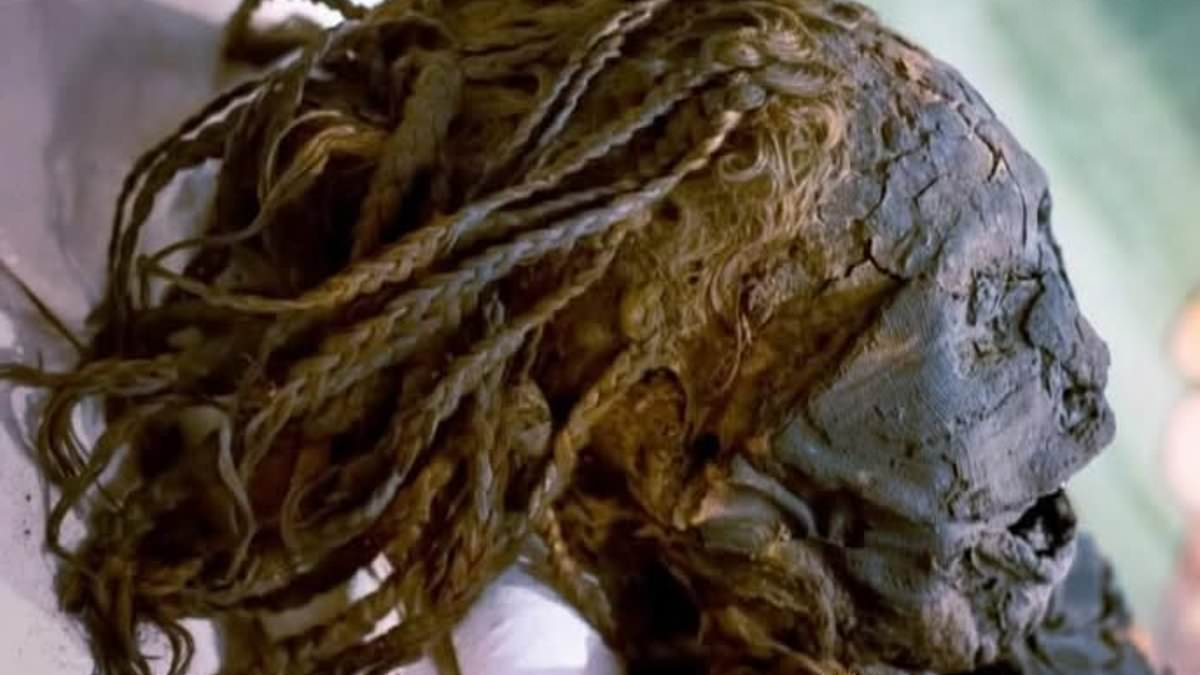
The secrets of an ancient Egyptian woman known as the 'Braided Lady' have been revealed after scientists digitally unwrapped her remains using high-resolution CT scans.Researchers examined the mummy, believed to date from between Egypt's 18th and 21st Dynasties, in the hope of uncovering clues about her life and death.One of her most remarkable features is her long, braided hair, which has remained intact for over 3,000 years.But an especially intriguing discovery came from the woman's teeth. These were heavily worn and damaged, probably as a result of the gritty, sand-laden diet common in ancient Egypt.The scans also revealed gum disease, a fractured molar and an incisor that had become displaced towards the throat.Researchers believe these unusual dental features may indicate that she took part in an ancient funerary rite.'Dental wear and pathology were observed, likely reflecting the abrasive diet of ancient Egyptians, and unique dental findings suggested participation in the 'Opening of the Mouth' ritual', the team wrote in the journal Radiology Case Reports.This practice was performed after death and was intended to restore the senses of the deceased for the afterlife. One of the woman's most remarkable features is her long, braided hair, which has remained intact for over 3,000 years Scientists digitally unwrapped her remains using high-resolution CT scans, revealing she suffered from gum disease, a fractured molar and an incisor that had become displaced towards the throatThe woman was initially discovered among a cache of mummies in Egypt and was later brought to Canada in 1860.She is believed to have lived sometime between 1077 BC and 1292 BC – roughly 3,000 to 3,300 years ago when the civilisation was at the height of its power.The team, led by a researcher at the University of Michigan, used CT scans to peer inside her remains.The technology stitches together hundreds of X-ray images to create detailed 3D views of the body, enabling researchers to digitally 'unwrap' a mummy without causing any damage.Analysis revealed that her body was exceptionally well preserved, with both bones and soft tissues still visible.The scans revealed that embalmers left parts of her internal organs inside the body, including remnants of the liver.They also found dried brain tissue, suggesting her brain was never removed during the mummification process.According to the researchers, this combination of techniques is consistent with burial practices used for wealthy non-royal Egyptians during the New Kingdom period. Despite the detailed examination, the team found no signs of a fatal injury or obvious disease that could explain how she died The scans revealed that embalmers left parts of her internal organs inside the body, including remnants of the liver (yellow arrow)The scans also revealed that the Braided Lady was a petite woman standing just 4ft 11in (151cm) tall, who died between the ages of 35 and 50.Despite the detailed examination, the team found no signs of a fatal injury or obvious disease that could explain how she died.Small calcified deposits seen in the scans may point to a long-term parasitic infection, the experts said.This was a common affliction in Ancient Egypt as many people lived alongside the Nile and relied on its water for drinking, bathing and agricultureHowever, the evidence remains inconclusive, with nothing to suggest it was fatal.As a result, the Braided Lady's cause of death remains a mystery thousands of years after she was laid to rest.'Despite limitations posed by tissue desiccation and lack of historical records, this multidisciplinary radiological assessment advances our understanding of ancient Egyptian funerary practices and demonstrates the value of modern non-invasive imaging in reconstructing the lives and deaths of archaeological individuals,' the team concluded.
Unravelling the mystery of Egypt's 'Braided Lady': Archaeologists use 3D CT scans to digitally unwrap a mummy after 3,000 years
Full Article
Original Source
Read the full article at Dailymail →KhanList aggregates and links to publicly available news content. We do not host full articles from third-party sources. Always verify important information with original sources.