
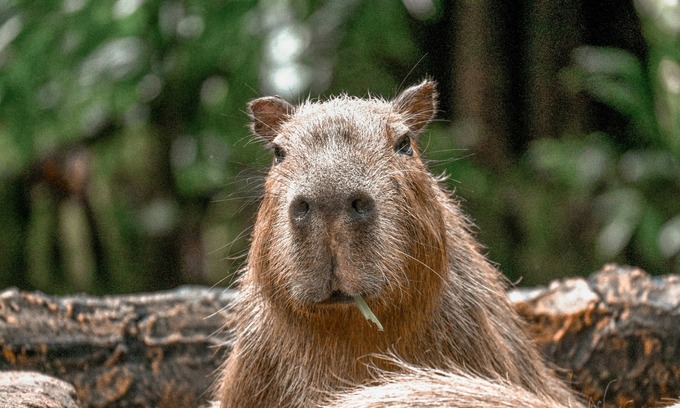
A rodent weighing about 30 kg lived in what is now southern Thailand some 34 million to 35 million years ago, a study of fossil teeth from a coal mine in Krabi Province shows. The species, named Yakamys sirindhornae, is described in a paper published in the journal Scientific Reports by researchers from Thailand's Department of Mineral Resources and colleagues in France and Canada. The lead author is Yaowalak Chaimanee, a mammal paleontologist at the French National Center for Scientific Research (CNRS).Announcing the find on Nov. 4, Natural Resources and Environment Minister Suchart Chomklin said it was the largest rodent yet discovered from the Paleogene period, which ran from about 66 million to 23 million years ago, Khaosod English reported.The researchers said the discovery shows rodents evolved toward larger body sizes 15 million to 20 million years earlier than previously understood, the Bangkok Post reported.The animal is known from just two teeth, a lower second molar and a fragment of a lower incisor, found close together in a clay layer within the main coal seam of the Bang Mark pit at the Krabi lignite mine, the paper says.With only teeth to go on, the team estimated its weight using seven equations that link tooth size to body mass. The results ranged from 21.4 to 47.3 kg, with a mean of 31.6 kg, and the authors used about 30 kg as a rounded figure while acknowledging substantial uncertainty.Despite its Thai nickname, "Sirindhorn's giant rat," Yakamys was not a rat but an ischyromyid, from one of the earliest major groups of rodents. Ischyromyids first appeared in North America and spread to Europe, Asia and Africa during the Eocene epoch. A capybara, the world’s largest living rodent. Illustration photo by Unsplash/Ivan Wong Asia's ischyromyid fossil record is sparse and dominated by small-bodied species, particularly from China and India, the authors wrote. Hulgana, previously regarded as the largest Asian ischyromyid, had molars less than half the length and width of those of Yakamys.The study concludes that Yakamys was exceptionally large for an Eocene ischyromyid, and that an early rodent lineage had already grown large by the late Eocene, well before giant rodents diversified in South America. The nearest match in tooth size among previously described ischyromyids, Manitsha tanka from South Dakota, lived later, in the Oligocene epoch.The largest rodents documented lived much later in South America. Josephoartigasia monesi, which lived within the last five million years, is estimated to have weighed about 350 kg, the paper notes.The genus name combines the Thai word yak, meaning "giant," with the Greek mys, meaning "mouse" or "rat." The species name honors Princess Maha Chakri Sirindhorn, the sister of King Maha Vajiralongkorn, for her longstanding support of scientific and paleontological research in Thailand.Suchart said the princess granted permission for her name to be used, and that Yakamys is the fifth fossil species to receive a royally granted name. The specimens are kept at the Department of Mineral Resources in Bangkok.
Fossil of 30 kg rodent from 35 million years ago discovered in Thailand
Full Article
Original Source
Read the full article at E →KhanList aggregates and links to publicly available news content. We do not host full articles from third-party sources. Always verify important information with original sources.