
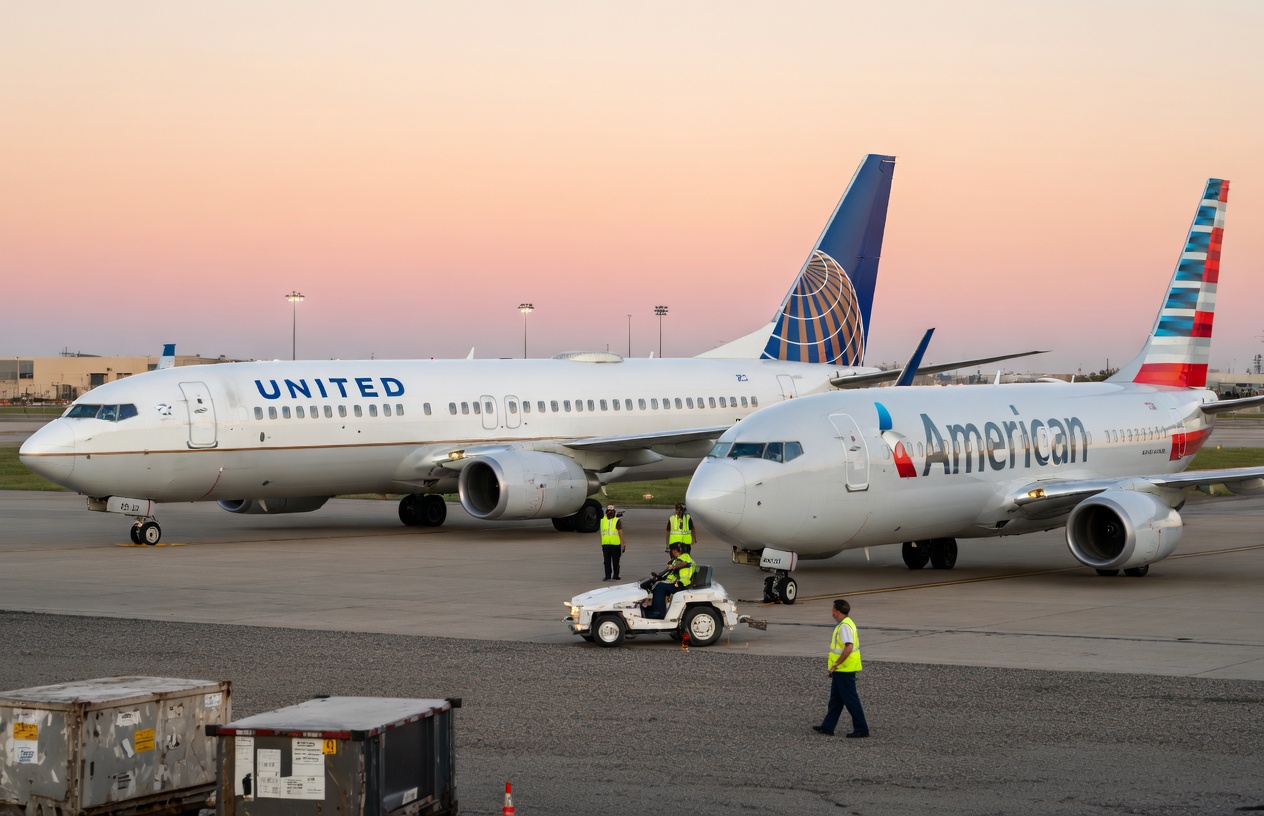
United Airlines CEO Scott Kirby says he’d build a Miami hub if he could get 40 or 50 gates. He wants more at New York JFK than United’s planned return that he says happens next year will provide. American Airlines has both things, and he’s still explaining why buying the airline would be good for customers. I understand why he wants American’s assets. I’ve even made the case that United could do more with them. But in an interview with The CEO Signal, Kirby offers a strange defense of consolidation: United, American and Delta don’t compete on price. They compete on quality and value, so the usual objections to a merger supposedly don’t apply. Airlines compete on quality, too. Removing a competitor can change how hard they have to try. And Kirby even explains why – new airlines can’t just build up in major cities, because there aren’t enough gates. Kirby Wants A Miami Hub, And He Says How Big Kirby describes United’s strength across the Atlantic and Pacific, then acknowledges South America as a hole in the network. “But we’re relatively small in South America. And the reason is because there’s really only one hub that works for South America, and it’s Miami. And I wish we could get 40 or 50 gates in Miami, but probably hard to do. I don’t think American’s going to give them up. If we could, we’d put a hub there.” He wants a large connecting operation, with enough gates to collect passengers from across the country and send them south. He has Houston, but that hub has largely been an orphan in United’s growth announcements over the past several years. (Of course, United has claimed Houston had become a powerhouse for Central and South America.) Miami offers ideal geography and a large local market both for business travel and visiting friends and relatives. And American already has… a little over 50 gates plus flights, customers and a connecting schedule. Buying that position is a lot easier than building another one next door. United has actually been rumored to consider a Florida hub for quite some time. United’s JFK Mistake Was Bigger Than Losing Routes Kirby takes some credit for pushing United out of JFK when he was President at American: “We’re going to be back in JFK next year. It was a really big mistake for United to pull out. I feel like I was partly responsible. That was one of my goals when I was the president of American Airlines, was to get United pushed out of JFK. Sadly, I succeeded, and now I’m paying the price.” “We’re going to be back. We’re not going to be back in as big a way as I would like.” United’s agreement with JetBlue provides for up to seven daily round trips at JFK beginning in 2027. Kirby wants more. But American didn’t make United leave. United’s leadership made a bad decision about what the operation was worth. I wrote about this in 2017: after exiting JFK in 2015, United lost corporate business beyond the flights it had eliminated. Customers such as Disney and Time Warner weren’t just buying New York–Los Angeles. Their travel business extended across the system, including Los Angeles–London. The same applies to an individual traveler deciding which airline to make their default, where to pursue status and which credit card to put spending on. Kirby understood this when he explained United’s hub growth in 2017. Better connections made the airline relevant to more customers, which helped sell credit cards. And in his 2018 economics presentation, he explained why removing apparently weak flying can wind up damage profits more than helping it. Kirby, by the way, understands that United needs JFK even if a narrow route calculation fails to capture its value. But he’s also argued that American should leave Chicago based on his estimate of its narrow route profitability there – because he ‘understands math’. I’ve explained why Kirby is wrong about Chicago and its’ the same reason he’s right about JFK. American Has What He Wants, But Isn’t Selling American would bring a major South America gateway, JFK access, and allow him to consolidate Los Angeles and Chicago if regulators would let him. There’s no question this would be valuable. And he’d get to be CEO of the airline that fired him. But American isn’t engaging and Kirby says “We can’t get it done without a willing partner, and we clearly don’t have one. So, hypothetical.” When the interviewer suggests he thinks a deal might happen, Kirby pushes back: “I didn’t. I said we can’t get it done without a willing partner, and we don’t have one.” The regulatory barriers seem insurmountable regardless, because it’s not just convincing the Trump administration but states attorneys general and regulators in countries to which the two airlines fly. JetBlue Offers JFK And Fort Lauderdale. Kirby Wants A Bigger Deal. The obvious alternative is JetBlue. It has a substantial JFK operation and a South Florida base at Fort Lauderdale. I’ve identified that South Florida opportunity many times before. Fort Lauderdale could support more connecting traffic and would give United a South Florida operation that could reach South America. It’s not Miami but it’s the next-closest ting. Kirby doesn’t address those possibilities in the interview. He says the scale is wrong, “Mergers are hard. They’re complicated. They put you on the sidelines while you’re trying to integrate technology. And it’s really just as hard to integrate a small airline as it is a big airline. So if you’re going to go through that brain damage, my first choice is do something big.” He also doesn’t mention JetBlue’s debt. His earlier explanation argued that JetBlue would require a 25 percentage point margin improvement to make the acquisition work. He Doesn’t Want To Own 49% Of A Foreign Carrier Asked about buying an international airline, Kirby rejects the idea: “No. Different culture, different economics. Most international airlines don’t care about economics. They’re semi-government-owned entities. They care about flying the flag.” “When we have talked to people about it, they want you to take a 49% ownership stake, and the government wants to tell you where to fly. We’ve done some of those deals. Every airline, including United, that did them years ago, that has invested in foreign airlines, 100% of the time has lost money. One hundred percent of the time has lost money. And the reason is because they’re not economically motivated on the other side.” He describes his answer to a question about the smallest stake he’d accept: “Somebody asked me about one deal, ‘What’s the minimum ownership stake that you would take to buy an airline?’ I thought about it for a second. I said, ‘100%.’ I don’t want to buy an airline unless we’re in control.” Of course, Continental bought 49% of Copa in 1998 and sold down its holding in stages. It recognized a $78 million gain when it sold the remaining stake in 2008. And United can obtain international reach through partners. United’s joint ventures with airlines like Lufthansa, Air Canada, ANA and Air New Zealand approximate mergers that foreign ownership restrictions don’t allow to happen. There’s something of an irony in dismissing foreign airlines for caring about flying their national flag while describing his own ambition to build America’s flag carrier. He says United would do it commercially, without subsidies. But he also argues for subsidized aviation fuel. “We Don’t Compete On Price” Is A Terrible Merger Defense Kirby says objections to buying American rest on the mistaken idea that air travel is a commodity. He argues customers value a better product, and United would bring that product to more people. “Because I think it’d be great for customers. The only way a merger works is if it’s good for customers. Like everything I’m doing at United Airlines, everything that I think about is: How do we make a great airline for customers? And I am 100% certain that that merger would be good for customers.” He also says regarding United, American and Delta that: “none of those three airlines compete on price. We’re not the price leaders. We’re price takers. Southwest often sets prices, and other low-cost carriers. We don’t compete on price.” …“United is certainly competing—and by the way, I think Delta would say the same thing—we’re competing on value. We are trying to give customers value so that they want to fly our airlines.” I’ve argued this combination could be less damaging than the conventional reaction assumes. Aircraft and pilots don’t disappear because ownership changes. Capacity could grow. A market doesn’t necessarily need dozens of firms to produce competitive outcomes. However, Airlines don’t just set fares, they decide how many seats to offer at the lowest fare, whether to match a sale, and how much more customers will pay for your schedule or service. Fare changes aren’t the only way airlines compete on price, and United touts basic economy precisely as a way to discount and compete on price without allowing those lower fares to become available to customers that don’t want the restrictions. United doesn’t use basic economy fares only in markets where they compete with Frontier – they use it wherever they have excess capacity that can’t sell at higher prices. Value includes price. Passengers care about price and quality, and whether quality is worth it is always a question of at what margin. Airlines compete on quality. Seats, lounges, reliability, service, apps and loyalty programs are ways to win business. They aren’t just competing on price, and fewer competitors in a market can reduce the incentive to innovate quickly. (It can also make it easier to do so, there may be some offsetting effects.) And antitrust analysis doesn’t look only to price or assume airline seats are a commodity. Their 2010 merger guidelines already addressed differentiated products and competition through quality, service and innovation. He Wants To Be The Airline Americans Think Of As Their Flag Carrier Kirby ties all of this to a larger ambition, asking how to create “a U.S. airline that doesn’t need government subsidies, doesn’t want them, doesn’t need them, but that has the scale to compete and be the best at everything.” That’s been his pitch to the economic nationalism of President Trump. He wants Americans to feel about United the way people in Singapore or Dubai feel about their home airlines. Fortunately, he isn’t as delusional as Ed Bastian who claims Delta is as good as Singapore is. Kirby acknowledges where United falls short: “Well, we aren’t. I’m careful to say I think we’re the best in totality. We’re not the best at everything. Places I don’t think we’re the best yet: primarily it’s product. And primarily it’s against Middle Eastern and Asian airlines.” That’s also the one thing that wouldn’t get fixed by buying American Airlines! A more complete United network would be a win. It would help their credit card revenue in New York, Chicago, Los Angeles and Texas. But the bigger question is raises is access to airports. Airlines effectively collude with airports to block competition over the long term. The federal government does that by gifting slots at New York JFK, LaGuardia and Washington’s National airport in perpetuity. Using congestion pricing is far better than gifting slots. Topics on this page
United CEO Wants A 50-Gate Miami Hub—Says American Airlines Has What He Needs
Full Article
Original Source
Read the full article at Viewfromthewing →KhanList aggregates and links to publicly available news content. We do not host full articles from third-party sources. Always verify important information with original sources.