
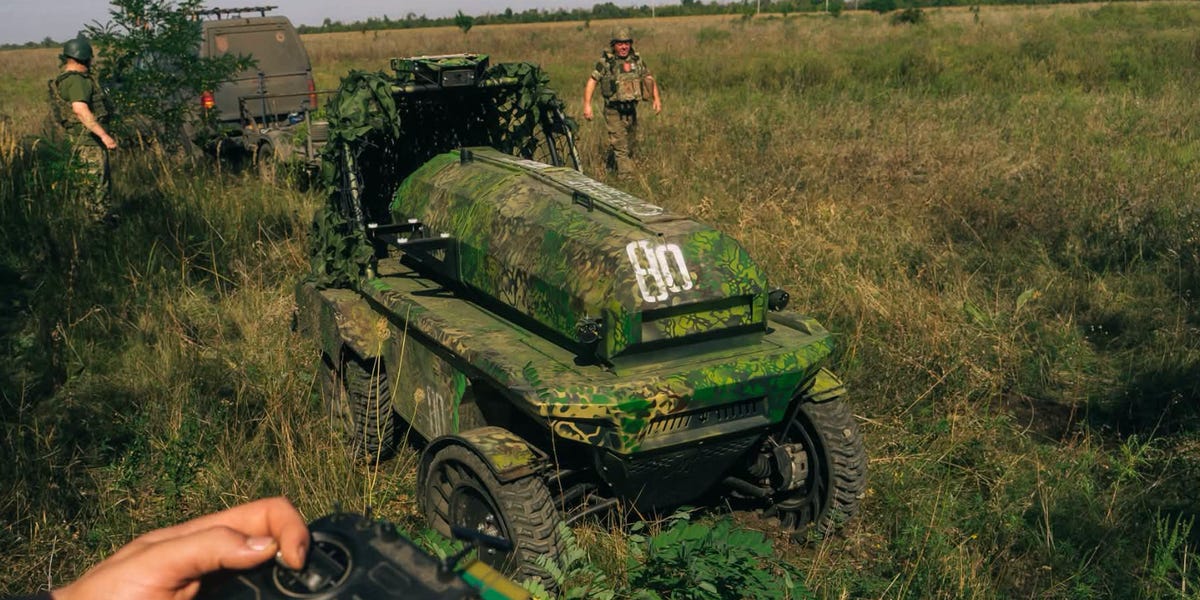
The MAUL purpose-built evacuation robot is designed to move faster than robots used for firing weapons and carrying gear. The First Medical Battalion of Ukraine Ukraine's robots designed to evacuate wounded soldiers move much faster than the robots built for attacking and hauling supplies, a design choice that developers and medics say can help save lives but also introduces new risks.Ukrainian military units are increasingly using uncrewed ground vehicles (UGVs) to move injured soldiers to safety because the machines can infiltrate the areas medics can't reach, reducing the risk of additional casualties. Like medical crews, though, casualty evacuation robots are targets. Combat footage has captured robots being attacked by Russian drones.Ukrainian robotics company DevDroid purpose-built its MAUL evacuation robot to outrun threats, making it faster than other robots being used in combat.Its reconnaissance and strike system, Droid TW-12.7, has a maximum speed of 12 kilometers per hour, while its MAUL purpose-built evacuation robot has a recorded mission peak speed of 72 kilometers per hour.Oleg Fedoryshyn, the company's director of R&D, told Business Insider that MAUL is quite a "unique device from all UGVs that we have because it's very fast." That helps it avoid some drone attacks, he said, and it gets soldiers to treatment faster.While most of the company's robots are electric battery-powered, MAUL uses an ATV chassis and a combustion engine.The MAUL robot was designed and developed by specialists from the 1st Separate Medical Battalion, a specialized medical unit of Ukraine's ground forces. The unit has repeatedly said that moving as quickly as possible is key to successful evacuations.Brave1, a Ukrainian government-backed defense technology incubator, say that MAUL's speed is essential. It says "one of the main challenges of the modern battlefield is to save the wounded in time," making specialized evacuation robots necessary. MAUL has an armored capsule to protect the injured soldier from attacks. The First Medical Battalion of Ukraine Last November, the 1st Separate Medical Battalion described an evacuation mission that was successful despite a Russian drone attack because the robot was able to outrun it. Nataliia, an engineer in an uncrewed systems company, told Ukraine's defense ministry in December that the idea for the faster engine "came from our battalion commander because he placed emphasis on speed. Existing solutions with electric engines did not allow us to reach the required speed."Jeffrey Wells, a US Navy veteran with experience in Iraq and Afghanistan who is now involved in medical training for front-line Ukrainian civilians, told Business Insider that "yes, speed matters." That's because "drones have made the last few kilometers to a casualty the most dangerous ground on the front."Evacuations are targeted, and "every minute a UGV spends crossing that ground is a minute it can be spotted and struck. From what I have seen this past year, speed shortens exposure, for the vehicle and for the wounded Ukrainian defender on it."There are drawbacks, though.Fedoryshyn said that at high speeds, a small mistake by the operator can cause a much bigger problem. If there is a lag or the operator makes a small error, "you will lose your vehicle."The aim is to keep adding more automation, much like modern cars, that help prevent accidents, he said.Wells said the faster platforms "leave less room for operator error: a misjudged turn or a lost link at speed is more likely to end in a rollover, and a rollover with a wounded person aboard is a serious problem."That can create even more danger if soldiers then have to go out to help and are targeted by Russian drones. "The operator is often working remotely, under fire, and exhausted, which compounds the risk," he said.The MAUL design accounts for many of these risks, including an armored capsule to protect soldiers from attacks and straps to secure them. Modifications and updates are also made regularly. Many types of robots in Ukraine can evacuate wounded soldiers, but not all have an armored capsule for their protection. Mykhaylo Palinchak/SOPA Images/LightRocket via Getty Images While these robots can move quickly, operators don't always push the machines to their maximum speeds. The First Separate Medical Battalion, for example, described on its social media an operation involving a robot with a maximum speed of 38 kilometers an hour, but during the mission, the bot's average speed was just 18 kilometers an hour.Wells, who is in Ukraine with the nonprofit medical organization Task Force Antal, characterized speed as "one variable among several" to consider."A casualty isn't cargo," he said. "Speed over broken ground means jolting, and that can worsen bleeding, fractures, or spinal injuries, especially when nobody is riding alongside to monitor or treat them."What's important, Wells explained, is "the whole chain: how fast a vehicle can safely move over that terrain, how well it can stay connected with its operator, how protected and stable the patient can stay, as well as how fast it can get to a place where a trained medic can help."Using robots means trade-offsUkraine's growing fleet of robots carries gear, lays mines, and blows up Russian positions, but units don't always have access to robots specially designed for each of these missions. Instead, they often rely on general-purpose systems or repurpose robots built for other jobs. Ukraine also uses robots that fire weapons, blow up Russian positions, and carry gear. Serhii Mykhalchuk/Global Images Ukraine via Getty Images Fedoryshyn said that the reality for soldiers is that "it's not like they have 10 different types of UGVs" and can simply decide which one they want to use.Instead, soldiers take ones made for one job and use them for something else. They'll take the turret off a robot and use what might have been an offensive system for logistics. Sometimes soldiers need to evacuate soldiers with a UGV that wasn't made for that specific purpose, "because they haven't any other option," he said.A combat unit might wrap up a logistics mission, for instance, then discover someone needs to be evacuated. In that case, they might just send the same robot out. DevDroid's goal is to increase MAUL production to reduce that problem, Fedoryshyn said.Soldiers often say that they like having more generalist robots that can easily be configured differently for varied operations, but sometimes, that takes its toll on specialized missions.While there is value in having multi-purpose robots, the speed and protection of a dedicated evacuation robot typically give soldiers the best chances of survival Read next Sinéad Baker is a Military and Defense Correspondent based in Business Insider's London bureau, writing about Russia's invasion of Ukraine and NATO actions.Sinéad most often covers soldiers' experiences, military strategy, battlefield developments, weapons systems, the defense industry's response, and the impact on NATO and European security, and geopolitical decisions that surround the Ukraine war. She has reported from NATO’s frontlines and around Europe, has interviewed multiple prime ministers and defense ministers, has appeared on BBC News and The Guardian's politics podcast, and has been cited by Congressional hearings.Sinéad has also extensively covered US politics and previously led Business Insider's breaking news coverage from London.Sinéad previously completed a master's degree in investigative journalism at City, University of London, and has written for The Guardian, The Observer, and TheJournal.ie. Sinéad is the former editor of the multi-award-winning The University Times in Dublin.ExpertiseExperiences of soldiers in Ukraine, including battlefield developments and tacticsWestern military responses to the war, and lessons they should learnNew weaponry built for and in response to the war Email Sinéad at sbaker@businessinsider.com or find her on X. Ukraine Russia
Ukraine’s fast medical robots can outrun Russian attacks, but speed creates new risks, makers and medics say
Full Article
Original Source
Read the full article at Businessinsider →KhanList aggregates and links to publicly available news content. We do not host full articles from third-party sources. Always verify important information with original sources.