
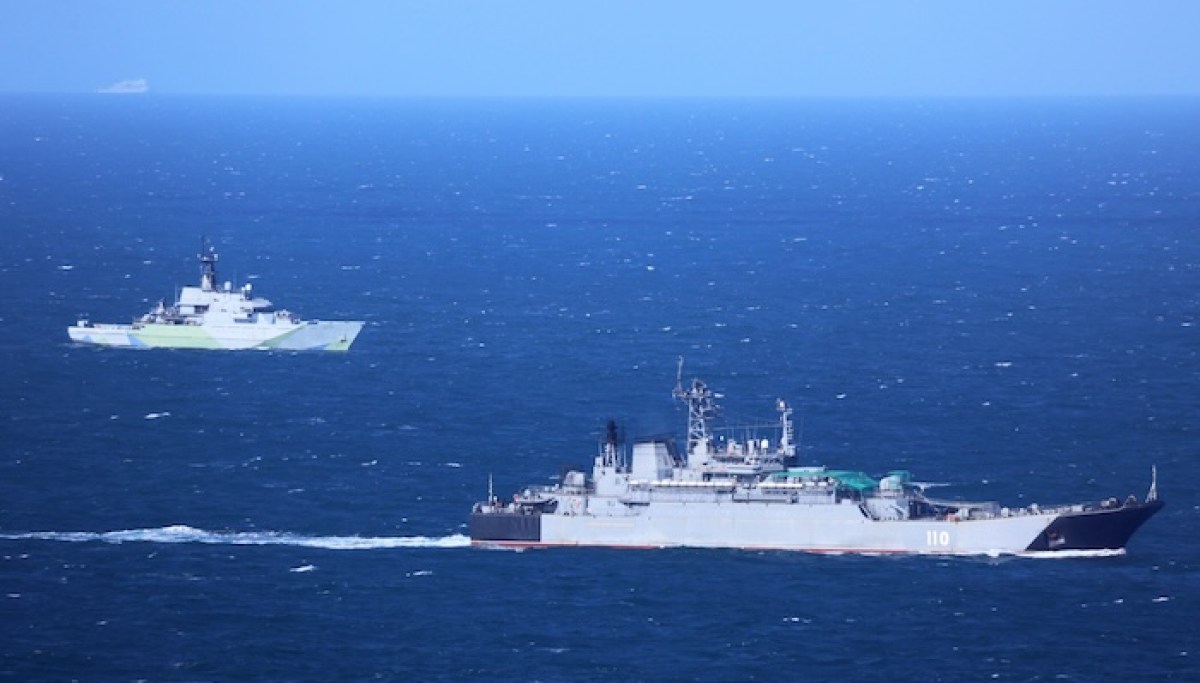
The United Kingdom’s Royal Navy dispatched personnel over multiple weeks in September and October to track Russian vessels in nearby waters, including an intelligence-gathering ship that was allegedly monitoring a NATO naval exercise.Russia’s Vishnya-class intelligence-gathering vessel Viktor Leonov was operating near the Outer Hebrides, and British helicopters tracked it from Sept. 29 to Oct. 8. Nearby, NATO troops were conducting Exercise Strike Warrior 26 in waters north and east of the U.K., featuring more than 2,000 personnel from six countries.The Royal Navy also tracked two other nearby Russian vessels during recent weeks. RFN Aleksandr Shabalin transited the English Channel alongside the cargo vessel MV Energy-2 and tugboat Proton, as did the Russian frigate RFN Neustrashimy with associated merchant vessels.The Royal Air Force used the Protector RG Mk1 long-range drone for the first time during these operations. This specific drone was unarmed, but it provided more than 10 hours of intelligence, surveillance, and reconnaissance coverage.“Our armed forces work together every day, around the clock, to keep our country safe and safeguard our national interests,” Secretary of State for Defence Wes Streeting said. “For the first time, Protector has joined Royal Navy warships and helicopters monitoring activity around our shores, demonstrating how we are constantly innovating to monitor and deter threats and irresponsible provocation.”They also used the HMS Tyne, HMS Dauntless, Wildcat and Merlin helicopters to monitor the vessels.“Protector’s first operational sorties in UK airspace demonstrate the significant value this capability brings to UK Defence. Working alongside Royal Navy vessels, it provided persistent intelligence, surveillance and reconnaissance coverage, highlighting its ability to operate seamlessly across military and civilian airspace in support of maritime security, NATO commitments and wider UK tasking,” said Wing Commander Sam Haley, the officer commanding XIII Squadron.Image shows the Royal Air Force’s (RAF) newest aircraft, Protector RG Mk1, a remotely piloted aircraft system aircraft conducting its first flight in the UK skies from RAF Waddington on 17th November, marking another important milestone in the delivery of the surveillance, intelligence, and precision strike aircraft to the front line.The U.K. said it has tracked a 25% increase in Russian movements during the first seven months of 2026 compared to the same period last year.THE MILITARY’S $1 BILLION DRONE PLAN TO TAKE ON CHINA — AND HOW IT HOPES IT NEVER HAS TO USE THEMAs part of the U.K.’s effort to respond to Russian naval activity, it deployed Merlin helicopters from Royal Naval Air Station Culdrose to Glasgow Prestwick Airport as part of Operation Iceblast to support multiple maritime security operations. Captain James Hall, the commanding officer of RNAS Culdrose, said: “I am immensely proud of the efforts of our people, who have once again demonstrated that the UK is prepared to respond to immediate operational requirements,” he said.“This tasking was part of a wider series of operations, known collectively as Operation Iceblast, which was designed to test the ability of Merlin Helicopter Force to deploy away from its home base of RNAS Culdrose in force and at short notice,” he added.Russia is increasingly at odds with other European countries that are more aligned with the West. Between increased Russian limited attacks, like this one, and the war in Ukraine, countries in Europe view Russia as a threat to their security.
UK navy says it tracked Russian intelligence-gathering ship near NATO naval exercise
Full Article
Original Source
Read the full article at Washingtonexaminer →KhanList aggregates and links to publicly available news content. We do not host full articles from third-party sources. Always verify important information with original sources.