
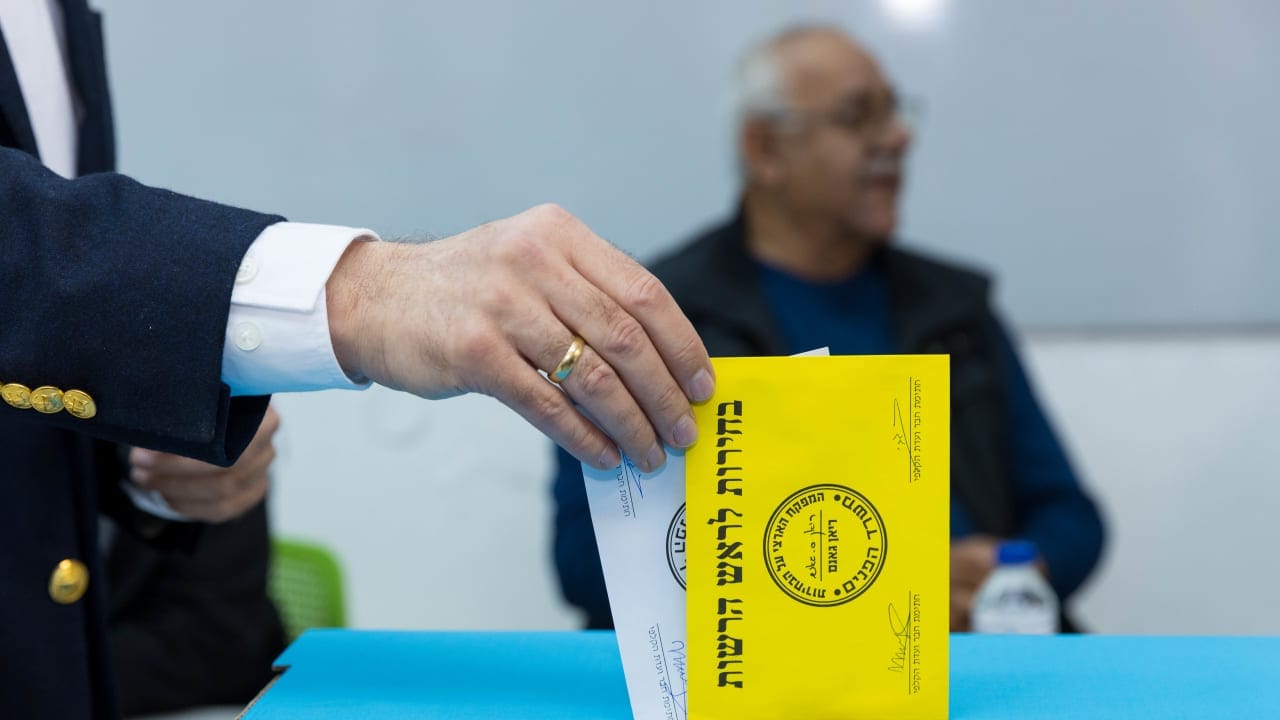
NOVEMBER 2, 2026 18:59Tuesday’s election left Israel’s leaders stuck, but its voters were hardly standing still.Turnout surged. Parties gained votes and lost seats. Nearly four in 10 seats in the next Knesset will be occupied by first-time MKs.The coalition arithmetic may be deadlocked. Beneath it, however, quite a bit is moving.Start with turnout.Election sees record-breaking Arab turnoutThe biggest story was in the Arab sector, where participation soared from about 53% in 2022 to about 77% this time - an increase of nearly 24 percentage points. That helps explain why the two Arab lists, Ra’am and the Joint List, nearly doubled their combined representation, from 10 seats to 19.A woman votes during the national election in the Arab city of Umm al-Fahm, northern Israel, October 27, 2026 (credit: REUTERS/AMMAR AWAD)Even that dramatic increase left them short of the sector’s demographic electoral weight. According to the Central Bureau of Statistics, Arabs account for about 18% of eligible voters living in Israel - the equivalent, on paper, of roughly 22 Knesset seats.The haredi sector, by contrast, accounts for about 10.5% of eligible voters, and its two established parties won 13 seats, roughly matching that share.But that combined figure conceals two very different results: seven seats for United Torah Judaism and six for Shas.For Shas, which had 11 seats in the outgoing Knesset, that was a shellacking - its worst showing since 1992.The party lost nearly 100,000 votes. Much of that loss has been attributed to its uncompromising opposition to haredi conscription, a position believed to have driven away traditional Mizrachi voters whose sons serve in the army.The draft issue also figured prominently in the campaigns of Ofer Winter and of Yoaz Hendel and Yaron Zelekha, whose parties together received about 250,000 votes but failed to cross the electoral threshold.Those votes were enough, in raw numbers, for roughly six seats. Add them to the five Shas lost, and the scale of the electoral movement around this issue becomes apparent.That does not mean every Shas defector left because of conscription, or that every Winter or Hendel voter came because of it. It does suggest that the dispute over who serves was far more than campaign background noise.The surge in Arab participation helped push overall turnout from about 71% in 2022 to nearly 78%, the highest since 1999.All told, 922,000 more people - almost a million - cast ballots this time than last.That larger electorate helps explain one of the election’s apparent anomalies: a party could gain voters and still lose seats.The Likud received 52,000 more votes than in 2022, yet dropped from 32 seats to 27. How? Its vote total grew by just 4.7%, while the total number of valid votes cast rose by 19.4%. Likud had more voters, but a smaller share of the vote.The pool used to allocate seats consists of votes cast for parties that crossed the 3.25% threshold. This time, each seat represented roughly 45,000 votes, compared with about 36,000 last time. So to hold on to the same number of seats as IN 2022, the parties had to increase the number of votes they received significantly. For example, UTJ - which received seven seats in both 2022 and on Tuesday - won 12% more votes this time, but that was not enough for an additional seat.The Democrats illustrate the other side of the equation.In 2022, Labor and Meretz ran separately. Labor won four seats, but Meretz barely missed the threshold by some 4,000 votes. Together, they received roughly 327,000 votes, but only Labor’s votes translated into Knesset seats. This time, running together as the Democrats, they received about 366,000 votes - an increase, similar to that of UTJ, of roughly 12% - and won eight seats.Their vote total rose modestly. Their representation doubled. At the time, however, none of those votes were left outside the Knesset.And what did all those voters, casting all those ballots, ultimately produce?An inconclusive result that will require weeks - if not months - of negotiations to form a government or, barring that, send the country back to the ballot box.But while the election did not produce a governing majority, it did produce a substantially different Knesset.No fewer than 47 members of the incoming Knesset have never served there before - just one short of the record first-year class elected in 2013.Gadi Eisenkot’s Yashar leads the way, with 15 newcomers among its 21 MKs. Bennett’s B’Yachad has six among its 12 - fully half. The Joint List has seven of 11.That is considerable renewal for an election whose results have so far produced a familiar political impasse.A closer look at the newcomers reveals another thread running across party lines: people whose lives were directly upturned by October 7 and the war that followed - bereaved parents, relatives of hostages, wounded soldiers, October 7 rescuers and veterans of extensive wartime reserve service.On Yashar’s list is Shira Shapira, whose son Aner was killed on October 7 while heroically protecting others in a roadside bomb shelter.Likud’s newcomers include Talik Gvili, whose son Ran, an elite police officer, was killed on October 7 and whose body was the last returned from Gaza, and Elisha Meidan, a reserve combat officer who lost both legs fighting in Gaza.B’Yachad includes Michal Hirsch-Negri, whose son Roy, a counterterrorism unit commander, was killed fighting at Be’eri. It also includes Noam Tibon, a retired general who took part in combat and rescue operations on October 7, including rescuing his son’s family at Nahal Oz, and Maglan reservist Yonatan Shalev, who served hundreds of days during the war.The connection runs across the political spectrum.The Democrats’ Omri Ronen fought on October 7 and served extensively afterward. His grandmother, Nira Ronen, was murdered in Kfar Aza.Yisrael Beytenu’s list includes Rafi Ben-Shitrit, whose son Elroy was killed defending the Nahal Oz military outpost, and Sharon Sharabi, brother of former hostage Eli Sharabi and of Yossi Sharabi, who was killed in Hamas captivity.The Religious Zionist Party’s newcomers include Zvika Mor, whose son Eitan was a hostage, and Itamar Eitam, a reserve battalion commander wounded by sniper fire in Gaza.This personal connection to October 7 is not confined to the new faces.Eisenkot lost his son Gal and two nephews, Maor Cohen Eisenkot and Yogev Pazy, in the war. Religious Zionist Party head Bezalel Smotrich’s son Benaya was wounded on the Lebanon border. Zehut leader Moshe Feiglin’s grandson Yair Levin was killed in Rafah.Others fought or took part in rescue operations, including Likud’s Almog Cohen in Ofakim and the Democrats’ Yair Golan, who rescued survivors of the Nova festival. Otzma Yehudit’s Yitzhak Kroizer served in the reserves during the war, including in southern Lebanon.The point is not that these experiences will lead them to the same political conclusions. Clearly, they have not. October 7 is changing who sits in the Knesset.Combat service, bereavement and the struggle to bring relatives home have given some candidates public recognition and political standing. Their authority comes, in part, from what they have endured.Their presence could help keep issues such as haredi conscription and budgets for rehabilitation of soldiers and hostages high on the agenda. Across party lines, the war’s consequences will feel more personal in the next Knesset.The familiar faces still lead the major parties and will dominate the coalition negotiations. Beneath that continuity at the top, however, the election has brought considerable change to the ranks.Still, a large freshman class is no guarantee of a lasting political generation.The 2013 election brought 48 first-time MKs into the Knesset - almost exactly the size of this year’s intake. Only seven of them will be entering the Knesset this time, a sobering statistic, perhaps, for those now celebrating their first election.But that class also produced two future prime ministers: Naftali Bennett and Yair Lapid.For now, attention is fixed on the veteran party leaders negotiating over who will lead the next government. Somewhere among the 47 newcomers, however, may be the person who leads the next one.Follow us on Google
Deadlock aside, turnout statistics are real story in Israel's election - analysis
Full Article
Original Source
Read the full article at Jpost →KhanList aggregates and links to publicly available news content. We do not host full articles from third-party sources. Always verify important information with original sources.