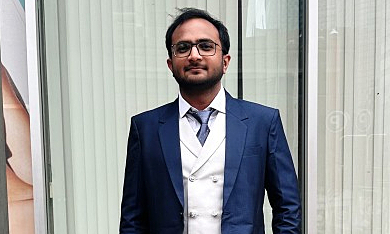
After two F-1 visa rejections, an Indian student eventually reached the United States, joined Tesla, began a Ph.D. program, and now advises applicants to strengthen their profiles. Mayank Vadaliya, 32, said his first attempt to enter an American university came in 2015, shortly after finishing his high school. He applied to Montana State University for a bachelor's degree and attended his F-1 visa interview believing his chances were strong. However, his application was rejected after a brief interview that focused on his identity and how his studies would be funded, according to Times of India. An F-1 visa is a non-immigrant visa that allows international students to pursue full-time academic education or English language training in the United States. He applied again the following year to the same university, but the visa was denied a second time. Rather than continuing to pursue an undergraduate degree in the U.S., he enrolled at Gujarat Technological University and completed his bachelor's studies in India. After graduating, he decided to make another attempt, this time applying for a master's program in the U.S. His third visa application was approved. Mayank Vadaliya in photo on his LinkedIn account. Speaking to The American Bazaar, Vadaliya said the difference was not a single interview answer, but rather the stronger profile he had built over time. He said he focused on completing his degree, clarifying his academic goals, and presenting a clear purpose for studying in the U.S. "After my two refusals I stopped trying to win over the officer in the moment and started building a profile that speaks for itself. I finished my degree, got clarity on what I wanted to study and clearly stated my intent in the application." "The other big thing is confidence," he added. By the time of his third visa interview, he had already received an offer from a university in Australia, which reduced the pressure he felt during the process. Vadaliya arrived in the U.S. in 2020 to pursue a master's degree in computer science at Cleveland State University. He later entered the technology industry and currently works as an Application Support Engineer at Tesla, supporting operations at facilities in Fremont, Nevada, and New York. At the same time, he returned to academic research and began a Ph.D. program in Information Technology at the University of the Cumberlands. This year, he was also accepted as a full member of Sigma Xi, a long-established scientific honor society, as stated on his LinkedIn account. He is currently in the United States on an F-1 student visa with work authorization under the Curricular Practical Training (CPT) program, which remains valid through 2028. If he meets the requirements, Tesla may later sponsor him for an H-1B non-immigrant U.S. work visa or O-1 non-immigrant work visa for individuals with extraordinary ability or achievement, according to India West. Vadaliya said his Ph.D. research centers on real-time traffic forecasting. He developed an open-source Python framework that integrates convolutional neural networks, long short-term memory (LSTM) networks, and gradient-boosted models to predict urban traffic congestion. He noted that the system cut prediction errors by more than 30% compared with using each model independently on the METR-LA freeway sensor benchmark. The framework is also designed to work with existing cloud and edge computing infrastructure, including platforms deployed under India's Smart Cities Mission. Drawing on his own experience of two visa rejections before ultimately succeeding, he offered this advice: "Build a stronger case, give yourself a back up plan, and walk in believing you belong there. A rejection is a delay. Not a dead end," as quoted by The American Bazaar.
Twice denied F-1 visa, Indian student now works at Tesla while pursuing PhD
Full Article
Original Source
Read the full article at E →KhanList aggregates and links to publicly available news content. We do not host full articles from third-party sources. Always verify important information with original sources.