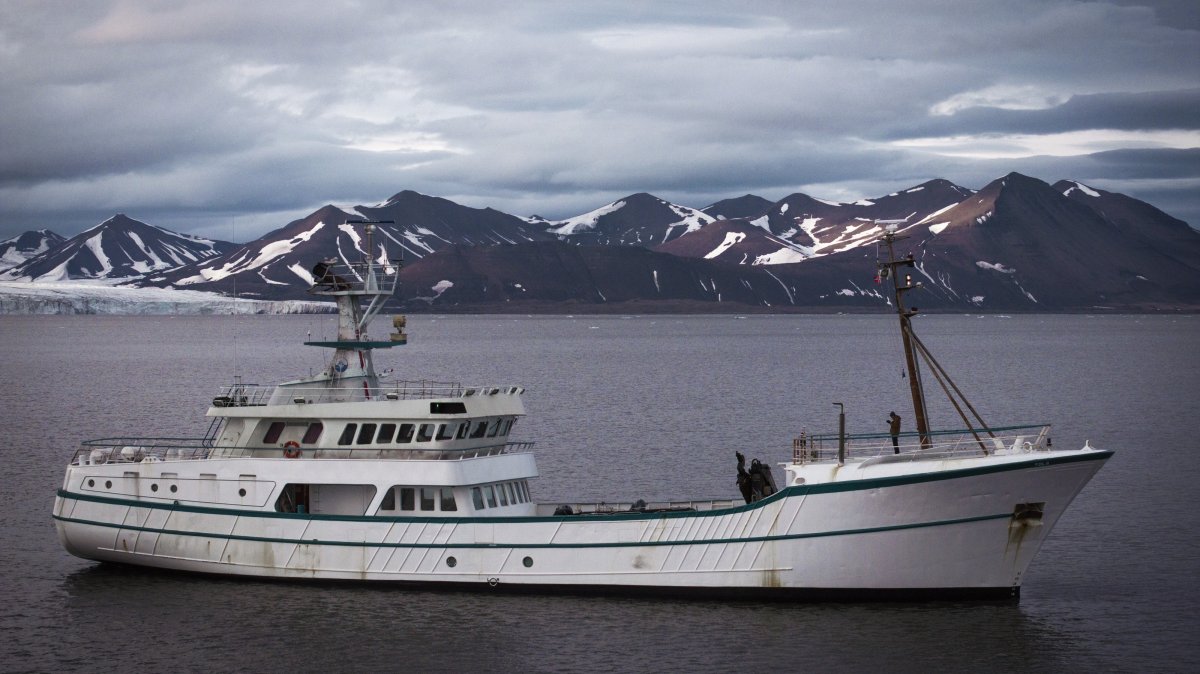
Turkish scientists have concluded the 6th National Arctic Scientific Research Expedition (TASE-VI) after carrying out critical studies on climate change, marine ecosystems, space technologies and high-precision positioning systems in the Arctic. The expedition, conducted under the auspices of the Presidency, coordinated by the Ministry of Industry and Technology and organized by the Scientific and Technological Research Council of Türkiye's (TÜBİTAK) Polar Research Institute (KARE), brought together 12 Turkish scientists and three international researchers from Argentina, Bulgaria and Uruguay. During the mission, the team implemented 12 scientific projects spanning oceanography, biology, chemistry, atmospheric dynamics, meteorology, geodesy and satellite systems. Traveling by ship to 82 degrees north latitude, researchers continued work under Türkiye's National Polar Science Strategy, focusing on global climate change, threatened ecosystems and human-induced environmental impacts. Scientists examine climate change's impact on marine life. Denizhan Vardar from Istanbul University's Institute of Marine Sciences and Management said the team joined the expedition to investigate how climate change affects organisms living on the seabed. "Our TÜBİTAK 1001 project on polar research was accepted, which gave us the opportunity to come here," Vardar said. "Our research has two main components. First, we are capturing images from 28 locations on the seabed to examine the surface coverage of marine organisms. We are also using underwater robots and drones to determine the boundaries where these organisms begin and end. In addition, we are conducting underwater imaging in particularly important and scientifically interesting areas, such as glacier fronts." Nanomaterials undergo Arctic tests Filiz Altay from Istanbul Technical University's Department of Food Engineering said her work primarily focuses on nanotechnology applications, which eventually led her to space research. She explained that her TÜBİTAK KARE-supported project consists of two parts. "In the first part of the project, we aim to determine the stability of nanomaterials produced in our laboratory under space conditions," Altay said. "In the second part, we are studying the extraction of exosomes, vesicles responsible for communication between cells, from fish species unique to the region." Bengüsu Mirasoğlu, deputy expedition leader and medical officer, said her role was to respond to any sudden illnesses or emergencies that could arise during the mission. She noted that her work as the expedition's physician began long before departure, with all participants undergoing comprehensive medical examinations and health screenings. "The purpose of these examinations is to minimize health risks during the expedition, prevent illness and provide treatment if necessary," she said. Mirasoğlu added that participants also received pre-expedition training on basic health and safety issues. "We did not encounter any major health problems during the expedition," she said. Research assistant Özkan Özel from Dokuz Eylül University's Institute of Marine Sciences and Technology said he joined the expedition after his project was accepted under TÜBİTAK KARE's 2026 Polar Research Program. "The selection of Svalbard is especially significant for understanding the impacts of global climate change because it is one of the rare places where atmospheric processes interact directly with the sea and ocean. It serves as a natural laboratory where freshwater and saltwater coexist," Özel said. He noted that conducting research at the same sites over the past three years would provide valuable long-term data on glacier melt rates and the effects of climate change, helping improve future scientific projections. Özel added that long-term monitoring of areas where glacial meltwater mixes with seawater, together with other studies around Svalbard, would contribute significantly to a better understanding of the region's ecosystem. Emre Bozdoğan from Gebze Technical University's Department of Geomatics Engineering said the team collected data using three different Global Navigation Satellite System (GNSS) receivers and antennas from the expedition's starting point in Tromso. "Our goal is to test the performance of different real-time GNSS techniques under Arctic conditions," he said. "We will also investigate whether data losses caused by signal and correction interruptions can be compensated using a kinematic VRS-based positioning software that we are developing as part of the project. We aim to provide uninterrupted positioning capabilities for both our country and the broader GNSS research community," Bozdoğan said.
Turkish scientists advance climate, space research in Arctic
Full Article
Original Source
Read the full article at Dailysabah →KhanList aggregates and links to publicly available news content. We do not host full articles from third-party sources. Always verify important information with original sources.