
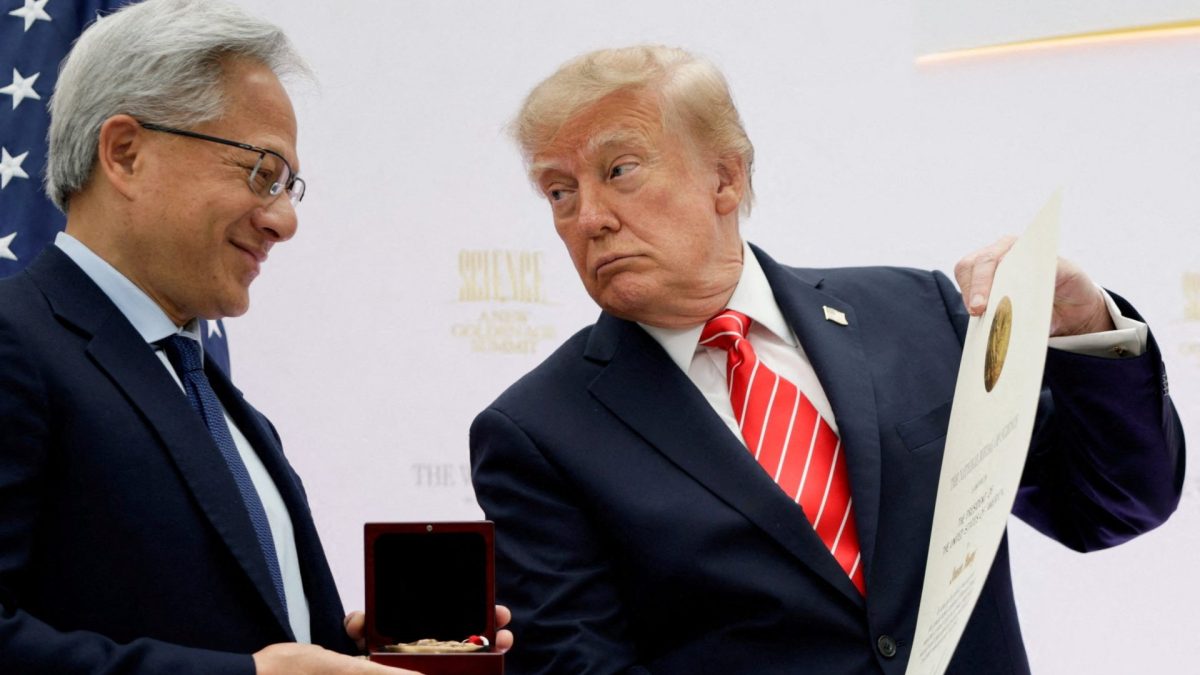
Tired, immoral, oligarchic, and in terminal decline – these are the things you think when you look at the United States now. An economy balanced on the top of an inflated AI bubble, a set of untouchable tech chief executives who wield the powers of kings but show no sense of judgement or restraint, a vain and self-interested president, obsessed with his own self-enrichment and immune to any notion of responsibility. Donald Trump’s personal intervention to bring back Jensen Huang as Nvidia chief executive feels like the terminal stage of regime corrosion. The president applied pressure on the company board over the weekend and ensured the former chief was brought back less than two weeks after he was forced to resign. It took place despite probes by the FBI and the Securities and Exchange Commission, congressional investigations, and thorny still-unanswered questions about Huang’s relationship with an alleged Chinese spy. Trump seemed alarmed at the market reaction to Huang’s troubles at the company. According to the BBC, Trump bought Nvidia stock 85 separate times through various investment accounts. Over the last two years alone, he purchased stock worth between $23m and $86m (£18m and £66m). But once he intervened, Nvidia’s share price bounced strongly, although it was still 20 per cent down on a month ago. (The White House says Trump does not decide how his portfolio is invested, stating that “all investment decisions are made entirely by independent managers”.) No sane country would be run this way. We don’t know whether Huang’s love interest was a Chinese spy. We don’t know whether the president’s financial interests were his primary motivation in intervening on Huang’s behalf. But what we do know is that the investigation into what happened should be given time to conclude so that we can assess with some certainty whether she was a spy. We know that no president should be so deeply embroiled in the financial performance of a company he is regulating, let alone personally intervening in. No sane world would ever allow this. One of the reasons Trump intervened in Nvidia is because the company is so important to the overall AI ecosystem. It is the key supplier of the chips used by AI and a major investor into those very same AI companies that are buying the product. In October, the company hit a peak valuation of $5.7trn. There is now no credible skepticism over whether AI is a bubble. It is certainly a very useful technology and it will probably be part of our lives forever, but it is a bubble. What we don’t know is when that bubble will pop – or how severe it’ll be. When AI company Anthropic listed on the stock market, it acted like a case-study in bubble-mentality. The stock briefly hit $2trn capitalisation as a result of FOMO and dazzle, but then later fell amid a broader tech sell-off, which looked quite panicked. Classic bubble behaviour: fizz and hangover. This keeps happening, sudden bouts of financial fear and anxiety sweeping through the system. Just weeks beforehand, the US midterm results sparked a terrible market wobble, with a huge move away from tech stocks as a result of public concerns about data centres. It wasn’t just the big names. Memory hardware and chip companies fell hard, often losing up to 17 per cent value in a day. The system is so profoundly fragile. The US economy, with its outsized impact on the rest of the world, relies on the tech sector. The tech sector relies on Nvidia to provide the chips. But Nvidia is not structured like a normal corporation. It resembles a kind of feudal lordship. Huang works with 60 direct reports, giving him key decision-making ability over every element of the firm. No other company at this scale would use that structure. His extra-marital affairs have therefore shaken not just his family life, but also the company. And through the company, the tech sector. And through the tech sector, the world economy. If the world made sense, we would take stock at that point. We would ask, as New York mayor Zohran Mamdani did yesterday, whether people “signed up for their pensions being tied to the question of Jensen Huang’s fidelity to his marriage”. We would ask deep searching questions of the economy, of tech, of the revenue potential of AI, of corporate governance, and of national security. We would, most importantly of all, ask whether too much risk is concentrated into a circular funding stream of a small number of valuable companies run by volatile individuals whose egos have veered completely out of control. Instead we have this, a bubonic spectacle of a dithery, half-witted president, fresh from an electoral humiliation but utterly uninterested in even pretending to care about voters, intervening directly and without any accountability whatsoever into the affairs of the company. Possibly he was doing it to boost his own personal investment. Possibly he was doing it in a desperate bid to keep the show on the road, to make sure that the AI bubble lasts just a little longer – a few more months, a couple of years – until the end of his term, when he can blame the inevitable collapse on someone else. Or perhaps it’s both. Perhaps – and let’s face it this is the most likely option – his financial and political benefit now overlap so extensively that it is no longer possible to distinguish them. Either way, it feels like the last dying gasps of a political regime and an economic status quo.
Trump’s utter contempt for America is now laid bare
Full Article
Original Source
Read the full article at Inews →KhanList aggregates and links to publicly available news content. We do not host full articles from third-party sources. Always verify important information with original sources.