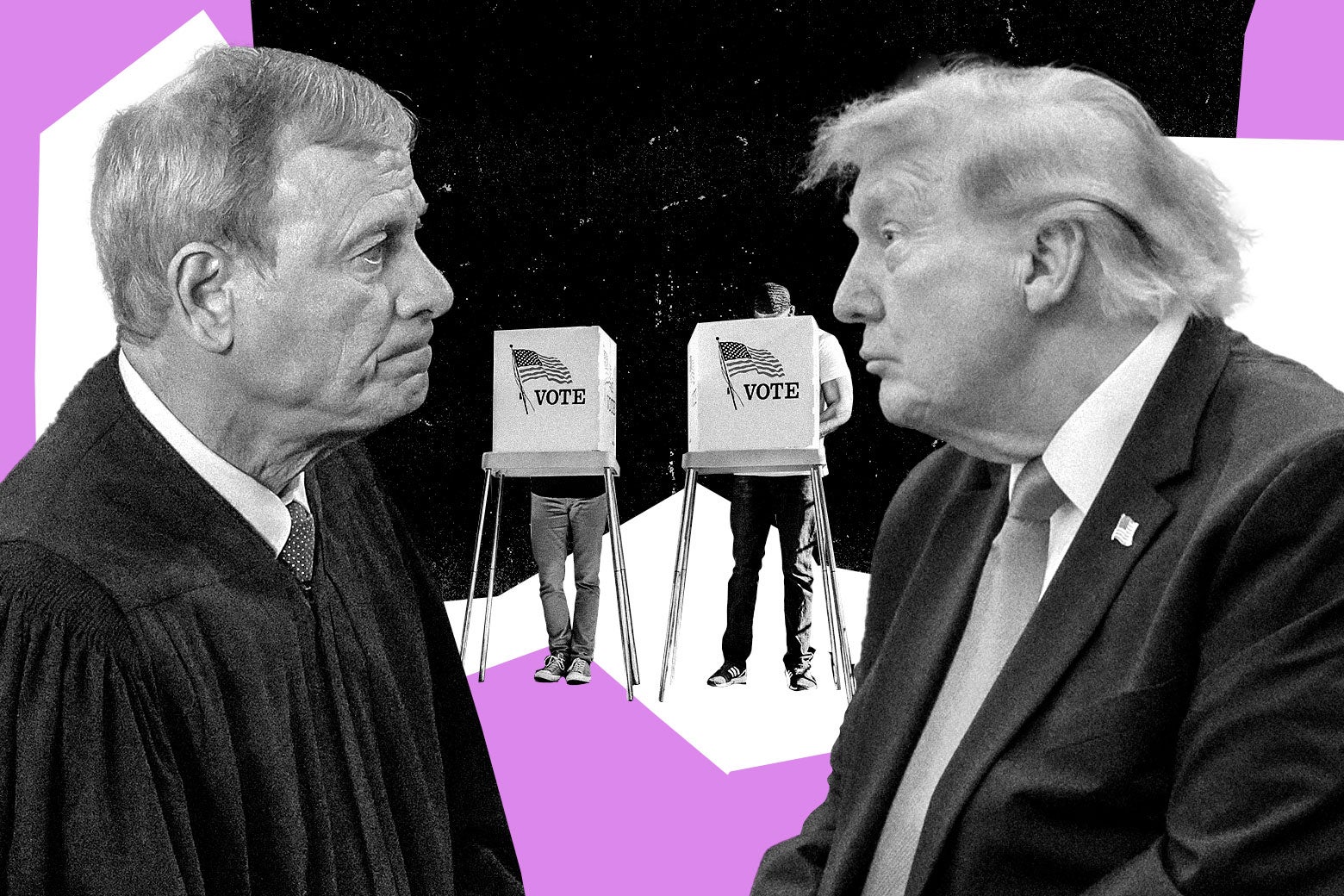
Jurisprudence SCOTUS will be deciding not only the fate of one executive order but whether its own doctrine of self-restraint in election cases still has any meaning. Photo illustration by Slate. Photos by Rawpixel/Getty Images Plus and Chip Somodevilla/Getty Images. Sign up for Executive Dysfunction, a newsletter that highlights one under-the-radar story each week about how Trump is changing the law—or how the law is pushing back. You’ll also receive updates on the latest from Slate’s Jurisprudence team. Imagine an NFL referee walking onto the field with two minutes left in the game to announce that the end zone has moved 10 yards downfield, effective immediately. Both teams would object, correctly, that changing the boundaries of the game this close to the final whistle makes a fair outcome impossible. For almost two decades, the Supreme Court has applied that same basic logic to elections, telling lower courts to leave voting rules alone once a race is close enough that altering them would confuse voters and overwhelm election administrators. This week, the Trump administration asked the court to do exactly what that rule exists to prevent, just from the other side of the field. On Monday, the administration requested that the justices let it fully implement an executive order that would remake how mail ballots work nationwide, about 100 days before the midterms. The order directs the Department of Homeland Security to compile lists of every citizen over 18 years old in each state, and it instructs the Postal Service to refuse mail ballots from any voter whose name is not on those rolls. A federal judge in Massachusetts blocked the plan for the 23 states, as well as the District of Columbia, that sued over it, and the U.S. Court of Appeals for the 1st Circuit declined to stay the injunction while the underlying case proceeds. The circuit court’s own order warned that letting the plan take effect this fall “would sow confusion and threaten disenfranchisement of many eligible voters.” The administration is now pushing the Supreme Court to overrule that judgment on an emergency basis, with the states due to respond by Monday. The doctrine at the center of all this has a name: the Purcell principle, a term coined by Slate contributor Richard L. Hasen after a 2006 case, Purcell v. Gonzalez. In it, the Supreme Court vacated a lower-court order changing Arizona’s voter-ID requirements just weeks before an election, reasoning that courts should be wary of altering electoral procedures once a vote is close at hand, because last-minute changes risk voter confusion and administrative chaos. In the two decades since, Purcell has become one of election law’s most invoked doctrines. It is not a statute or a constitutional command. It is a judge-made rule of caution that the justices devised themselves. Voting rights advocates have long argued that it functions asymmetrically: It is almost always cited to block courts from loosening a restrictive guideline shortly before an election, rarely to stop such a guideline from being imposed in the first place. Whatever one thinks of that critique, the principle has always rested on one consistent idea: Don’t change the rules of the game as the clock is running down. What makes the government’s new emergency application unusual is that it isn’t a court trying to change the rules close to an election. It’s the executive branch itself, asking the nation’s highest court, on an emergency and expedited basis, to let it impose a sweeping, brand-new nationwide restriction that did not exist before this year, with the fall election already on the calendar. If Purcell means anything, it should be that the branch urging the emergency intervention doesn’t get an exception just because it is the one bringing the change rather than resisting it. The 1st Circuit’s language about “confusion” and “disenfranchisement” is not a talking point borrowed from the plaintiffs. It’s the same vocabulary Purcell itself uses to describe exactly the kind of last-minute disruption that courts have spent 19 years trying to prevent. There is a reasonable legal argument, which the solicitor general has made, that the courts should not be weighing in at all at this point, because the relevant agencies have not finished deciding how they would even implement the order. That argument might carry real weight on its own terms. But it sits awkwardly next to the request that accompanies it: an emergency stay, granted immediately, precisely because there supposedly is not enough time left before November to let the ordinary appeals process run its course. Those two arguments pull in opposite directions. According to one, there’s no rush because nothing concrete has happened yet. According to the other, the court must act immediately because time is critically short. The administration is trying to occupy both positions in the same filing. Whatever the Supreme Court decides after the states’ deadline next week, the underlying tension is worth sitting with. Purcell is premised on the idea that stability in the closing months of an election is worth protecting, that the machinery of a vote should not be redesigned while it is already running. That premise doesn’t come with a carve-out for whichever branch of government happens to be asking for the redesign. Whatever the outcome, the court will be deciding not only the fate of one executive order but whether its own doctrine of self-restraint in election cases still has any meaning. A rule against moving the goalposts late in the game isn’t much of a rule if referees get to move them themselves, so long as they ask nicely enough, and quickly enough, right before the whistle. Sign up for Executive Dysfunction Delivered every Thursday morning. Donald Trump Jurisprudence Supreme Court Voting Voting Rights Judiciary Opinionpalooza 2026
Trump’s Desperate Attempt to Get the Supreme Court to Reverse Itself on Voting Chaos
Full Article
Original Source
Read the full article at Slate →KhanList aggregates and links to publicly available news content. We do not host full articles from third-party sources. Always verify important information with original sources.