
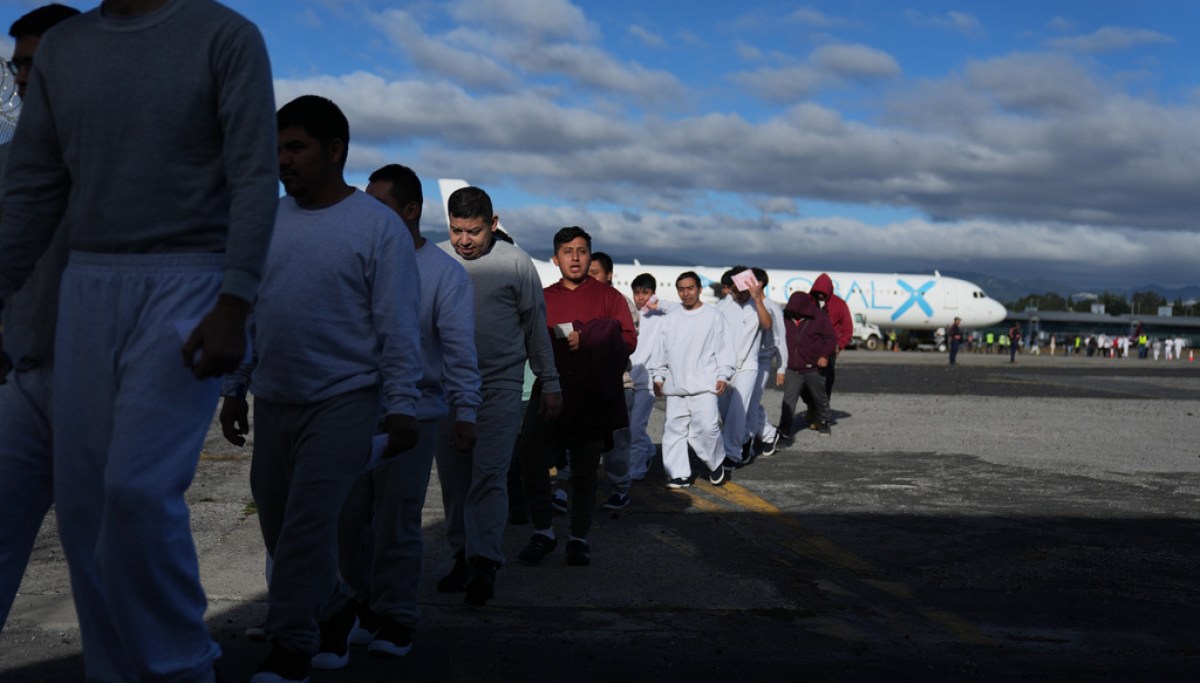
The Trump administration has moved to accelerate deportations by securing deals with countries worldwide to receive individuals deported from the United States who are not originally from their destinations.Through a process known as third-country deportations or third-country removals, the departments of Homeland Security and State have been able to increase how many illegal immigrants Immigration and Customs Enforcement can fly out, including those from places with governments that will not take back their own nationals.Approximately 23,000 individuals have been flown to countries worldwide where they have no citizenship, family ties, or personal connections. Approximately 35 countries have signed on to the deals, often in response to financial incentives or diplomatic pressure, according to Human Rights First. The practice was historically used in rare instances, and while it makes up a small percentage of the more than 1 million illegal immigrants that DHS says it has removed during the second Trump administration, it is being used as a way to encourage those in the country unlawfully to depart voluntarily — or face the prospect of being sent tens of thousands of miles away.The history of third-country removals Historically, Mexico has been America’s biggest partner when it came to accepting deported immigrants who were not originally from Mexico.For more than a decade, the U.S. has relied on deals known as safe third country agreements to send people in the U.S. to a third country that was willing to let them seek asylum. The difference now is that immigrants being sent to third countries are not able to opt in. Rather, they are detained in ICE custody and then put on a plane with sometimes less than a day’s notice of where they are being sent.President Donald Trump signed a declaration in March 2025 that invoked the Alien Enemies Act, which stated that Venezuelan men who the U.S. government deemed members of the Tren de Aragua gang are eligible for immediate removal, bypassing normal immigration court proceedings.Within days, the Trump administration sent 250 illegal immigrants to a mega-prison in El Salvador, and the U.S. sent a $4.7 million grant to El Salvador. Approximately 95% of those men were from Venezuela, not El Salvador, and were flown out of the country on the basis that they were affiliated with the global crime organization. Several months later, Venezuela agreed to accept its citizens back and the immigrants detained in the Salvadoran prison were moved to Venezuela.The Trump administration has also used visa sanctions or the threat of cutting off visas as a way to encourage cooperation from other countries. In one example, the U.S. lifted visa sanctions on Ghana after it agreed to accept non-Ghanaian citizens deported from the U.S.As of early September, Amnesty International reported more than 30 agreements with countries to accept deportees not from the U.S. or the recipient country, including 12 African countries: Cabo Verde, Cameroon, Central African Republic, Democratic Republic of the Congo, Equatorial Guinea, Eswatini, Ghana, Liberia, Rwanda, Sierra Leone, South Sudan, and Uganda.Across the Caribbean, Central America, and South America, the U.S. has reached agreements with 15 countries, including: Antigua and Barbuda, Belize, Costa Rica, Dominica, Dominican Republic, Ecuador, El Salvador, Guatemala, Guyana, Honduras, Mexico, Panama, Paraguay, St. Kitts and Nevis, and St. Lucia. Kosovo, Poland, and Uzbekistan have also signed on.The White House’s motivation DHS has touted third-country removals as a way to push illegal immigrants to self-deport to their country of origin to avoid the risk that they could be arrested and flown to a country on the other side of the world. The American Immigration Council, an organization that advocates the rights of all immigrants, described these types of removals as an effort to create fear in the immigrant community that leads people to leave the U.S.“The administration has used third-country deportations both to scale up removals of people who could not be deported to their home countries for various reasons, and as a scare tactic: using the threat of deportation to countries such as El Salvador and South Sudan to intimidate immigrants out of continuing to remain in the United States,” the AIC wrote in a fact sheet released on Aug. 31.Last June, the Trump administration placed 19 African countries on its travel ban list. The only way off the list, administration officials said, was to accept immigrants deported from the U.S. whose countries of origin were unwilling to receive them. As a result, the Trump administration has brokered more deals with African countries than with countries on any other continent.The government has prominently featured the third-country deportations on its social media accounts and encouraged people illegally residing in the U.S. to leave the country on their own accord.BLUE CITIES SUE TRUMP ADMINISTRATION TO KEEP IMMIGRANTS ON WELFAREThe DHS has offered one-way airline tickets and a stipend of up to $3,000 to those who choose to leave the U.S. as a cost-saving incentive that is cheaper than spending taxpayer dollars to seek out, detain, and remove them.To date, the White House has touted 2 million self-deportations. The Center for Migration Studies of New York has noted that figure is roughly 15% of the total illegal immigrant population nationwide.
Trump’s deportation strategy increasingly includes flying illegal immigrants to ‘third countries’
Full Article
Original Source
Read the full article at Washingtonexaminer →KhanList aggregates and links to publicly available news content. We do not host full articles from third-party sources. Always verify important information with original sources.