
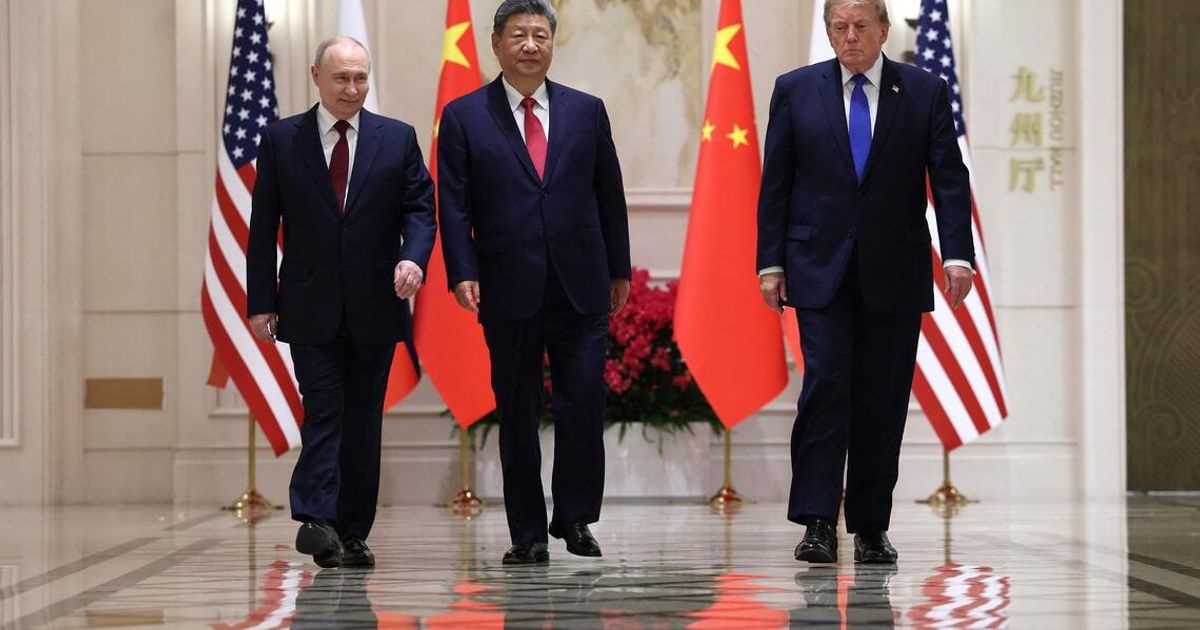
WASHINGTON - On his two-day trip to China this week, US President Donald Trump glad-handed and exchanged hugs with Xi Jinping and Vladimir Putin in an effort to flex his power after his Republican Party suffered a midterm election blowout at home.The imagery and symbolism of the meeting with the Russian and Chinese leaders often gave the opposite effect. He offered plaudits and praise instead of pressuring them on matters of disagreement. His warm exchanges with the US’ foremost geopolitical rivals belied the outsize tensions between them and further undercut the president’s standing with American allies and national-security hawks.The iconic photo of the three-way summit, with Xi at the centre and Trump and Putin at his sides, visually delivered Beijing a status it’s long sought: a dominant seat at the table presiding over the world’s great powers. “The summit showcased the three leaders doing the most to destroy American power,” said Kori Schake, a former Bush administration official now at the American Enterprise Institute. “An electorally-weakened US president, stripped of both the allies and ideas that make America internationally dominant, allowed Russia to escape isolation and pretend to be a great power while China presided with no mention of its economic subterfuge of US tech firms.”Trump’s encounter with Putin on the sidelines of the Asia-Pacific Economic Cooperation leaders meeting intensified his quixotic effort to end Russia’s full-scale invasion of Ukraine, yet it also kneecapped international attempts to isolate the Russian leader whose armed forces continue to attack Ukrainian cities and civilian targets. Furthermore on China, the US president passed up an opportunity to confront Xi over alleged efforts to gain access to advanced American artificial intelligence chips, amplified by the Nvidia scandal, even as some of his own advisers have warned that US export restrictions are too lax.Trump has long pursued a different foreign policy than his predecessors, one guided by direct diplomacy with American adversaries and skepticism of traditional alliances. Yet after more than half a decade in the White House, his critics say the strategy has borne little fruit. As he flew back to Washington, Trump posted on social media that the trip was “Great and Highly Consequential” and said he would hold a White House news conference on Nov 20 in order talk about its achievements, including trade frameworks struck with Thailand and the Philippines.Trump said he spoke about the conflicts in Iran and Ukraine with his counterparts, as well as AI. But concerns about China’s efforts to obtain sensitive US technology and pressuring Russia to scale back its attacks on Ukrainian targets did not appear to be top of mind for Trump when speaking about his interactions.Instead, the president spent the final day of the trip highlighting his friendship with Putin and his “outstanding” bond with Xi, including in trilateral talks at a lush villa outside of the Chinese technology hub of Shenzhen.“It’s an honour to be here with you, Vladimir. It’s an honour to be with you, Mr President,” Trump said, referring to Xi. He called each man a “friend”.The bonhomie on display in Shenzhen also risked striking a discordant note with Americans at home, who in recent days experienced a series of anxiety-inducing disruptions of air travel, telecommunications and banking. An ocean away from those domestic crises, Trump merely downplayed them, creating a split-screen effect as US news coverage was dominated by technology outages.“Tell them to relax. Everything’s good,” he said in a Fox News interview from China on Nov 19. That messaging threatens to amplify criticisms that Trump has lost touch with voters on issues ranging from the high cost of living and inflation to the risks posed by AI and cyberattacks.Isaac Stone Fish, founder of Strategy Risks, a business intelligence firm focusing on China, said while Trump made the right decision to go ahead with the trip, its priorities seemed far removed from the issues the American public is focused on.“I don’t know of any domestic constituency that was clamouring for Trump to meet with Xi and Putin,” he said.Anna Kelly, a White House spokeswoman, said Trump “effectively restored American strength – and his events in Asia showcased the great respect and deference that world leaders bestow upon our country under this president’s bold leadership. President Trump will meet with anyone in order to advance our country’s interests”. In his opening remarks at the APEC summit, Trump said US inflation had been tamed, comparing other countries’ fights with high prices unfavorably to Washington’s work on the issue.That position does not square with the feelings of many in the American electorate, who voted Republicans out of their majorities in Congress largely because of anger over the high cost of gasoline and goods, fueled by Trump’s tariffs and the conflict with Iran.Trump touted the trilateral meeting with Putin and Xi for weeks, expressing lofty ambitions such as the unlikely prospect of convincing Beijing to rein in its nuclear weapons stockpiles. At the same time, he dismissed more immediate concerns, saying for example that he did not need their help to resolve the war in Iran. In the end, the much-anticipated meeting which had allies and other nations fearing that they would be cut out of major geopolitical decisions, offered few – if any – concrete outcomes, beyond talk of reforming the United Nations, curbing the International Criminal Court, continuing discussions on nuclear weapons and uncertain pledges to boost supplies of petroleum products. “There was very little of substance, but there was a lot of, I think, bad optics for the Western democracies,” said Mary Lovely, a senior fellow at the Peterson Institute for International Economics, citing Putin’s criticisms of Western governments and international organizations. “It looks like three very powerful men who seem to be criticizing the current global governance architecture and replacing it with basically nothing,’ she said. Trump said that the reception he received was a win for the nation itself. Asked by Fox News how Americans would view the trip as a success, the president said he had “already gotten that headline, because the relationship that I have with China is a great one”.“The fanfare, the beauty, the pageantry, the thousands of people, the young children, the soldiers, the whole thing,” he recalled of his arrival in Shenzhen. “It was a great respect, and I appreciate that. That’s a big win for us. It’s a big win for China too.”Upon his return to Washington, Trump may also find that the good feelings from the summit are short-lived.On Air Force One as he departed China, the president called into a meeting of Ukrainian allies to tell them a separate face-to-face meeting with Putin had gone well and it would advance efforts toward a ceasefire. Putin, though, has already promised to step up attacks on Ukraine, saying earlier on Nov 19 that he would respond to an attack that damaged a key bridge between Russia and occupied Crimea. China this week also warned the US over restrictions to restrict its access to cutting edge artificial intelligence chips and servers. Trump for his part seemed eager to avoid any chance of offending his hosts, dismissing the espionage concerns by saying that both sides spy on each other and saying he did not think there was a national security risk from the Nvidia revelations. BLOOMBERG
Trump’s camaraderie with Xi and Putin draws pushback at home
Full Article
Original Source
Read the full article at Straitstimes →KhanList aggregates and links to publicly available news content. We do not host full articles from third-party sources. Always verify important information with original sources.