
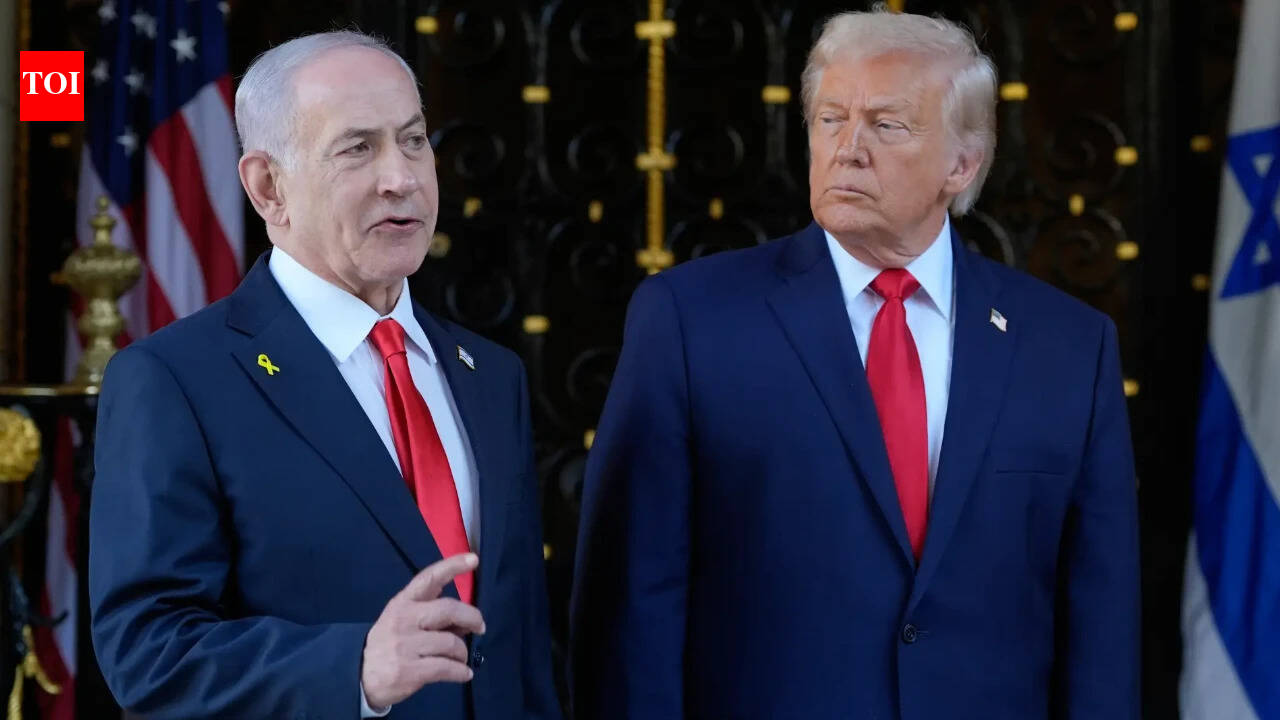
File photo: Israeli PM Benjamin Netyahu with US President Donald TrumpUS President Donald Trump spoke to Israeli Prime Minister Benjamin Netanyahu by telephone on Saturday as Washington assessed options for potentially resuming military operations against Iran, according to a US media report citing people familiar with the conversation.The call followed a meeting at the White House earlier in the week, during which Trump discussed possible military action with senior military commanders, The Wall Street Journal reported.The diplomatic engagement comes as the US continues to explore negotiations with Tehran while keeping the possibility of fresh military strikes open. US secretary of state Marco Rubio said talks with Iran had not stopped, adding that Trump had yet to decide whether to resume military action.Speaking to reporters after the G20 Foreign Ministers' Meeting in Georgia, Rubio said Washington remained open to a diplomatic settlement, provided it addressed US security concerns.“There are multiple talks; talks have actually never stopped. There's been active conversations going both in some cases directly, but often through intermediaries,” he said.Asked how long the US would allow diplomatic efforts to continue before considering military action, Rubio declined to set a deadline or assess the progress of negotiations.“I'm not gonna characterise either the progress on those talks or any timeframe on it other than to tell you that if there is a diplomatic solution, we would be open to it,” he said.Rubio said any agreement would have to address Iran's nuclear programme and its support for armed groups in the region. He also accused Tehran of threatening commercial shipping and disrupting maritime trade.On the possibility of renewed strikes, the US secretary of state declined to discuss specific military plans but said Washington believed it could achieve its objectives through force if required.“We can achieve military objectives if we seek to. He hasn't made a decision,” Rubio said, referring to Trump.US, Israel reportedly prepare for possible escalationThe Jerusalem Post, citing Israeli defence assessments, reported that the US and Israel were preparing for the possibility of renewed strikes, although Israeli officials remained uncertain about the timing of any escalation.According to the report, Israeli defence officials believe Iran is unlikely to accept an agreement requiring it to completely abandon its nuclear programme or stop producing ballistic missiles.They also assess that Tehran may be seeking to prolong negotiations ahead of the US midterm elections.The report said that despite preparations by the US military's Central Command (CENTCOM) for a possible operation, the White House was not expected to order strikes before the midterm elections unless it detected preparations for a surprise attack.The US and Israel have reportedly also drawn up plans for renewed strikes after the elections.The Jerusalem Post further reported that more than 3,000 American troops were stationed in Israel, while there had been no sharp increase in the number of US military aircraft redirected to the country during the previous week.Last week, 10 US Air Force transport aircraft arrived at Israeli Air Force bases in southern Israel as part of a wider military air convoy moving equipment across the Middle East, according to KAN News.The aircraft had travelled from Fort Bliss in Texas and were believed to be carrying air defence systems.Other aircraft in the convoy landed in Jordan, Qatar and Saudi Arabia. The report also referred to the transfer of an additional Patriot air defence system to the region.Iran signals response to US diplomatic overtureEven as Washington continued to signal its willingness to negotiate, Iranian officials offered their assessment of the latest diplomatic exchanges.Iran's top security official, Mohsen Rezaei, said the tone of a letter from US Vice President JD Vance had changed significantly.“Their tone has shifted completely, which is a good sign that shows that our people have secured their victory,” Rezaei told Iranian state broadcaster IRIB.The letter was delivered to Rezaei, secretary of Iran's Supreme National Security Council, through Qatari mediators on Sunday. According to The New York Times, the US proposal envisaged direct talks led by Vance, with Iran's nuclear programme included in discussions from the outset.The Wall Street Journal, citing a source, reported that the communication outlined a “framework for negotiations” rather than specific peace terms. The letter was sent at Trump's direction.Iranian foreign minister Abbas Araghchi said on Saturday that Tehran had studied the letter and described Washington's attempt to initiate dialogue as a “positive step”. He also said an aide had travelled to Doha for consultations with mediators.Citing sources, Al Jazeera reported that a meeting could take place within a week, with Doha and Istanbul being considered as possible venues.Iran's Supreme Leader Mojtaba Khamenei, meanwhile, warned that the country's armed forces would respond to any military or terrorist attacks by the US or Israel.He said Iran's response would be “geographically unrestricted”, adding that the armed forces and the Iranian people would determine the timing and conditions for ending any future confrontation.Rubio accuses Tehran of threatening maritime tradeRubio also criticised Iran's conduct at sea, accusing Tehran of deliberately targeting commercial vessels carrying cargo, oil and natural gas.He said US naval forces were intercepting incoming drones and anti-ship missiles almost every night. Despite the security concerns, he said petroleum transit volumes remained comparable to pre-conflict levels.The secretary of state warned that disruptions to maritime trade could have consequences for global food security, particularly if supplies of fuel, agricultural inputs and food commodities were affected.He also accused Iran of supporting armed groups across the Middle East, including Hezbollah in Lebanon, the Houthis and militias challenging the Iraqi state.“So anywhere you turn, what you find is some Iranian proxy that's undermining the peace and stability of the Middle East,” Rubio said.Trump had said at the White House on Friday that Tehran was keen to negotiate, reiterating that diplomatic contacts were under way.“There are talks, they want to talk, they keep talking,” he said, adding, “We have time, frankly.”The US president also claimed Iran was “in a lot of trouble” and predicted that the conflict would end “very soon”.
Trump speaks to Netanyahu as US weighs fresh military strikes on Iran: Report
Full Article
Original Source
Read the full article at Timesofindia →KhanList aggregates and links to publicly available news content. We do not host full articles from third-party sources. Always verify important information with original sources.