
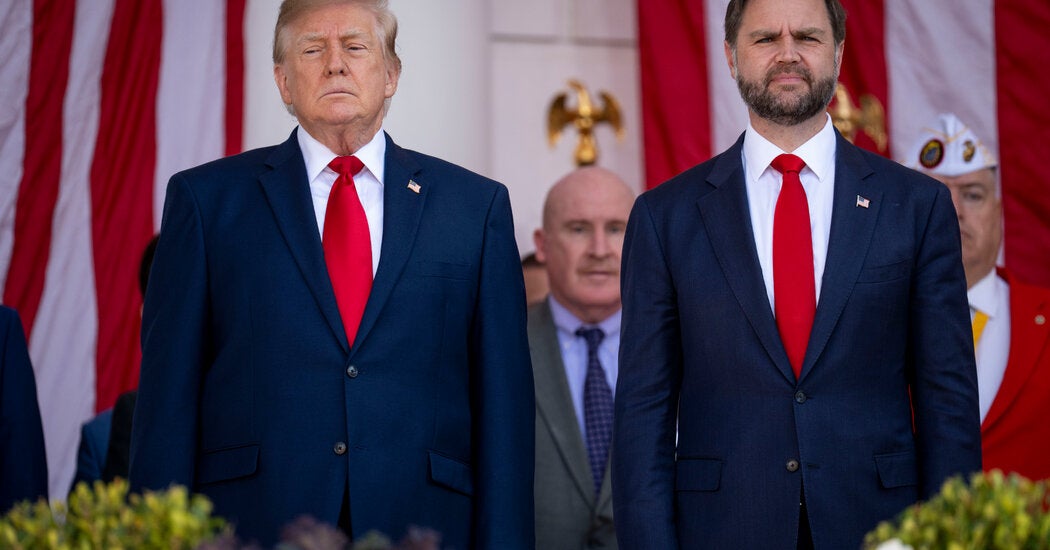
AdvertisementSKIP ADVERTISEMENTNews AnalysisThe administration appears to be moving toward a long-term economic pressure campaign as President Trump expresses little urgency in securing a nuclear agreement.President Trump says it is more important for Vice President JD Vance to investigate cities and states run by Democrats than to negotiate an end to the war with Iran.Credit...Doug Mills/The New York TimesDavid E. SangerDavid E. Sanger has covered five American presidents, and written on the efforts to contain the Iranian nuclear program for more than two decades.Nov. 13, 2026, 1:20 p.m. ETPresident Trump says he is leaning toward a new solution to the Iran nuclear crisis: Declare it is over, even if not much has changed.Mr. Trump and his team have taken to asserting that they have the Iranians right where they want them. They say they no longer need a new nuclear agreement that would remove potential bomb fuel from the country, or to limit Iran’s missile capability, two of the leading reasons the president cited 10 months ago for going to war.Mr. Trump appears — at least for now — to have rejected a series of military options that would involve intense, if time-limited, attacks on military installations, nuclear sites and even some energy infrastructure.All the talk this year of sending in commandos to seize roughly 970 pounds of uranium from the country, enriched to a near-bomb-grade level of 60 percent purity, has been abandoned, albeit for the moment. So has the detailed analysis of whether America’s biggest bunker busters are powerful enough to get deep into Pickaxe Mountain, a site U.S. intelligence believes — but is not sure — is the location of advanced centrifuges that can purify uranium into bomb fuel.In comments to reporters this week in Paris, where he was attending a meeting of foreign ministers from the Group of 7, Secretary of State Marco Rubio described an approach best characterized as strategic patience: waiting for sanctions on Iran to take their toll and ultimately crack their government.“At this point, the economic campaign and the pressure and the devastation that our economic campaign is having on the Iranian regime is working so well that the president really doesn’t have any need to conduct major combat operations,” Mr. Rubio said.If Iran “crosses certain red lines” the United States could intervene, he added, because it has “the most capable military in the world.”The new approach was underscored on Thursday when Mr. Trump announced that he was redirecting Vice President JD Vance away from his efforts to engage in direct negotiations with Iran’s top security official, Gen. Mohsen Rezaei, the secretary of the Supreme National Security Council and a former commander in chief of the Islamic Revolutionary Guards Corps.The vice president, who has blamed the war for the widespread Republican losses in the midterm elections, had previously positioned himself to play a key role in bringing the conflict to a negotiated end.Now Mr. Trump seems to think that a negotiation would be a waste of Mr. Vance’s time. “We don’t need a deal with Iran,” Mr. Trump wrote in a social media post. “Those days have long since passed.” He said it was more important for Mr. Vance to investigate cities and states run by Democrats, and to hunt down wasted federal funds.Meanwhile, he asserted that he had all the leverage over Iran he needed. “We’ve got their money, Hundreds of Billions of Dollars,” he wrote, overstating the amount of Iranian assets held by the United States and its allies, “and we’ve got their Strait!” (While estimates differ widely, there may be upward of $100 billion of Iranian funds frozen in various accounts around the world, but only $2 billion or so in the United States.)The Strait of Hormuz, which Iran disrupted within days of the initial attack, catching the United States flat-footed, has only partially reopened. Each day is a game of cat and mouse as the U.S. Navy tries to guide oil tankers out of the strait.Despite Mr. Trump’s claims, there are no signs that the United States is packing up and going away. The naval blockade that has prevented Iran from shipping oil remains, officials say, and there is no immediate plan to end it. That suggests a continued, large-scale military presence in the region — exactly what Mr. Trump and his allies said in the spring they wanted to avoid.Mr. Trump’s hope seems to be that with time, Iran will seep off the front pages as a major issue, and the regime, under greater and greater economic pressure, will crack. But it may not be that simple.“The president may be finished with Iran, but Iran isn’t finished with him,” Suzanne Maloney, an Iran expert at the Brookings Institution, said on Friday. While the Navy now has oil shipments coming out of the Persian Gulf “near prewar levels,” she noted, it comes “at high cost and considerable uncertainty about its sustainability.”Tehran will continue to disrupt transit through the strait, rebuild its missile and drone stockpiles, and reconstitute its nuclear program. And as Iran’s economic conditions deteriorate, its leadership is likely to escalate in an effort to relieve the pressure. So the United States remains mired in a stalemate in the Gulf that is likely to intensify rather than fade away.And there is the nagging issue of that 60 percent enriched uranium. The near-bomb-grade fuel was the No. 1 reason Mr. Trump cited when he ordered the beginning of American attacks on Iran on Feb. 28. Now he sounds unconcerned about the stockpile.“They have nothing,” Mr. Trump said on “60 Minutes” on Sunday, when Ross Douthat pressed him about the fuel. “It’s buried under thousands of tons of rock,” he said, noting that American spy satellites are watching it.Of course, it has been sitting under that pile of rock since June 2025, when American bombers first struck three major Iranian nuclear sites: Fordo, Natanz and Isfahan.At the time, the president said Iran’s nuclear capacity had been “obliterated.” It was an overstatement, experts said — the material was still there, intelligence reports assessed, but the attack certainly made it hard to retrieve.While the fuel remains exactly where it was, apparently untouched, Mr. Trump’s arguments about it have shifted to match his current needs. He has said he ordered the strike in 2025 because Iran was “two weeks from being able to make a bomb.” It was not; if the fuel had been recovered, it might be two weeks away from having that uranium boosted to bomb-grade material. Fashioning it into a warhead would have taken months or years more.Now he says it is nothing to worry about. But Mr. Trump’s latest declaration raises the central question: If the nuclear material is not a threat, sitting exactly where it was in February, why did America go to war?“Trump began the war thinking he would be a hero,” said Karim Sadjadpour, an Iran expert at the Carnegie Endowment for International Peace. “He’s now trying to figure out how to end the war without looking like a loser.”“He started with maximalist goals: ending Iran’s nuclear program, its missile production, its regional proxies and potentially the regime itself,” Mr. Sadjadpour added. “He now seems to be preparing for a minimalist outcome: accepting that the nuclear material is still there, as long as it’s buried under rock.”Should Mr. Trump decide to give up and go home, he would presumably leave it to the Gulf allies, and perhaps the Europeans, to deal with what is left behind. The worry of many officials in the region is that Iran, to forestall a future attack, will decide it should find a way to produce a nuclear weapon — exactly the outcome Mr. Trump said he was determined to prevent.David E. Sanger covers the Trump administration and a range of national security issues. He has been a Times journalist for more than four decades and has written four books on foreign policy and national security challenges.Related ContentAdvertisementSKIP ADVERTISEMENT
Trump Signals New Strategy on Iran: A Waiting Game
Full Article
Original Source
Read the full article at Nytimes →KhanList aggregates and links to publicly available news content. We do not host full articles from third-party sources. Always verify important information with original sources.