
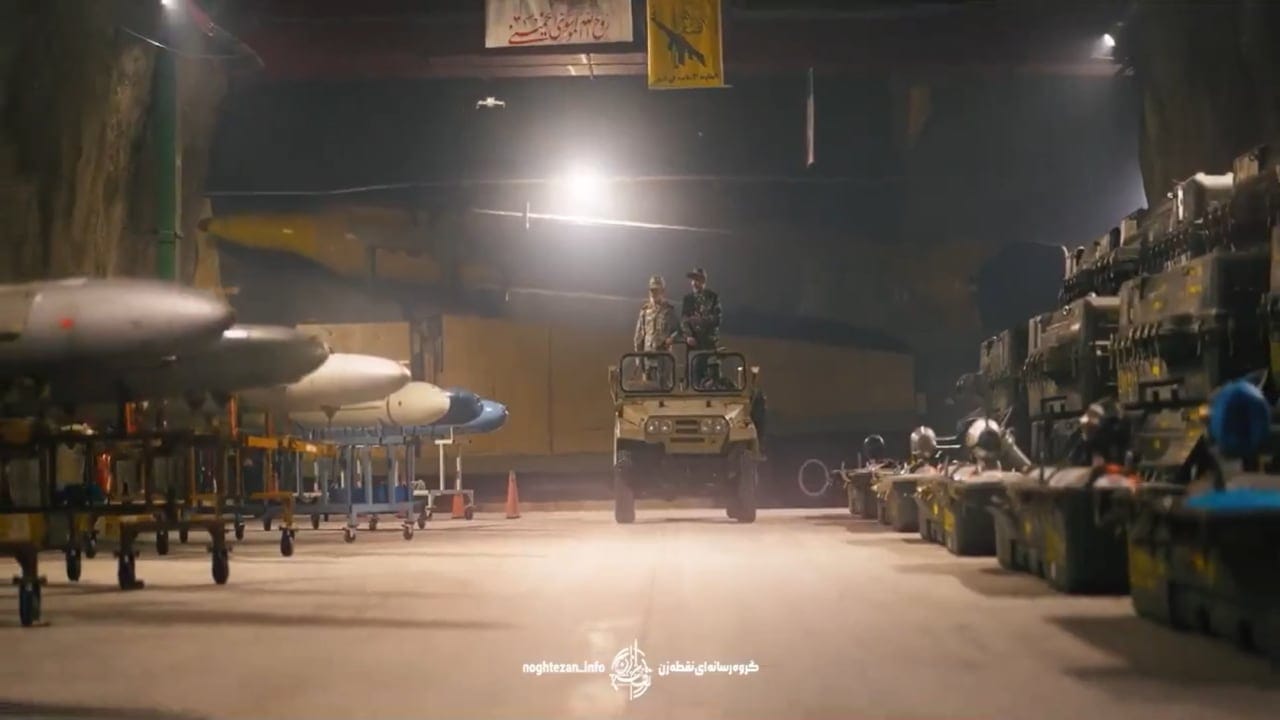
NOVEMBER 13, 2026 19:49The Swords of Iron war, the rounds of fighting with Iran, and the conduct of our enemies in Gaza, Lebanon, and Iran have once again highlighted the damage that kinetic strikes can inflict on above-ground assets. Such strikes affect the IDF's military and intelligence continuity of operations, the operational continuity of critical national infrastructure, and the ability to maintain normal life. This stands in sharp contrast to the strategic and extensive use our enemies make of the underground domain.Our enemies understood long before we did the considerable advantage offered by the underground domain. They made it a central element of their strategy, using it to gain partial protection from detection and attack. This has given them some degree of military and national continuity of operations, in both defense and offense.The IDF and the US military have overcome the challenges posed by the underground domain in most cases. However, doing so required efforts disproportionate to the scale of the threat. By the end of the process, the enemy had indeed been severely damaged but not eliminated.The military doctrine our enemies built largely around the advantages of the underground domain has significantly undermined Israel’s operational capabilities. Their underground capabilities in the south, the north, and the more distant theaters have required Israel to develop specialized, expensive, and complex intelligence, operational, and kinetic capabilities to address the threat and prevent the enemy from continuing to exploit this advantage.The Nagel Committee on the Defense Budget, which I discussed at length in previous articles, addressed this issue and recommended that Israel embark on a national project to develop underground solutions as essential to preserving security-related and civilian continuity of operations.A terrorist from the Izz el-Deen al-Qassam Brigades, the armed wing of the Hamas movement, gestures inside an underground tunnel in Gaza. (credit: REUTERS/MOHAMMED SALEM/FILE PHOTO)One reason I chose to write about this in the week the new Knesset was sworn in is that two members of the Nagel Committee who strongly supported these recommendations, and were personally responsible for drafting parts of them, are now in key decision-making positions. Col. (res.) Talia Lankri was elected to the Knesset in a high position on the Yisrael Beytenu list, and Brig.-Gen. (res.) Mahran Prozenfer serves as director of the Budget Department at the Finance Ministry. They should use this opportunity to advance this important issue.Some degree of continuity of operations can also be achieved through redundancy and alternative above-ground facilities. The extent to which this is possible depends on the level of risk decision-makers are willing to accept. However, such solutions will be less effective and, over time, will not be less expensive, assuming an adequate solution is built.The Home Front Command, in cooperation with local authorities and under the guidance of the political leadership, has the main responsibility for planning and constructing national underground infrastructure, including protecting the population during emergencies. This falls within the government’s responsibility for civil defense and population protection.Another important part of preparing for continuity of operations is the state’s ability to provide its citizens with an uninterrupted supply of water, food, medical services, communications, and more. The state should give this issue due consideration as well.Core principles and the required responseThe main problem is that, with a few exceptions, continuity of operations is generally neither raised nor addressed when national infrastructure is established, whether military or civilian, officially designated as critical infrastructure or not. Examples include military bases, command-and-control centers, emergency supply depots, ammunition production lines, power plants, refineries, data centers and national storage facilities.The military is represented on regional and national planning committees, but it represents only its direct needs. Even then, it usually overlooks the underground domain, apart from a few cases. Approval processes follow a bottom-up approach: the developer proposes the location and the least expensive construction method that suits its needs. As a result, a complete plan and its selected geographic and physical location, whether above or below ground, may be approved even if it poses security problems, fails to provide adequate protection or does not include sufficient underground construction.The use of the underground domain for protection is almost always dropped, or not even raised for discussion, during the planning stage because of budget considerations. The main reason is that responsibility for protecting national infrastructure, and consequently for ensuring continuity of operations at the national level, falls between the cracks in Israel. No single body is responsible for seeing the full national picture when it comes to national security needs related to construction and its funding.What did the Nagel Committee recommend?The Nagel Committee focused primarily on military and security matters and less on protecting the home front, which was outside the main scope of its mandate. Nevertheless, it recommended locating as much essential infrastructure as possible underground or inside mountains, using tunnels. Building tunnel-based infrastructure that takes advantage of geography and topography is the most cost-effective approach. The protection is almost absolute, and tunneling costs are falling, particularly because of technological advances in the field, especially for civilian applications.There is extensive and successful experience around the world with storing fuel underground or in tunnels, with no known environmental damage. Many countries have already recognized that underground storage of oil and petroleum products, and certainly of munitions, is preferable to above-ground storage, including in terms of safety, operations and environmental protection.Another advantage of tunnels is that a facility can be accessed through one or, at most, two entrances. This can generate significant long-term savings because there is no need to secure the entire perimeter of the infrastructure; only the access points need to be protected. Of course, this advantage also presents a significant drawback: an attack that blocks an entrance for an extended period prevents access to and use of the facility, and can severely harm those trapped inside. Israel has done this to some underground facilities in Lebanon and Iran.How should Israel proceed?• Develop a national concept for continuity of operations and establish criteria for identifying national infrastructure, military and civilian, that must be protected through the use of the underground domain.• Map existing infrastructure essential to continuity of operations, using the agreed criteria, and decide whether to relocate it or build a secondary underground facility to support it.• Examples of critical military and civilian infrastructure include national and military headquarters, command-and-control centers, critical intelligence infrastructure, storage sites for essential munitions, production lines for critical components and systems, hospitals, blood banks, and energy, communications and water systems.• Review the regulatory changes needed, taking the full picture into account, making the best use of national resources and enabling decisions at the national level. For example, a decision could require that no new government building be constructed without appropriate underground infrastructure.• Map public civilian infrastructure, such as railways, tunnels, shopping centers and emergency food storage facilities, and consider requiring it to include substantial underground components in its design.The state could partially offset the investment through subsidies. In some cases, this is already being done, including with the light rail, the Carmel Tunnels, and some hospitals.To implement these proposals, a national directorate should be established quickly to develop underground solutions that ensure continuity of operations across the country.It could be established directly under the prime minister, like the National Cyber Directorate and the National AI Directorate, or under the National Security Council.Its role would be to develop a national concept, map and plan the required infrastructure, and submit a funded implementation plan to ensure continuity of operations using the underground domain. It is also important that the directorate recommend the necessary regulations and prepare draft government resolutions to implement the plans over a period of years.The directorate’s action plan should include the following stages:1. Mapping and preparing an initial action plan.2. Detailed planning and decisions on implementation stages and required budgets.3. Beginning implementation and continuously updating the plan and its budgets.The mapping and planning processes must culminate in a funded, interministerial national plan. The burden should not fall on a single ministry, and certainly not solely on the Defense Ministry, or the plan will not be implemented.This is an important issue that has been neglected for many years. It must be at the center of national decision-makers’ attention, rather than considered solely from a military or security perspective. Fully implementing such a plan would require a very large budget, so the investment must be spread over many years. Israel is far behind all the countries it faces in its use of the underground domain. It is time for a significant change.Brig.-Gen. (res.) Prof. Jacob Nagel is a senior fellow at the Foundation for Defense of Democracies (FDD) and a professor at the Technion. He served as Prime Minister Benjamin Netanyahu’s national security adviser and as acting head of the National Security Council.Follow us on Google
Going underground: Israel must fortify its vital infrastructure before the next war - opinion
Full Article
Original Source
Read the full article at Jpost →KhanList aggregates and links to publicly available news content. We do not host full articles from third-party sources. Always verify important information with original sources.