
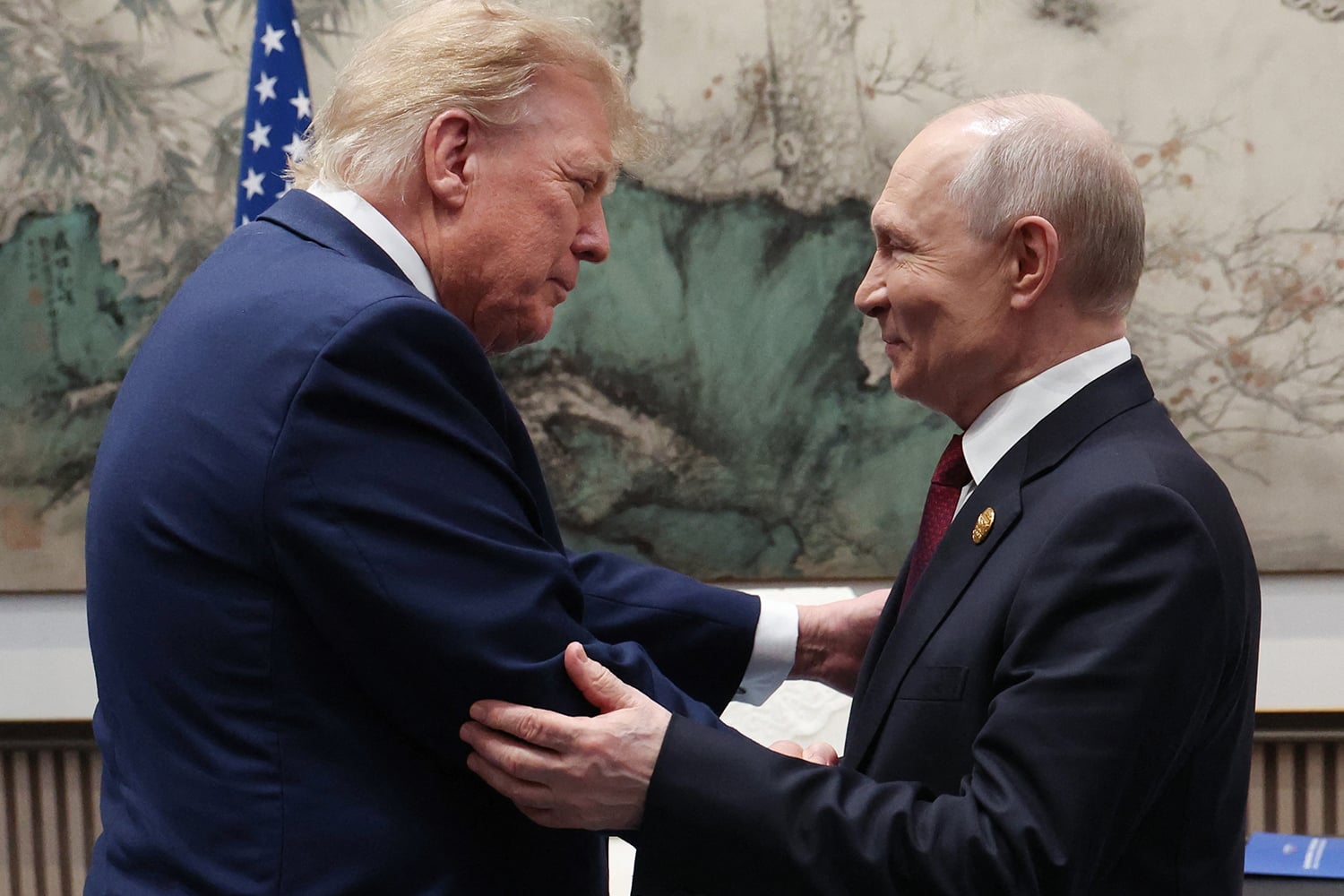
The clock is ticking. Sources in the White House say U.S. President Donald Trump wants a Ukraine peace deal by early January—before the Democrats, riding high after their stunning midterm election win this month, come sweeping in to take control of Congress. “The Americans are pushing hard and there’s some concern that it would need a great deal of Ukrainian concessions to get anywhere near a deal,” one European official told the Financial Times. “The Americans are in a hurry, Putin is in no hurry,” another said. But wait—what’s the rush? Why exactly does Trump have to get a deal before the new Congress convenes? Surely he can find plenty of allies in the House and Senate who would be happy to support a just and equitable peace in Ukraine. After all, his goals are purely humanitarian; as he keeps telling us, he just wants to stop the killing. The clock is ticking. Sources in the White House say U.S. President Donald Trump wants a Ukraine peace deal by early January—before the Democrats, riding high after their stunning midterm election win this month, come sweeping in to take control of Congress. “The Americans are pushing hard and there’s some concern that it would need a great deal of Ukrainian concessions to get anywhere near a deal,” one European official told the Financial Times. “The Americans are in a hurry, Putin is in no hurry,” another said. But wait—what’s the rush? Why exactly does Trump have to get a deal before the new Congress convenes? Surely he can find plenty of allies in the House and Senate who would be happy to support a just and equitable peace in Ukraine. After all, his goals are purely humanitarian; as he keeps telling us, he just wants to stop the killing. If saving lives were really his priority, there are plenty of things that Trump could have done by now to achieve that end. He could have increased humanitarian and financial aid to the Ukrainian government. Along with other weapons to bolster Kyiv’s defenses, he could have sent Patriot missiles to protect Ukrainian civilians from ballistic missile attacks, which Russia has been steadily ramping up in recent months. And, even more importantly, he could have pressured Russian President Vladimir Putin to end the war, rather than gutting sanctions passed by Congress and allowing Moscow to sell diesel fuel on global markets (which hasn’t helped U.S. consumers but has given Russia more funding for its war). “The United States government is actually trying to get a very good deal for Russia,” as military historian Phillips O’Brien recently told a Ukrainian newspaper. “That’s its starting point.” He dismisses Trump’s professed humanitarian concern, arguing that Trump’s ideological affinity for Putin-style authoritarianism and persistent contempt for Kyiv are driving him to accommodate Russia’s interests while treating the Ukrainians as an afterthought. The urgency with which Trump is pursuing this agenda also has a tangible financial component. He thinks that Russia is a potential gold mine, and he wants to wet his beak. The Kremlin understands this perfectly well, and the Russians have been working hard to service his expectations. Indeed, the list of potential business deals Moscow is offering Team Trump seems to be growing by the day. Putin has tasked Kirill Dmitriev, the head of Russia’s sovereign wealth fund, to pitch tempting proposals to Trump’s negotiating team, led by son-in-law Jared Kushner and real estate tycoon Steve Witkoff. The deals on offer include oil and gas investments and sales of aluminum and critical minerals; many of them would require the lifting of current Western sanctions before funding can flow, a huge incentive for Putin. Dmitriev has claimed that the total value of the projects under discussion amounts to $14 trillion—wildly fanciful but just what Trump wants to hear. Trump and his cronies stand to benefit personally from these deals. A Texas financier named Gentry Beach, who has close ties to the Trump family, has already signed an agreement with Russian natural gas company Novatek. Dmitriev has suggested that Elon Musk’s Boring Co. could take part in a project for a tunnel underneath the Bering Strait; it’s a nonsensical notion but demonstrates just how deftly the Kremlin knows how to cater to the Trump World mindset. Trump, of course, wants a cut of his own. In October, the New York Times reported that one of the multibillion-dollar oil deals under discussion with Russia would benefit Middle Eastern investors with links to Kushner and Witkoff. And these are only the projects that we know about. Hence the need for speed. Trump is clearly hoping that a peace deal will continue to yield dividends to himself and his friends long after he leaves office. Said differently, the White House is holding a fire sale of U.S. foreign policy to the highest and most likely bidder, which in Trump’s eyes is Putin. In that sense, Trump’s Ukraine policy is merely an extension of his broader program of replacing the U.S. national interest with his own—what the Atlantic’s Anne Applebaum has aptly called an “empire of grift.” A screenshot of a social media post from the account Donald J. Trump (@realDonaldTrump) featuring large black text that reads "My Friend" above a photo. In the photo, Trump and Vladimir Putin wearing dark suits shake hands while leaning in closely together in front of a U.S. flag and a painted backdrop. A post on Trump’s Truth Social account on Nov. 19.Donald Trump/Truth Social But first, he has to get a deal signed, and that is looking less likely by the day. The president’s much-ballyhooed trilateral summit in Shenzhen, which was supposed to make Trump look like a global titan, ended without any sort of palpable progress on the Ukrainian front. The terse final communique didn’t mention either Iran or Ukraine (although it did offer up a vague swipe at the International Criminal Court). Neither Chinese President Xi Jinping nor his vassal Putin seems to have regarded the war in Ukraine as worth mentioning. That has left Trump, the man who repeatedly claimed that he’d stop the war within 24 hours of taking office, sounding increasingly desperate. On his way back from the summit in China, he assured European leaders that the Kremlin was keen on peace: “Putin wants to end the war. He wants the deal done. He is getting tired of this.” Shortly thereafter, Putin demonstrated his peace-loving credentials by raining missiles down on Ukrainian President Volodymyr Zelensky’s hometown, killing a 7-year-old boy and a 20-year-old paramedic and wounding 52. As that example shows, Putin has yet to show that he’s actually interested in peace on any but maximalist terms. The Russian leader thinks he’s winning and that all he has to do is stay the course. In October, the Russians launched a record 153 ballistic missiles and 4,000 jet-powered attack drones into Ukraine. Rather than softening his negotiating position, Putin—encouraged by Trump’s permissiveness—has actually expanded his list of conditions for peace to include completely revising the current European security framework, including a rollback of NATO to its 1997 state. When Kushner recently claimed that Russia wouldn’t oppose Western security guarantees for Kyiv, a Putin aide immediately slapped him down. Whether Putin actually knows how bad things are or bases his intransigence on rosy assessments from advisors is hard to say. But the Ukrainians aren’t letting up. Keen to demonstrate that the great powers can’t afford to exclude it, Kyiv prefaced the Shenzhen summit with a stunningly effective attack on the Kerch Bridge, a crucial lifeline connecting Russian-occupied Crimea with the Russian mainland. That was a carefully calculated middle finger aimed at Putin, who has turned the bridge into a symbol of Crimea’s allegedly indelible link with Russia. There was a message for the Americans folded into that attack as well. In recent months, the Ukrainians have been experiencing slowdowns in their access to Starlink and Starshield, the Musk-owned satellite networks that Kyiv has used throughout the war to target Russian positions. Neither Musk nor the White House has been willing to admit responsibility for the lags, but many in Kyiv see the restrictions as a form of tacit U.S. pressure to comply with any deal the White House deems acceptable. (There are also rumors that Russia has threatened to attack the satellites.) So the Ukrainians decided to send a signal of their own—by attacking the bridge, one of Moscow’s most heavily protected assets, without using Starlink at all. The military planners in Kyiv came up with an entirely indigenous solution to the problem. This isn’t the only way that the Ukrainians have been showing that they still have cards to play (to use the phrase wielded by Trump in his notorious Oval Office bullying of Zelensky). Ukraine has effectively stymied Russian efforts to capture territory this year; Russia actually lost ground in September and October, not least thanks to daring Ukrainian offensive operations incorporating remotely controlled ground vehicles. Ukraine’s General Staff claims that the Russians incurred 54,400 casualties (killed, wounded, or missing) in October alone, which would make it the bloodiest month of the war. When Trump urged the Ukrainians to cease their attacks on Russian oil refineries, they simply ignored him. Those strikes are one of their most effective ways of inflicting pain on the enemy, and they’re in no mood to capitulate. Trump’s efforts to engineer peace are also running up against the stubbornness of the Europeans, who for all their dysfunction aren’t ready to give up. Given all these adverse conditions, it’s hard to imagine how the president and his feckless negotiating team will be able to get their way before the new crop of Democrats moves into Congress. But you never know. As a great American philosopher once said: “It ain’t over till it’s over.” This post is part of FP’s ongoing coverage of the Trump administration. Follow along here.
Trump Is Desperate For a Ukraine Deal, but the Window Is Closing
Full Article
Original Source
Read the full article at Foreignpolicy →KhanList aggregates and links to publicly available news content. We do not host full articles from third-party sources. Always verify important information with original sources.