
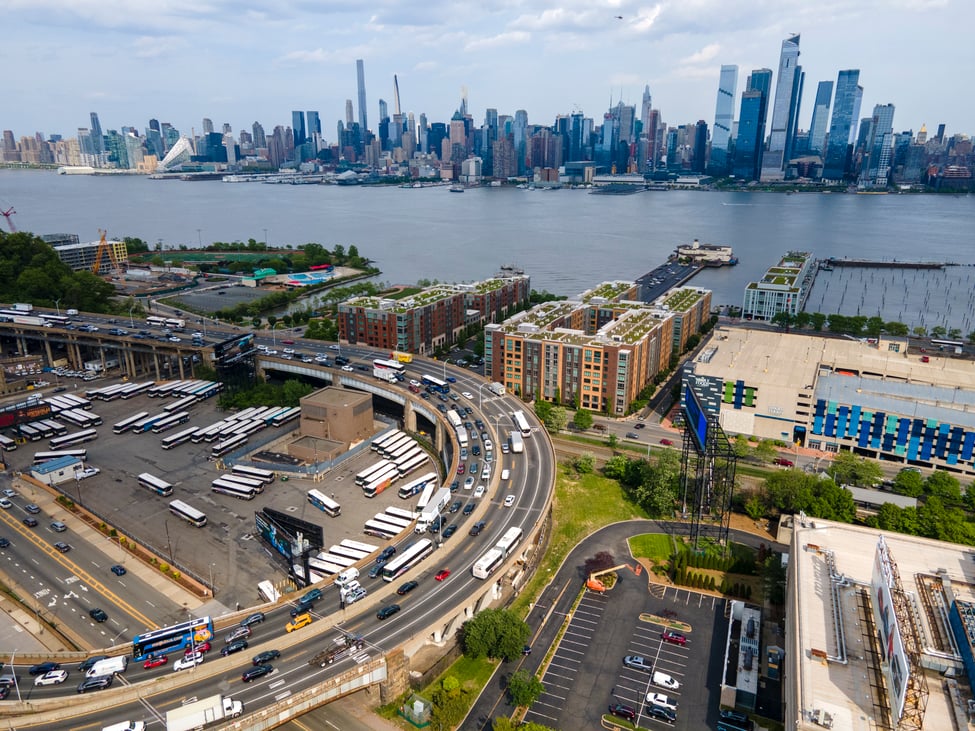
The Trucking Association of New York claims truck drivers are unfairly targeted by the toll since they have to pay each time they enter the district, while passenger cars pay once daily.MANHATTAN (CN) — Nearly two years after the start of New York City’s congestion pricing program, the Second Circuit on Wednesday was once again tasked with weighing in on the first-in-the-nation tolling scheme.This time, it was a challenge brought by state truckers, who claim the toll unfairly penalizes commercial drivers like them since they are charged a fee every time they enter Manhattan’s central business district — unlike passenger cars, which only pay a single daily fee.“Despite making up only 4% of all traffic in the zone, commercial trucks bear by far the biggest burden under the tolling program,” the Trucking Association of New York claims in its now-dismissed 2024 complaint, which sought to stop the program before it was implemented.The truckers claim the lower court got it wrong, and asked a panel of Second Circuit judges on Wednesday to revive their lawsuit. The association’s lawyer, Brian Carr, argued his clients aren’t looking for the federal appeals court to necessarily shutter the program, just to let them bring their case to discovery.Still, that effort can only succeed if the Second Circuit gives credence to the truckers’ claims that congestion pricing is unconstitutional and preempted by federal law, arguments that have already failed at the appellate level.U.S. Circuit Judge Maria Kahn, a Joe Biden appointee, acknowledged it was Congress that passed the Value Pricing Pilot Program — the program under which congestion pricing was created — in the first place.“Doesn’t the fact that Congress created the VPPP, which led to the approval of the tolling program here, undermine your argument that Congress intended to preempt precisely this type of congestion pricing law?” the judge asked.Carr said that wasn’t necessarily the case. The VPPP established the framework to create novel strategies to manage highway congestion, but that doesn’t mean every program envisioned under it is necessarily a lawful one.“Yes, Congress did approve it. No, this program does not pass constitutional muster,” he said.Carr added that this case was different from the others that challenged congestion pricing in the past. Other lawsuits have generally focused on the impact of passenger vehicles, while this one, as Kahn put it, hinges on a “very unique fee structure imposed on trucks.”Brandon Trice, representing the state agencies carrying out the tolling program, disagreed.“I don’t think that’s a distinction,” he said, arguing that truckers pay more because their vehicles contribute most to traffic congestion — and also benefit most from reduced traffic. “As we know, living in New York, trucks take up a lot of space when they turn, when they double park.”Wednesday’s three-judge panel, which also included U.S. Circuit Judges Amalya Lyle Kearse, a Jimmy Carter appointee, and Myrna Pérez, a Joe Biden appointee, didn’t immediately rule following the hearing.The case is one of several challenging congestion pricing, which has been in place since the start of 2025 and, based on data from its first year, has led to measurable drops in traffic and emissions in New York City’s central business district.Under the program, vehicles are charged a toll for entering Manhattan south of 60th Street. Passenger vehicles, pickup trucks and small commercial vans are charged a $9 fee once per day and $2.25 overnight. But larger trucks are charged more based on their size, up to $21.60 each time they enter the zone.Thus far, the program has survived appellate scrutiny — the Second Circuit in July found the $9 toll was not unconstitutional, despite a challenge from suburban New York counties.While controversial at its inception, congestion pricing has gradually grown in popularity among New York City residents after data revealed faster commutes and less noise. The toll also raised more than $500 million in 2025, which will go toward repairing the city’s aging public transit infrastructure.Subscribe to our free newslettersOur weekly newsletter Closing Arguments offers the latest about ongoing trials, major litigation and rulings in courthouses around the U.S. and the world, while the monthly Under the Lights dishes the legal dirt from Hollywood, sports, Big Tech and the arts.Additional Reads
Second Circuit hears another challenge to NYC congestion pricing — this time from truckers
Full Article
Original Source
Read the full article at Courthousenews →KhanList aggregates and links to publicly available news content. We do not host full articles from third-party sources. Always verify important information with original sources.