
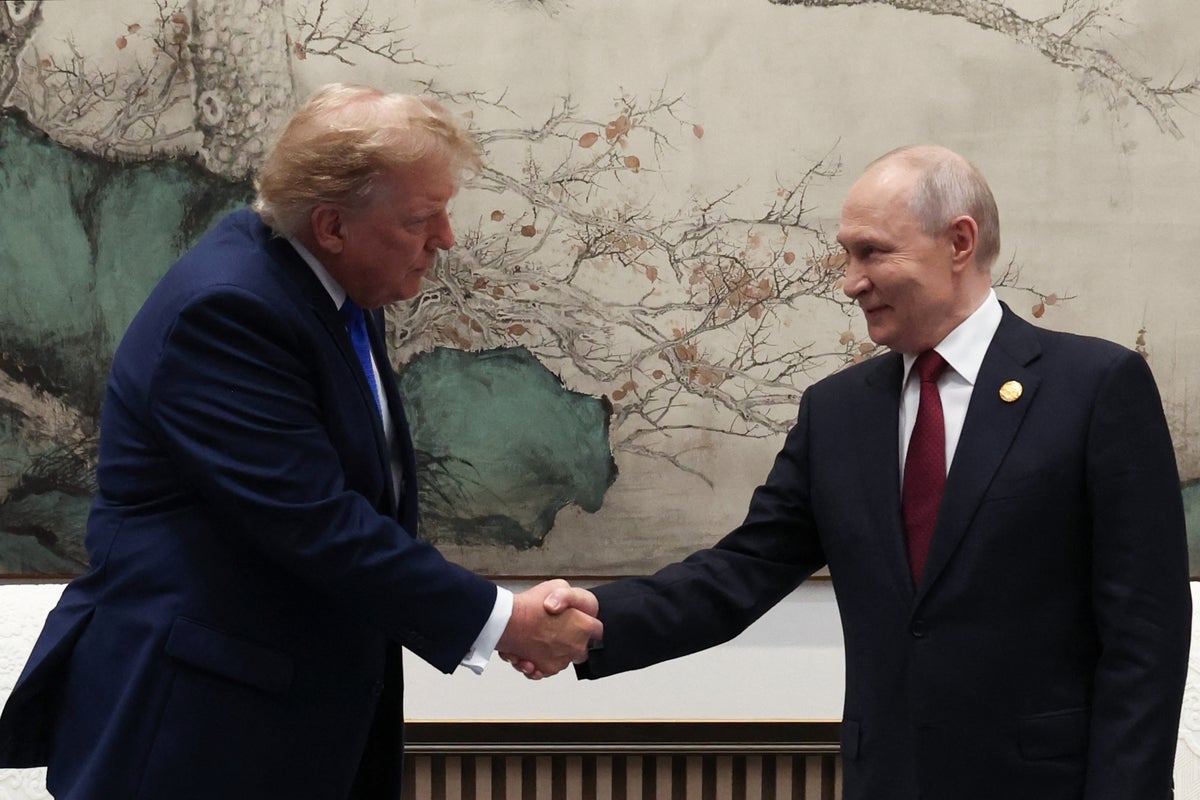
Imagine if former President Ronald Reagan had arrived at his 1985 summit with Soviet premier Mikhail Gorbachev and immediately began commenting on how much he loved the communist leader and how Nancy Reagan found his iconic port-wine birthmark just the tiniest bit sexy.Consider a scenario in which Richard Nixon, during his historic visit to Beijing in 1972, had opined about how much he and Chairman Mao had in common and gushed over the Chinese revolutionary’s sartorial choices. Or ponder a scene of Sir Winston Churchill visiting Nazi Germany to gush over Hitler and compliment his fastidious mustache grooming and skills with a painter’s brush.Anyone with a passing knowledge of history and geopolitics would undoubtedly dismiss each of those fictional situations as ridiculous hypotheticals, as would the idea of any American president kowtowing to an authoritarian adversary.That’s why the scene on Thursday in Shenzhen, China, when President Donald Trump met Russia’s Vladimir Putin for the first time since their shambolic summit in Anchorage, Alaska, just over a year ago, was so jarring.Russia's Vladimir Putin and US President Donald Trump shake hands during a meeting on the sidelines of the Asia-Pacific Economic Cooperation Summit in Shenzhen, China, Thursday. Trump has drawn ire for gushing over the war-mongering autocrat (AFP/Getty)The leader of the free world was positively glowing when he arrived at a hastily-arranged bilateral meeting with the Russian leader, pointing at Putin and jokingly asking: “Who is he?” before breaking into a smile.As he walked over to his Russian counterpart, the grinning Trump answered his own question with a conspiratorial stage whisper: “He’s my friend!”The bizarre exchange was just one of a number of madcap scenes in a day that culminated in the first-ever trilateral summit between Russian, Chinese and American heads of state Thursday.U.S. presidents have never been quite comfortable meeting with their Russian or Chinese counterparts separately, much less at the same time.Geopolitical tensions that come with nuclear power status, and the long and tortured history of relations between America and both nations dating back to the Cold War, make Xi and Putin less-than-ideal as hang-out buddies. But the fact that both are confirmed authoritarians who have spent years violently repressing any opposition and restricting political freedoms makes things even more awkward.Not so with Trump. Since entering the White House for his first term in 2017, Trump has been far more comfortable with the unelected despots of the world: be it hereditary rulers in the mold of Saudi Crown Prince Mohammed bin Salman or Kim Jong Un; repressive authoritarians who exist within a rotted husk of democracy such as Turkey’s Recep Tayyip Erdogan or (until recently) Hungary’s Viktor Orban; or straight-up dictators in the mold of Xi and Putin. Trump meeting with Chinese President Xi Jinping and Russian President Vladimir Putin Thursday, in an unprecedented gathering between the leaders of the world’s three largest nuclear powers (AP)In contrast, the democratically-elected leaders who make up the bulk of America’s traditional allies seem to give Trump the ick. Those leaders have to answer to competing political imperatives and have to uphold ideals that go beyond the pursuit of power and wealth and the use of brute force. It’s complex, messy and it often makes for results that Trump considers weak.By contrast, men such as Putin and Xi operate in a world of might-makes-right, where the biggest and strongest can create their own reality, whether it’s demanding that a war be called a “special military operation” or insisting that a news outlet rename a body of water. And not only does Trump prefer the company of despots, but the three-way confab gave him a chance to do something he has obsessed over for more than 40 years — negotiate over nuclear weapons.Trump has been talking about nukes since at least 1984, when he told The New York Times that his fear of nuclear war came from conversations with his uncle, John Trump, an MIT professor. In a November 1984 interview with The Washington Post, the then-38-year-old developer said he wanted to lead America’s arms negotiations with the Soviet Union, and that his friend and lawyer Roy Cohn had urged him to go after the job. Chinese President Xi Jinping hugs President Donald Trump upon his arrival in China to attend the Asia-Pacific Economic Cooperation Summit in Shenzhen (AFP/Getty)It was “something that somebody should do that knows how to negotiate and not the kind of representatives that I have seen,” he said. “It would take an hour-and-a-half to learn everything there is to learn about missiles. I think I know most of it anyway.”Bernard Lown, a cardiologist who shared the 1985 Nobel Peace Prize for his campaign against nuclear war, later said Trump told him in 1986 that he would ask Ronald Reagan to make him “a plenipotentiary ambassador for the United States with Gorbachev.” According to Lown, Trump also said that “within one hour the Cold War would be over” were Reagan to trust him to negotiate. And though Trump told the writer Ron Rosenbaum he was “dealing at a very high level” with the Reagan White House on nuclear issues as late as 1987, nothing ever happened.But three decades later, he got his shot — and tried to go big.In his first term, the Trump administration refused to extend New START, the last treaty capping the American and Russian arsenals, unless China joined a broader agreement. China said no. When U.S. and Russian negotiators met in Vienna in June 2020, the American envoy, Marshall Billingslea, posted a photo of the table with small Chinese flags in front of empty seats and wrote: “China is a no-show.” At the time, Beijing called Trump’s proposal “unserious, unprofessional and unappealing.” And while President Joe Biden extended the treaty without China in 2021, it lapsed this February after Trump turned down Moscow’s offer to renew it.Less than a month into his second term, Trump told reporters in the Oval Office that one of the first meetings he wanted was “with President Xi of China, President Putin of Russia,” so he could tell them: “Let’s cut our military budget in half.”That meeting took place Thursday in the grand setting of a Chinese government-owned lakeside resort in Shenzhen. Before the trip, a senior U.S. official said the administration did not “expect to get to any kind of agreement” and called the talks “the first conversation.” China’s foreign ministry said joining trilateral arms talks would be “neither fair, reasonable nor realistic.”Afterwards, the joint statement the three leaders issued - titled a “Declaration toward Peace,” - does not mention arms reductions, treaties or limits on warheads. Its nuclear section runs two sentences. The three “reaffirmed that a nuclear war cannot be won and must never be fought,” and said their countries “will conduct a dialogue on reducing nuclear risks and preventing the proliferation of nuclear weapons.” But despite the White House’s prior claim that Trump would talk with his counterparts about reducing their stockpiles, nothing about cutting their numbers appeared in the statement.And what came out of the meeting on nuclear weapons wasn’t even original.The language on how a nuclear war “cannot be won” is almost boilerplate in Russo-American diplomacy and dates back to the November 1985 summit between Reagan and Gorbachev in Geneva, just a year after Trump told The Post he wanted to negotiate with Moscow himself.Russia and China signed on to the same language again with Britain and France in January 2022. So after three decades of insisting he alone could fix the problem of nuclear war, all Trump ended up with was some warmed-over sentences that have been kicking around since he was a much younger man.
Trump fanboyed over Putin, again. To what end?
Full Article
Original Source
Read the full article at Independent →KhanList aggregates and links to publicly available news content. We do not host full articles from third-party sources. Always verify important information with original sources.