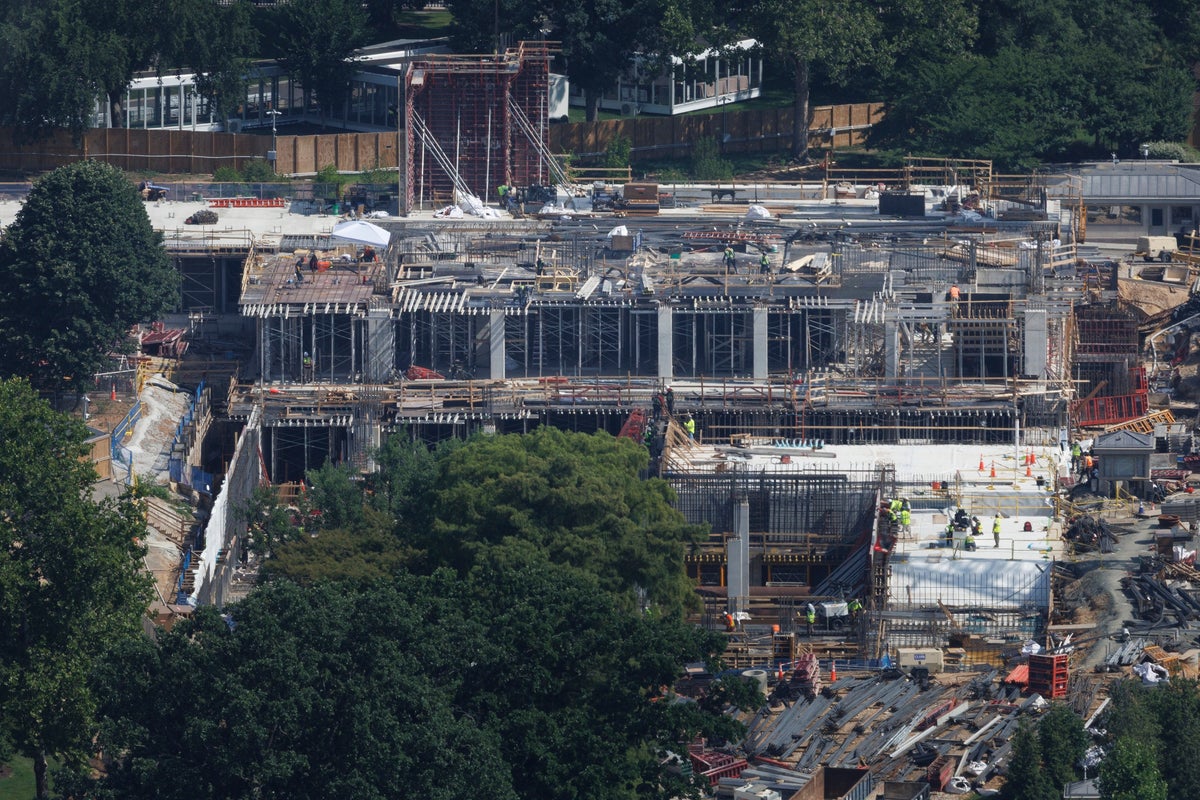
The Trump administration is racing ahead with President Donald Trump’s White House ballroom project, which is now rising from the ground even as a court case to stop the project continues. Recent photos of the ongoing construction, highlighted by the New York Times, show that crews have assembled the framing of the first floor of the East Wing, a minor milestone indicating construction has progressed from strictly bunker-related to above-ground.The ascent is occurring quickly – before a federal appeals court can rule whether or not the administration violated the law by knocking down the historic East Wing and beginning construction without Congress’s approval. Trump has long bragged about the ballroom project, which has soared to $600M in costs. In addition to the ballroom the project also calls for a new underground bunker at the site.Last month, lawyers for the Justice Department told the appellate court judges that courts couldn’t stop the administration from continuing construction “It’s above ground,” Yaakov Roth, a lawyer for the DOJ, said. “They’ve installed like three million pounds of steel rebar, which is a lot apparently, and it’s well on its way.”A July 2026 photo shows part of President Donald Trump’s ballroom addition for the White House starting to rise from the ground. The construction is ongoing despite a lawsuit that wants to stop the project (Reuters)Lawyers for the government have argued that Trump has full authority to build a 90,000-square-foot addition to the White House without congressional approval. It’s among the arguments they’ve invoked while fighting a challenge brought by a nonprofit historic preservation group. Another one, which the president has repeated, is that it's necessary for security because the ballroom will sit atop an underground bunker containing a military complex, a hospital and an emergency operations center.“Thanks to the Builder-in-Chief, the long overdue and desperately needed East Wing Modernization Project at the White House is well underway and will be completed on time and under budget,” White House Spokesperson Davis Ingle said in a statement.During oral arguments, Roth had even gone as far as to argue that, in a hypothetical scenario, the government would be allowed to bulldoze the Statue of Liberty without Congressional approval or lawsuits. “If the government decides to move very quickly and bulldoze the Statue of Liberty, the people whose ancestors — that was the first thing they saw coming to this country — but the government moved too fast, nothing can be done?” Judge Patricia Millett, a member of the three-judge panel, asked.“I think that’s right, yes,” Roth responded.Some of that strategy appears to align with the timeline of construction. A photo from October 2025 shows the destroyed historic East Wing after the president began construction for his proposed White House ballroom (Getty)A photo, dated January 5, 2026, shows the excavation of the site where the East Wing once sat (AFP/Getty)Shortly after demolishing the East Wing in October 2025, crews started work to excavate the site and begin construction on what was first pitched as a $200 million renovation but later became a $400 million project - that now has a $600 million estimated cost.Construction continued even after the National Trust for Historic Preservation sued to stop work and a federal judge expressed skepticism about the project. While the judge allowed construction to move forward, he requested the White House obtain design approval from two oversight groups – the U.S. Commission of Fine Arts and National Capital Planning Commission.By January, pile drivers, used to push foundational poles into the ground, and bulldozers, were working on site as the administration requested approval from the two groups. The National Trust for Historic Preservation continued to push back against the ballroom construction and in March, the federal judge finally sided with the group, arguing the administration needed congressional approval before making sweeping changes to the White House. Invoking arguments about national security, the federal government insisted it was vital that construction continued. The federal judge allowed for below-ground construction to continue temporarily, so long as it was for national security reasons.But after a shooting at the White House Correspondents’ Dinner, the president’s allies in Congress attempted to add $1 billion in funding to be used for security measures related to the White House ballroom. Though, that later failed. Crews had installed beams and other load-bearing walls into the underground portion of the bunker below the new White House ballroom by mid May (Getty)First-floor framing began in late June (Getty)After appealing the ruling to the D.C. appeals court, the administration got the go-ahead, in April, to continue construction while the three-judge panel considered the arguments. Since then, construction has quickly escalated from below-ground framing to above-ground work. All the while, the judges, two of whom repeatedly questioned the administration’s justification, have yet to decide whether Trump is allowed to build the ballroom.
Trump ballroom begins to rise above the ground at the White House despite court case to stop construction
Full Article
Original Source
Read the full article at Independent →KhanList aggregates and links to publicly available news content. We do not host full articles from third-party sources. Always verify important information with original sources.