
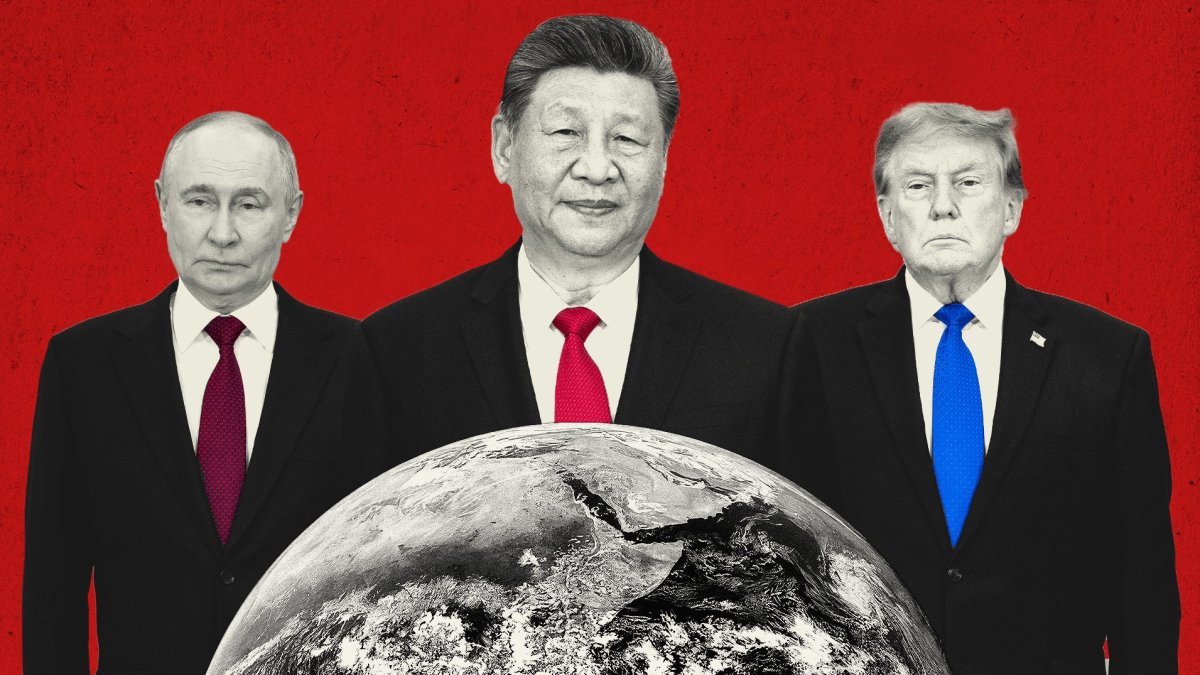
This is Dispatches with Patrick Cockburn, a subscriber-only newsletter from The i Paper. If you’d like to get this direct to your inbox, every single week, you can sign up here. Much mockery has been directed at the idea that the three-way summit of Xi Jinping, Vladmir Putin and Donald Trump was in any way comparable in global importance to the Stalin, Roosevelt, Churchill meeting at Yalta in 1945 that reshaped the world according to their wishes. Cynics express scepticism about the significance of the Shenzhen summit this week, correctly pointing out that Yalta was a meeting of victorious and all-powerful warlords carving up countries and territories which their conquering armies had already seized or were about to do so. At Shenzhen, on the contrary, two of the attendees were Putin and Trump, whose ill-judged military adventures have left their countries mired in draining and failing wars against Ukraine and Iran, conflicts which have become demonstrations of Russian and American weakness rather than strength. We now live in a world in which, thanks to the US-Israeli attack on Iran on 2 February coming on top of Putin’s invasion of Ukraine four years earlier, military conflicts have become the main driver of political and economic developments worldwide. To pick but two examples at random, it is war that led to the Democratic Party triumph in the US midterm elections on 3 November, and to the increased price of electricity in the UK. More generally, the politics of war differ from the politics of peace because military power and commitment counts for more than political sophistication and economic heft. Thus Ukraine was able to hold off Russia with its far larger population and resources; sanctions-hit Iran has more than stood up to the US; and the Houthis in Yemen, one of the poorest countries in the world, are striking damaging blows on Saudi Arabia, one of the richest.On the very day Trump was meeting with Xi and Putin, the Houthis hit the tallest skyscraper in the Saudi capital Riyadh housing its sovereign wealth fund with $900bn in assets. Churchill, Roosevelt and Stalin at Yalta in 1945 (Photo: Pictures From History/Universal) Yet David does not always defeat Goliath. In this more violent world, the three leaders gathered at Shenzhen control the world’s largest nuclear arsenals. Russia arguably has an economy smaller than Britain’s, but it also has a military stockpile of 4,400 nuclear warheads, compared to 3,700 in the US and 620 in China, according to the Stockholm International Peace Research Institute. War hawks in Europe and the US are inexplicably dismissive of these devastating weapons ever being used, but as the post 1945 order disintegrates, the danger is growing. Nuclear war is a weapon of last resort, so it is the losers in international conflicts rather than winners who are most likely to use them. If, for example, Ukraine was to be on the verge of reconquering Crimea, would not Russia consider using tactical nuclear weapons to stop them? Actually, we can calculate with some accuracy the answer to this grim question, because in the autumn of 2022, the CIA told the White House that it estimated there was a 50 per cent chance of Russia using nuclear weapons if its frontline collapsed in the south and its control of Ukraine was at risk. Many commentators dismiss the China-US-Russia summit as a piece of political theatre, deriding it as a photo opportunity without any concrete consequences. Their relief is understandable but short-sighted: at Yalta 81 years ago, the so-called “big three” powers – China later replaced Britain in the troika – were in charge, but today nobody is. Some may welcome this as the end of the era of grasping imperialist superpowers, but the price of this is a return to a world where nation states are at each other’s throats and war against a neighbour becomes a feasible option. At the trilateral talks in China, Putin stated grandly that “our three states are united not only by the status of being the victorious countries in World War II, but most importantly by the joint responsibility for maintaining international peace and security.” International summits invariably bubble with hypocritical statements, but this one was rich stuff coming from the man who had done so much to destabilise Europe by his attack on Ukraine. Moreover, Russia’s reputation as a great military power has, aside from its nuclear arsenal, been permanently deflated and, with all its resources absorbed by the Ukraine war, Russian allies from Syria to Cuba have collapsed or been cast adrift. Doubtless Putin is pleased to escape international pariah status by sitting at a round table as co-equal with Xi and Trump, but this does not alter the fact that the Russian army in Ukraine is approximately where it was four years ago. As host of the summit, China was in a strong but rather peculiar position, its comparative status artificially boosted by the self-inflicted troubles of Russia and the US. It may have its own problems, but these do not include fighting stalemated wars. Xi is doubtless pleased to have Trump treating him as an equal and Putin paying him court, but China does not want to be dragged into any over-close engagement with either side in the Ukraine and Middle East. Neither conflict was mentioned in the final bland statement from the summit, which also avoided saying anything substantive about nuclear weapons, since China wants to expand its own arsenal to catch up with the others. A Ukrainian missile strike badly damaged the Kerch Bridge to Crimea – pictured before the attack (Photo: Vantor/Reuters) In the wake of the calamitous Republican defeat in the midterms, Trump was a diminished figure at Shenzhen. He made the usual noises about the leaders putting the world to rights, but the Chinese will not have missed clear evidence that he is losing full control of policy in Washington. A strong sign days after the midterms was the fall of Nvidia chief Jensen Huang, powerful backer of fairly open US-China trade relations. Even as Trump was on his way to the summit, his administration was imposing a stringent ban on the export of Nvidia AI chips to China, or their remote use by Chinese companies using data centres in south east Asia. The US security and foreign policy establishment are clearly much more eager for a more confrontational relationship with China than Trump – and the Chinese may well conclude that they are getting a preview of post-Trump American policy. It is also unlikely to be a coincidence that the Ukrainian missile attack that badly damaged the Kerch bridge to Crimea, just before Trump greeted Putin as his friend, could have occurred without the knowledge – and possible assistance – of the US intelligence services. Again, China and Russia are likely to conclude that the Deep State in Washington is back in business and will increasingly call the shots during the last two years of Trump’s lame-duck presidency. So much of America and the world has come to detest Trump as the source of all evil that they feel any replacement will be a marked improvement. But it is worth recalling that the wars in Ukraine and the Middle East began under Joe Biden and the Democrats, and the decline and fall of Trump will not necessarily bring their end any nearer. The world’s greatest military powers – the US and Russia – are both wounded big beasts, making them even more dangerous than they were before. Further Thoughts Everybody is aware that Putin made a calamitous mistake in invading Ukraine in 2022 in the belief that his war would be a walkover. Four years later, Trump committed a similar error on 28 February 2026, when he attacked Iran in alliance with Israel thinking the regime in Tehran would be unable to retaliate effectively and would swiftly collapse. Less well known is the fact that Saudi Arabia had likewise waged war on a weaker and poorer opponent – the Houthi movement in Yemen – in 2015, in the unfortunately named “Operation Decisive Storm”, in the expectation of a swift victory. The war turned out to be anything but decisive and was only brought to a halt by a rickety ceasefire in 2022. The Saudis then unwisely restarted the conflict in July this year by attacking the international airport near Yemen’s capital Sanaa. Saudi Crown Prince Mohammed bin Salman, apparently not a leader who learns from past mistakes, has since seen his plans to boost Saudi Arabia as a global business and finance centre crash in ruins. This Thursday, Riyadh’s tallest skyscraper, housing the headquarters of the Saudi sovereign wealth fund (PIF) with at least $900bn in assets, became the latest iconic building in Riyadh to be hit by a Houthi missile. It blew out windows across seven to eight floors of the PIF Tower, damaging parts of its metal facade. Two weeks earlier, the Houthis damaged another landmark in the capital’s financial district, this time the building of the state oil giant Saudi Aramco. Damage to the Public Investment Fund (PIF) Tower in Riyadh, headquarters of the Saudi sovereign wealth fund, after the Houthi attack (Photo: Saudi Press Agency/Reuters) After the PIF Tower was hit, the entrances to King Abdullah Financial District were sealed and people were evacuated as ambulances and fire engines raced to the site of the missile strike. The extent of the damage is not known as Saudi Arabia – along with other Gulf states – claims that almost all missiles are being intercepted and any damage visible is caused by falling debris. But an investigation by Reuters reports this to be propaganda and Houthi and Iranian missiles regularly penetrate air defences and accurately hit their targets. The renewed Saudi-Houthi war is now the hottest – though least reported – front in the wider Iran war. The Houthis launched a surprise offensive against Saudi-back proxy forces in September, gaining control of the strategically vital Bab al-Mandab strait at the mouth of the Red Sea, and targeted Saudi oil tankers and other commercial vessels. Anti-Houthi proxy forces, backed by Saudi air strikes, briefly recaptured these positions only to lose them again this week. Videos show their abandoned vehicles. Houthi forces are now less than 50 miles from the port of Aden. Some 340,000 people displaced by the fighting are on the roads or living in tents. As Houthi missiles strike everywhere in Saudi Arabia, the Crown Prince’s ambition to attract non-oil investment and host international events have become a distant dream. Ideally, the Saudis would like to back a counteroffensive by its proxies, supported by the US. But Trump is reluctant to expand his disastrous war with Iran, which is vastly unpopular in the US. The Houthis would certainly retaliate directly against American interests – as it is not currently doing – if the US entered the war against them. The Saudi-Yemen and US-Iran wars are far from over, but already they have changed the balance of forces in the Gulf and in the Arabian Peninsula as a whole. Saudi Arabia has been shown up as a diminished power, vulnerable to missile attacks which it cannot stop, be they from Yemen to the south, Iran to the east, and the Shia militias in Iraq to the north. Along with other Gulf states, Saudi Arabia has discovered that hosting US bases not only does not protect them, but makes them a target for Iran. Meanwhile, Yemen is for the first time demonstrating that it is a regional power to be feared by its neighbours. Beneath the Radar (Readers may find the accounts below distressing) Perhaps the most appalling developments this century are the way in which Israeli atrocities, repeatedly detailed in investigations by human rights organisations, continue to be perpetrated on the five million Palestinians in Gaza and the West Bank. It is as if killings, torture, rape, mass displacement have become normalised in the eyes of the rest of the world. Yet nobody in coming years can claim they did not know what was happening. The latest authoritative and detailed report to be largely ignored by governments and the international media is by the UN’s Independent International Commission of Inquiry on the Occupied Palestinian Territory, including East Jerusalem and Israel, published in October, which paints a horrific picture not just of mass killing and wounding but of terrible cruelty and humiliation. Since the report has received so little publicity, let me quote some of its findings. Since 7 October 2023, when Hamas attacked Israel, killing approximately 1,200 people, “Israeli forces have used heavy and unguided munitions in densely populated areas, alongside drones, quadcopters and sniper fire, resulting in the systematic destruction of civilian life and objects. “These patterns have continued after the so-called October 2025 ceasefire, with sustained air, artillery, drone and gunfire attacks resulting in over 1,431 people being killed, including at least 300 children and 130 women, and 5,026 injured as of 30 September 2026. Israeli officials allege that the attacks are in response to ceasefire breaches. “The Commission investigated a series of air strikes carried out by Israeli forces across Gaza on 28-29 October 2025. As a result of the strikes, 104 Palestinians, including 46 children and 20 women, were killed and 253, including 78 children and 84 women, injured, according to the Palestinian Ministry of Health.” The details of the sexual violence inflicted on civilian prisoners makes a hard read, but the Commission believes that they had become the officially sanctioned norm. “In one case, a victim was forced to undress completely at the infirmary of the detention facility where his genitals were searched with a metal detector. The handle of a metal detector was inserted into his anus multiple times. “In another case, an HIV positive man was arrested and made to stand in the heat wearing a jacket after which he fainted. He was also denied water and his HIV medication which was destroyed in front of him… “In one case, a plastic cord was tied around the victim’s genitals during interrogations for a prolonged period of time while he was told to urinate, in another, a victim was raped with a stick and forced to insert it into his mouth, until he vomited.” Cockburn’s Picks The Lucy Letby case takes another extraordinary turn with a story in The Guardian revealing that a senior doctor whose evidence helped to convict Letby, and who was held up by prosecutors as a pre-eminent expert, was barred from treating patients during the trial over fears he posed a risk to their safety.
Trump and Putin are the world’s wounded beasts. They’re more dangerous than ever
Full Article
Original Source
Read the full article at Inews →KhanList aggregates and links to publicly available news content. We do not host full articles from third-party sources. Always verify important information with original sources.