
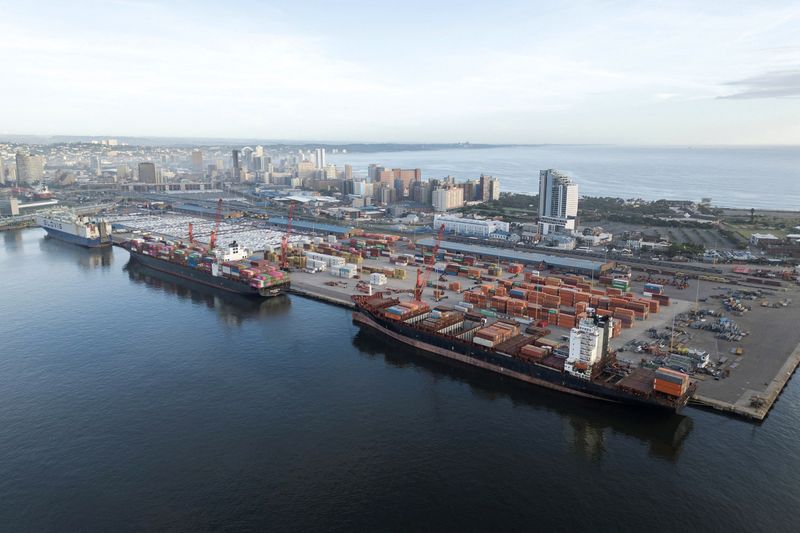
The company that operates Durban Gateway Terminal (DGT) in partnership with Transnet is keen to reassure the public that the port is improving. However, questions linger over Transnet’s role in the collaboration and when the ripple effect of vessel backlogs, longer turnaround times, and delayed imports will hit consumer wallets.International Container Terminal Services Inc (ICTSI), based in the Philippines, paid Transnet R10.5-billion for a 49% stake in DGT, previously known as Pier 2, through an agreement that took effect at the start of this year. A recent rough patch saw cargo volumes dropping about 30% between 14 August, just before DGT switched to a new IT system called Navis N4, and 10 September, compared with the previous four months’ average.Many have taken notice – and rightly so, considering that DGT “handles nearly half of the country’s containerised freight”, as President Cyril Ramaphosa noted in an address to the Durban Chamber of Commerce and Industry (DCCI) last week. This crisis has reminded us how far Durban has to go if it aspires to be the international container hub Transnet described in its KZN ports masterplan. It is a reminder that things have been pretty dysfunctional until now – on Transnet’s watch – though the state-owned enterprise has laid out a wide-scale recovery strategy in recent years. ICTSI, as the new entrant brought on to drive improvement, has been in the hot seat. Despite still holding a 51% stake in DGT, Transnet has hung back a little. “We haven’t heard from Transnet; Transnet is quiet,” said Arend du Preez, who chairs the South African Freight and Logistics Association.State of play The situation reached a crisis point in August, and major delays continued in September. Since then, things have eased up, but not fully recovered. Between 19 and 25 October, DGT’s waterside throughput saw a weekly increase of about 9% to 31,149 twenty-foot equivalent units (TEUs), meaning that cargo flows picked up slightly, but not enough to make a serious dent in the backlog. Jacob van Rensburg, head of research and development at the South African Association of Freight Forwarders, said: “The improvement reflects stabilisation from a depressed base. It has not yet produced a material reduction in the vessel backlog.”While yard conditions are “manageable … the vessel queue remains severe,” he said, with the average waiting time for a ship at anchorage being about 12 days. Gantry cranes above a container ship at the Port of Durban. (Photo: Kevin Sutherland / Bloomberg via Getty Images) For those who have recently enjoyed Durban’s coastal views, but noticed what seems to be the same Cosco ship in the same place for more than a week: you are not imagining things. “At the demonstrated processing rate of approximately 3,381 moves per day, the current queue adds about 19.5 days to the supply chain. On a static-workload basis, the model indicates clearance around 17 November,” Van Rensburg explained. That forecast assumes no additional vessels will join the queue, which he said will not be the case. “Clearing the backlog within 30 days while absorbing approximately 3,246 new moves per day requires sustained output of about 5,000 moves per day,” he added. “DGT’s 3,400-move target is 1,600 moves per day – or 47% – below the required recovery rate. Therefore, expectations are slim that we can expect normalising in a month’s time. It will be longer.” Presidential concernThe problem has crossed President Cyril Ramaphosa’s radar and received some airtime in his address to the DCCI. Ramaphosa said the metro and its vital harbour were “on a firm path to recovery” despite ongoing issues. Ramaphosa noted:“The port has faced very real challenges – the unrest of 2021, the floods of 2022, load shedding and insecurity on the freight rail network. Yet we are seeing steady progress. Rail volumes continue to recover. Security incidents and cable theft on the network have declined. Transnet is procuring additional security to protect the central corridor that feeds the Port of Durban.” Issues at DGT remained the elephant in the room: “We are aware of the serious disruptions at the Durban Gateway Terminal following the migration of its terminal operating system. The minister of transport visited the terminal earlier this month to meet its management, and government will continue to monitor the situation closely until operations are fully restored,” said the President.Another drop-in by Transport Minister Barbara Creecy at Durban’s Transnet Engineering plant scheduled for 28 October did not materialise. We suspect she may have had her hands full with the latest SAA drama, though the Department of Transport did not specify this. President Cyril Ramaphosa has impeccable timing with his Durban visits, usually just before elections. (Photo: Per-Anders Pettersson / Getty Images) The President continued in his DCCI speech: “As expansion plans for the Port of Durban move ahead, Transnet and the municipality need coordinated plans and solutions. The chamber can help forge practical solutions that serve both development and the communities of Durban.”An ICTSI representative told Daily Maverick: “The President is positive about DGT turnaround, and Busa [Business Unity South Africa] has also offered its support.”Try before you buy ICTSI took over a port running on ageing equipment and outdated technology – that was part of the reason the government looked to the private sector for help. It is unclear whether ICTSI knew the full extent of what it was getting into when it agreed to the partnership. If it did not know, the question, of course, is “Why?”, given that it is standard practice for a company to review a potential target for acquisition carefully before reaching for its pocketbook.“When we saw the state of … Pier 2, we were quite shocked to see there was a graveyard full of straddle carriers,” said Du Preez. “I can’t really speak on their [ICTSI’s] behalf, but to me as an outsider, I don’t think they knew the extent of what they were getting themselves into. I can’t believe that a global corporate would be that naive. I don’t think they knew.” Transnet asserts that the condition of the port and its equipment was communicated transparently to ICTSI before the deal went through. “This includes all operational and financial statistics, along with investments made in the last three years, prior to handover,” Transnet told Daily Maverick.Now that ICTSI is here, industry players and government want to see rapid improvement, but if the pain of the Navis transition is anything to go by, this will not be an easy process. “We expect the major changes to come in about 12 to 18 months – when the new equipment starts arriving. We’ve been assured that the equipment has been ordered,” said Du Preez.The question is whether the economy can weather the inevitable storm that will result from companies choosing not to ship via Durban, or suffering severe delays, in the interim. Du Preez pointed to the manufacturing sector – suppliers to Toyota and the like – as a major worry: “Those people are having to fly goods and cargo in at a massive cost just to keep the manufacturing line going. There’s a massive amount of cost that we’re putting into the supply chain. And, you know, there’s always a lag, so I think about 12 months from now, the poor consumer will definitely feel the brunt.”“Durban has already been downgraded.. It’s not a given that they’ll be the flavour of Africa or southern Africa for ever and ever,” he added, particularly as operating conditions improve at other ports, such as Walvis Bay, Dar es Salaam and Mombasa.Procurement problems?Another concern Du Preez mentioned is the extent to which the procurement process for DGT is independent from Transnet. The freight sector’s understanding is that, at least until recently, procurement has been contained within the Transnet system.Though the partnership took effect in January, we cannot assume that procurement has already switched to ICTSI’s channels. ICTSI and Transnet have not publicly disclosed the current status of DGT’s procurement framework. For its part, Transnet has said it does not control the spending of the funds ICTSI invests in the terminal. “Transnet does not exercise direct supervisory control over the Durban Gateway Terminal (DGT) as both DGT and Transnet’s operating division TPT [Transnet Port Terminals] are entities that operate independently and with autonomous operational authority,” said Transnet. Elsewhere in KZN, Transnet is grappling with an investigation into alleged procurement irregularities at the port of Richards Bay. In August, Transnet said the issue had been referred to Durban’s Serious Corruption Investigation unit.Du Preez believes ICTSI can help turn things around, but said: “Transnet is still a 51% shareholder, so it’s not a true public-private partnership. That’s a concern for us. I just hope that they [ICTSI] will have the reins and no interference from the likes of Transnet or other parties. The communication from their side has been quite good so far since they took over in January, but at some stage you also need to … see things happening.”If you believe key infrastructure like ports should remain in public control, and thus publicly accountable, you would argue it’s good that Transnet still has a hand in things. But that means Transnet has to stand up and take the heat, rather than downplaying its role by saying it does not directly control this part of the port.Thrown under the bus, or boat For its part, ICTSI has contacted Daily Maverick directly asking us to clarify in our reporting that DGT is not a privatised terminal. Officially, it is a private-sector participation project.ICTSI makes the case that Transnet handed over a broken system expecting miracles, then left the newcomer to deal with angry logistics firms when it became clear how challenging the upgrade process would be. Transnet and the Department of Transport’s perspective is that it brought ICTSI on precisely because it knew things could not continue on the same old trajectory, and help was needed in the form of an operator with international experience. The state logistics arm told Daily Maverick that the initial six-month “transitional period” for DGT had been extended by another six months to December.“As such, the imminent recovery plan and performance framework from DGT – which are under way – is in keeping with the signed concession agreement,” Transnet noted. It’s tempting to play the blame game, but the companies that need to get goods in and out of Durban – and there are plenty, because many are transporting to Johannesburg via the seaside city – simply want things to hurry up. It may take longer than anyone would like, and the problem is that shippers have no time to waste. They have had to reroute to other ports, or revert to air transport, which is a major concern for Durban, said Du Preez. To make matters worse, rumours are circulating that the pier itself is not stable, due to poor maintenance.“People are talking about it, and the fact that it hasn’t been maintained, and there’s a possibility that the pier might collapse or shift or be unstable,” said Du Preez. “If that should happen, then the whole port will come to a standstill because it’s not safe to operate, and the fact that people are talking about it in the market means there must be something, so I really do hope that it’s going to get the attention that it needs.”No seat at the table As Ramaphosa pointed out in his address to the DCCI, private-sector investment should drive improvement. Bringing ICTSI on was meant to make the port better, but arguably, it has allowed Transnet to minimise its own power and avoid criticism by pointing to its new partner as the responsible entity. In this kind of scenario, the people with the least power are the ones who slip through the cracks. This seems to be the case for fixed-term port workers, whose skills are useful enough to be called upon from time to time, but not enough to land them secure jobs, apparently. Several temporary staffers, speaking on condition of anonymity, said they had worked for Transnet on seasonal contracts for several years, but could not secure permanent roles.Their contracts ended last November. ICTSI stresses that this preceded its involvement, and that these were Transnet employees, not employees of DGT ICTSI. Transnet maintains that none of its workforce lost their jobs when the new partnership came into effect; it accounts for the discrepancy between that version of events and the one shared by workers by saying it occasionally recruits seasonal staff, who one assumes are excluded from the official headcount. It said its organisational structure is based on “forecasted volume demand and…signed agreements with customers”, adding that “vacancies are advertised on business platforms for public consumption”. Workers dispute this, reporting that when they were given a chance to apply for permanent posts, those roles were frozen. They also said they lost out on permanent roles by not having access to the internal site where roles were advertised.Du Preez said he was not aware of insufficient staff as a major issue. Even if one dismisses the workers’ concerns of understaffing, the fact remains that logistics firms are quickly losing patience and Durban is losing its standing as a freight hub. The seasonal workers, who say they were brought back in September and are due to leave again this month, do not see calm waters ahead. Though the busy citrus season is drawing to a close, the freight industry will be under more strain during Black Friday sales and the broader festive period. On that point, Transnet said: “DGT, as an independent operator, will decide on its manpower demands, whether seasonal, temporary or permanent.”Workers have also flagged safety concerns, which become more worrying when combined with the rumour of a possible pier collapse. ICTSI and Transnet maintain that safety is a top priority in their plans to improve the port.There are many moving parts here – gantry cranes included – and in all the chaos, it is unlikely that a relatively small number of workers’ interests will be prioritised. But what does that say about the vision for the port’s recovery, and its role in job creation? None of the posturing matters to the people whose safety and livelihoods are at stake on a daily basis, or to the logistics sector, which just wants the terminal to work. DM
Troubled port: Transnet and foreign operator face scrutiny over backlog at Durban Gateway Terminal
Full Article
Original Source
Read the full article at Dailymaverick →KhanList aggregates and links to publicly available news content. We do not host full articles from third-party sources. Always verify important information with original sources.