
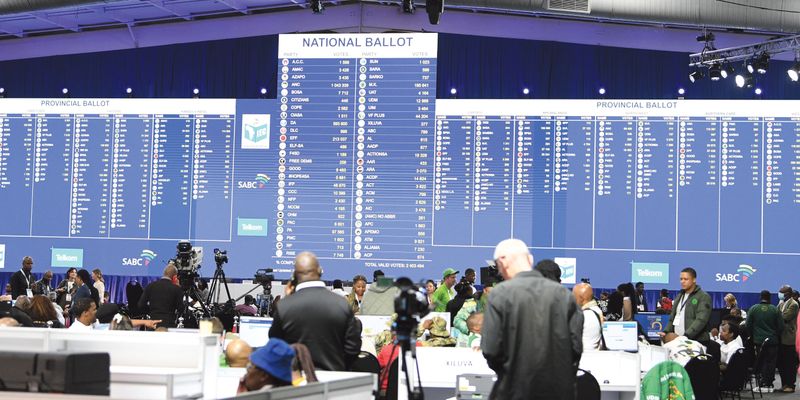
What happens after 9pm on Wednesday?The Electoral Commission of South Africa (IEC) starts the count at each voting station when it closes. Then each voting station’s result slips are forwarded to the IEC results system, where they are checked, audited, and finalised before the results are released publicly. Running in parallel is the process of resolving objections, if any.Results, election declaration and more…The first results start coming in within a few hours of the voting stations closing. As results are updated on the giant electronic boards in the provincial and national IEC results centres, or the IEC online dashboard, election trends emerge. Once all results are in, the IEC calculates seats and later also gazettes the councillor lists for each municipality.However, for the elections to be official, they need to be declared. The IEC has seven days for this under the Electoral Commission Act.This time, the IEC’s job is more pressurised because the EFF, MK Party, ActionSA and the Good party provided only one name for the proportional representatives lists. Section 17 of the Municipal Structures Act enables this, but it means the IEC must “immediately” contact these political parties to supply additional names in those councils where they qualify for more than one candidate. If any political parties dilly-dally, the IEC is under pressure because it can’t finalise the 257 municipalities’ councillor lists for publication in the Government Gazette.The elections are declared. What next?This official results declaration marks the start of the 14 – calendar, not working – days window during which councils must be established, according to Section 29 of the Municipal Structures Act. That’s relatively straightforward in councils where one political party has reached the 50 plus one majority threshold. However, where no one political party received majority support, coalition talks must start. That can be tricky, given political and other rivalries.In addition, each local municipality must appoint its representatives to district councils within 14 days of the election declaration, according to Section 23(4) of the Municipal Structures Act, to supplement the directly elected district councillors from the third ballot cast in all municipalities except metros.Coalition-making: What’s at stake?Time pressure and local political dynamics. With only 14 available days, negotiations unfold for each council without an outright winner, or set of councils if there’s broader horse-trading involved. The role of hyper-local parties comes into play as potential kingmakers. If the numbers fail to add up to a coalition majority, the possibility of minority governance exists, although this requires mobilising support afresh for each council decision.The ANC is on public record that coalition negotiations and decisions will be made by its Top 7 officials. The DA may take a wider set of skills into consideration as it did with the 2024 national unity government, or GNU, negotiations, but federal council chairperson Ashor Sarupen and leader Geordin Hill-Lewis are set to play key roles.First council meetingThe municipal manager must call the first meeting, according to Section 29 of the Municipal Structures Act. The local government MEC designates a person in the absence of a municipal manager. A majority of councillors must be present for a valid meeting. The municipal manager, or MEC-designated person, presides over the meeting to elect a speaker. Nominations are called without debate and made on a form that the nominee must sign. If only one person is nominated, (s)he is considered elected. If more than one nomination is made, a secret ballot is held, and the person with the most votes is declared speaker, according to Schedule 3 of the Municipal Structures Act.Once elected, the speaker presides over the meeting electing the executive mayor, a key position as the mayor appoints a mayoral committee to run various council portfolios. The same election procedure applies. Although an executive committee system is provided for in law, this has been ignored to date because posts are shared to reflect political parties’ strength, rather than allowing the mayor’s political party to dominate.Then what?The executive mayor appoints a mayoral committee, the council establishes its committees, and ward committees or sub-councils. And the councillors’ work begins.What happens if no council can be established?The local government MEC steps in under Section 139 of the Constitution to either direct the council to remedy shortcomings or to assume municipal responsibilities. The MEC can also dissolve the council, requiring written notice to the cooperative governance minister, provincial legislature and the National Council of Provinces. Dissolution triggers fresh elections under Section 25 of the Municipal Structures Act. It’s a measure of last resort. DM
LOCAL ELECTIONS 2026: What happens after the vote? Councils, coalitions and (maybe) controversies
Full Article
Original Source
Read the full article at Dailymaverick →KhanList aggregates and links to publicly available news content. We do not host full articles from third-party sources. Always verify important information with original sources.