
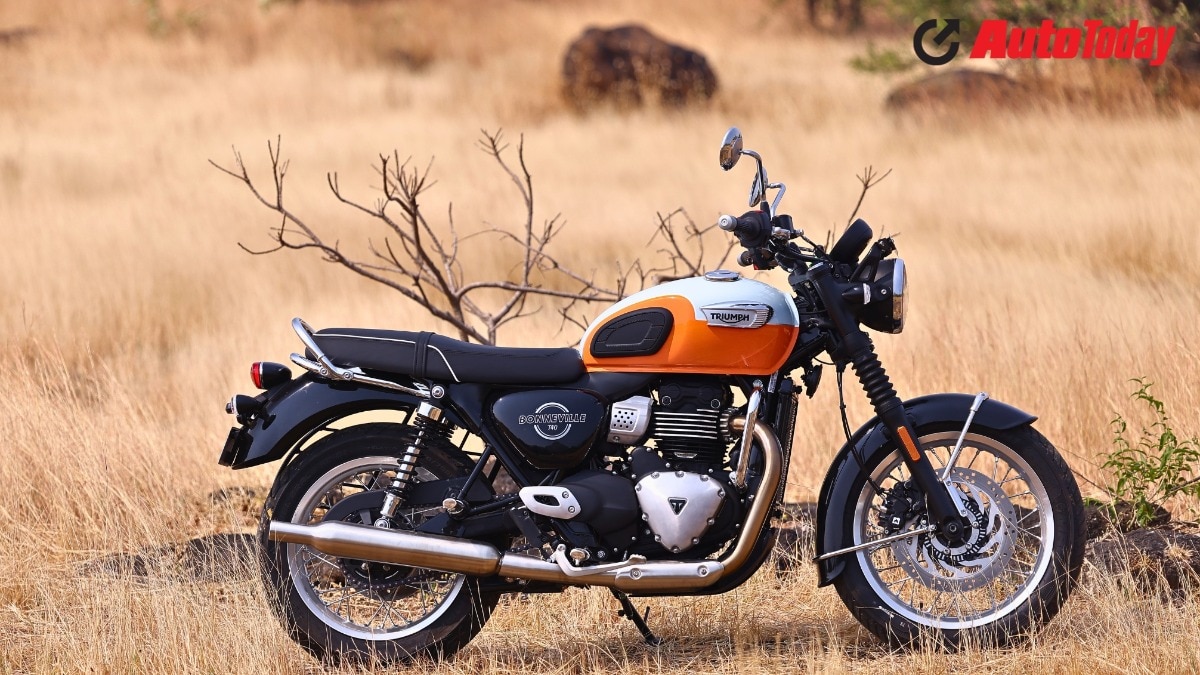
If motorcycles had casting agents, Triumph would probably never be out of work. We have seen its motorcycles feature in films such as An Officer and a Gentleman and How to Lose a Guy in 10 Days, often looking every bit as charismatic as the actors sharing the screen with them. Something about a Triumph lends itself to the movies. Perhaps it is the unmistakable silhouette, the history behind the badge or simply the fact that these motorcycles have never really needed to shout to get noticed. The Bonneville, in particular, has been one of the brand’s most enduring icons. It is a name that carries considerable weight, and not just because of its association with a certain kind of British motorcycling.For a long time, the prospect of a more accessible Bonneville for India remained just that, a prospect. Now, it is finally here in the form of the T40. A baby Bonneville, if you will, but one that arrives with the promise of an authentic experience rather than simply borrowing the name and styling of a legend. That is an important distinction. The Indian market has long had the Royal Enfield Bullet 350 and Classic 350 to cater to buyers looking for an old-school roadster with character. So, does the Bonneville T40 finally give these established names a rival worth considering? And can a 350cc Triumph live up to one of the most storied nameplates in motorcycling?A proper Bonneville The T40 gets the Bonneville proportions just right, with its teardrop-shaped tank and hand-painted detailing capturing the timeless simplicity of Triumph design. The T40 gets the proportions right. It is unmistakably a Bonneville, and that is perhaps the biggest compliment one can pay its design. The teardrop-shaped metal fuel tank is the centrepiece, with its hand-painted detailing and classic Triumph badge lending it the sort of visual appeal that does not need dramatic styling flourishes. The round LED headlamp and conventional mirrors retain its classic silhouette. The round LED headlamp, conventional mirrors, rubber tank pads, peashooter exhaust and twin rear shock absorbers all contribute to the familiar silhouette. There is a lovely simplicity to the way everything comes together. The rear design is equally elegant, staying true to the Bonneville T40's retro styling. The engine is visually prominent, as it should be on a motorcycle of this genre. The finned cylinder head, exposed mechanical detailing and neatly finished surfaces give it a purposeful appearance. The exhaust is particularly well integrated into the design. It is compact, neatly finished and, as I would discover later, sounds every bit as good as it looks. The wire-spoke wheels are another important part of the Bonneville identity, although I would have preferred a tubeless arrangement. More on that later.The T40 does not try to reinterpret the Bonneville design language or make it look futuristic. Instead, it gets the fundamentals right. The tank, seat, handlebar and rear section have the right visual relationship, while the twin shocks give it the traditional roadster stance. The finish is impressive, too. There is a sense of care in the way the paint, metal surfaces and smaller components have been put together. It looks like a motorcycle that has been designed to age gracefully rather than chase a trend.Old-school soul, new swagger The T40 gets a reworked chassis, featuring a new rear section, twin shocks, tubular steel swingarm and welded subframe for a distinct identity. Underneath that familiar styling is a chassis that has been substantially reworked for the T40. The front section of the frame is related to the other single-cylinder Triumphs, but the rear is new. It has been redesigned to accommodate the twin shock absorbers and a tubular steel swingarm, replacing the aluminium arrangement seen on its siblings. The subframe is also welded to the main frame instead of being bolted on. These are meaningful changes, not merely cosmetic ones, and they help give the T40 its own identity within the range.Suspension duties are handled by a 43mm conventional telescopic fork at the front, complete with rubber gaiters, and twin shock absorbers at the rear. Both ends offer 130mm of travel. The setup is slightly different from what you get on the other TR Series motorcycles, and the T40 has a character of its own as a result. Braking is taken care of by a 310mm front disc with a twin-piston calliper and a 255mm rear disc with a single-piston calliper. There is dual-channel ABS, with lean-sensitive intervention, while cornering traction control adds another layer of electronic assistance. The T40 offers wire-spoke wheels wrapped in MRF tyres developed exclusively for the T40. The wheels are wire-spoke units, shod with MRF tyres developed specifically for the motorcycle. They look the part, but the cross-spoke, tubed arrangement is one of my reservations. In a country where punctures are an everyday possibility, tubeless tyres are simply more convenient. A centre stand is standard, which is useful, but it does not quite make up for the absence of a tubeless setup. The T40 weighs 195kg, and that figure might seem substantial on paper. Fortunately, it is a motorcycle that does a very good job of concealing its mass once you get moving. The T40 gets a 4-inch round colour TFT display. The electronics package is where the T40 makes a particularly strong case for itself. The highlight is the new, round 4-inch colour TFT display. It is neatly integrated into the cockpit and manages to look contemporary without disturbing the motorcycle’s classic aesthetic. There are several display layouts, but the Heritage mode is easily my favourite. It gives the screen a wonderfully old-school appearance, making it feel as though a traditional instrument has been given a clever digital makeover. It is sublime, and one of those details that makes you appreciate the thought that has gone into the motorcycle.The display also supports smartphone connectivity and navigation through Triumph’s app. The switchgear is more comprehensive than what you get on some of the other single-cylinder Triumphs, allowing access to the various riding aids and settings. There are five riding modes: Road, Rain, Eco and two customisable modes. The more comprehensive switchgear provides easy access to riding aids and settings. The package also includes cruise control, configurable traction control and lean-sensitive ABS. The cornering functions are particularly welcome on a motorcycle that is likely to spend a fair amount of time on winding roads. It is an interesting contrast: a motorcycle that looks as though it belongs to another era, but has a fairly sophisticated electronic safety net underneath.Art of going fast, slowly The reworked 349cc liquid-cooled engine gets a larger crank and Speed T4 camshafts, producing 29bhp and 31.2Nm. The first thing that strikes you when you start the T40 is its exhaust note. The peashooter silencer produces a lovely, deep, slightly old-school thrum that gives the motorcycle plenty of character without becoming intrusive. It is not excessively loud, nor does it need to be. There is enough bass and rhythm to make every acceleration feel that little bit more involving. It is one of those engines you will find yourself blipping the throttle on, even when there is no particular reason to do so.The 349cc, liquid-cooled, single-cylinder engine has been reworked for the Bonneville application. It gets a larger crank and uses the same camshafts as the Speed T4, with its tuning aimed at delivering a broad spread of usable performance. It produces 29bhp@7,000rpm and 31.2Nm@5,500rpm, figures that might not sound particularly intimidating, but the way the engine delivers them is what matters. The low and mid-range are particularly good. There is a strong, accessible pull from low revs, and it builds speed without demanding constant gear changes. It is an easy engine to ride in traffic, but it is far from out of breath once the road opens up. The T40 pulls strongly beyond the mid-range, continuing to build speed with surprising urgency despite its relaxed demeanour. There is a pleasing surge towards the top end, too. The T40 does not feel like a motorcycle that runs out of enthusiasm as soon as you get past the mid-range. Keep the throttle open, and it continues to gather speed with a degree of urgency that is not immediately apparent from its relaxed appearance. On a suitable stretch, the speedometer will get close to 130kmph. That is more than enough for a motorcycle of this kind, and it makes the T40 one of the more entertaining options in its segment when you want to cover ground quickly. Fuel efficiency should be around the 30kmpl mark, although the final figure will naturally depend on how enthusiastically you use that engine.The six-speed gearbox has taller gearing than the Speed T4, with different sprocketing and a revised final-drive ratio to suit the Bonneville’s character. The ratios feel well matched to the engine’s broad spread of torque. You are not constantly hunting for another gear, and the motorcycle is quite happy to settle into a relaxed cruise. The clutch action is extremely light, which is a welcome quality in stop-start traffic. The gear shifts are easy enough, too, although adjustable levers would have been a useful addition at this price.I spent most of my time riding in Road mode. It suited the way I wanted to ride the T40, and there was no real need to keep switching between modes. The different settings give the rider the flexibility to tailor the electronics and throttle response to conditions, while the two customisable modes allow for a more individual setup. The important thing is that the electronics do not overwhelm the experience. They are there when you need them, but the T40 still feels like a straightforward motorcycle to ride.The chassis is where the Bonneville really surprised me. It has a good balance between ride comfort and handling, with a slightly firmer setup than some of its rivals. I actually enjoyed that. The suspension is controlled, and the motorcycle feels composed when you begin to pick up the pace. The front fork, however, is not quite as sharp or responsive as the units on some of the other TR Series motorcycles. It does its job, but it does not have quite the same level of feedback or sophistication when you start pushing harder.The brakes are reassuring. The front has good bite and a progressive feel, and it does a more convincing job of hauling the motorcycle down than the rear. The rear brake is useful for trimming speed and settling the motorcycle, but the front is where most of the stopping power comes from. The lean-sensitive ABS and cornering traction control are welcome additions, particularly when the road surface or conditions are less than ideal. The T40 impresses around corners, changing direction confidently while remaining planted through bends. What really stands out is how well the T40 handles corners. It changes direction with confidence, holds its line and feels planted through a series of bends. The 195kg kerb weight is exceptionally well hidden once the motorcycle is moving. It does not feel cumbersome, nor does it require much effort to make it change direction. There is a reassuring stability to the way it goes about its business, and the slightly firmer suspension gives you the confidence to carry speed without the motorcycle feeling unsettled. It is not a sports roadster, and it does not pretend to be one. But it is certainly more capable than its classic styling might suggest.The riding position is a good mix of relaxed and engaged. The handlebar is slightly forward-set, which gives the rider a mild lean without putting too much weight on the wrists. The footpegs are neutrally positioned, so there is no awkward knee bend or excessive stretch. It is a natural riding posture, and one that works well both in town and on the highway. The 790mm seat height is another positive. It makes the T40 accessible to a wider range of riders, and the relatively narrow shape around the tank helps when putting your feet down.The seat itself is well cushioned and offers a comfortable perch. There is decent room for a pillion, too, making the T40 a motorcycle that can be used for more than solo weekend rides. The suspension’s slightly firmer character does not translate into an uncomfortable ride. Instead, it gives the motorcycle a sense of control without making it harsh over every imperfection. I would happily spend a few hours in the saddle, particularly on a route that mixes open roads with a few interesting corners.There is something so appealing about the way the T40 encourages you to ride. It is quick enough to make progress, composed enough to enjoy a winding road and comfortable enough to keep going when the journey gets longer. But it never makes you feel as though you have to hurry. That, to me, is the essence of a Bonneville.Verdict The T40 stands out as the finest TR Series Triumph, despite its steep Rs 2.80 lakh price and minor misses. Its engine, comfort, handling and character make it special. The Bonneville T40 is my favourite of the Triumph TR Series motorcycles in India, hands down. However, it’s important to note that it is also the most expensive among its direct rivals: Royal Enfield Classic 350, Honda CB350C and Jawa 350, and Rs 2.80 lakh is a steep asking price. I would have liked it closer to Rs 2.50 lakh. Tubed tyres and non-adjustable levers are other misses. But the engine, handling, comfort and sheer character make it special. Most importantly, I came away from the ride with a big smile on my face, and some beautiful scenery imprinted in my mind. To sum up, the Triumph Bonneville is one of motorcycling's most storied names, and the T40 could be its most important chapter yet.Subscribe to Auto Today Magazine - Ends
Triumph Bonneville T40 review: More than just a pretty retro
Full Article
Original Source
Read the full article at Indiatoday →KhanList aggregates and links to publicly available news content. We do not host full articles from third-party sources. Always verify important information with original sources.